(Peer-Reviewed) Video-rate wavefront capture and replay via single-shot reference-free measurement: toward holographic telepresence
Minwook Kim ¹ ², Chansuk Park ¹ ² ³, Chulmin Oh ¹ ², KyeoReh Lee ¹ ² ⁴, Herve Hugonnet ¹ ², YongKeun Park ¹ ² ⁵
¹ Department of Physics, Korea Advanced Institute of Science and Technology (KAIST), 291, Daehak-ro, Yuseong-gu, Daejeon 34141, Republic of Korea
² KAIST Institute for Health Science and Technology, KAIST, 291, Daehak-ro, Yuseong-gu, Daejeon 34141, Republic of Korea
³ Current affiliation: Samsung Electro-Mechanics, Maeyeong-ro 150, Yeongtong-gu, Suwon 16674, Republic of Korea
⁴ Current address: Department of Applied Physics, Yale University, New Haven, 06520 Connecticut, USA
⁵ Tomocube Inc., 141 Jukdong-ro, Yuseong-gu, Daejeon 34109, Republic of Korea
Opto-Electronic Advances
, 2026-08-25
Abstract
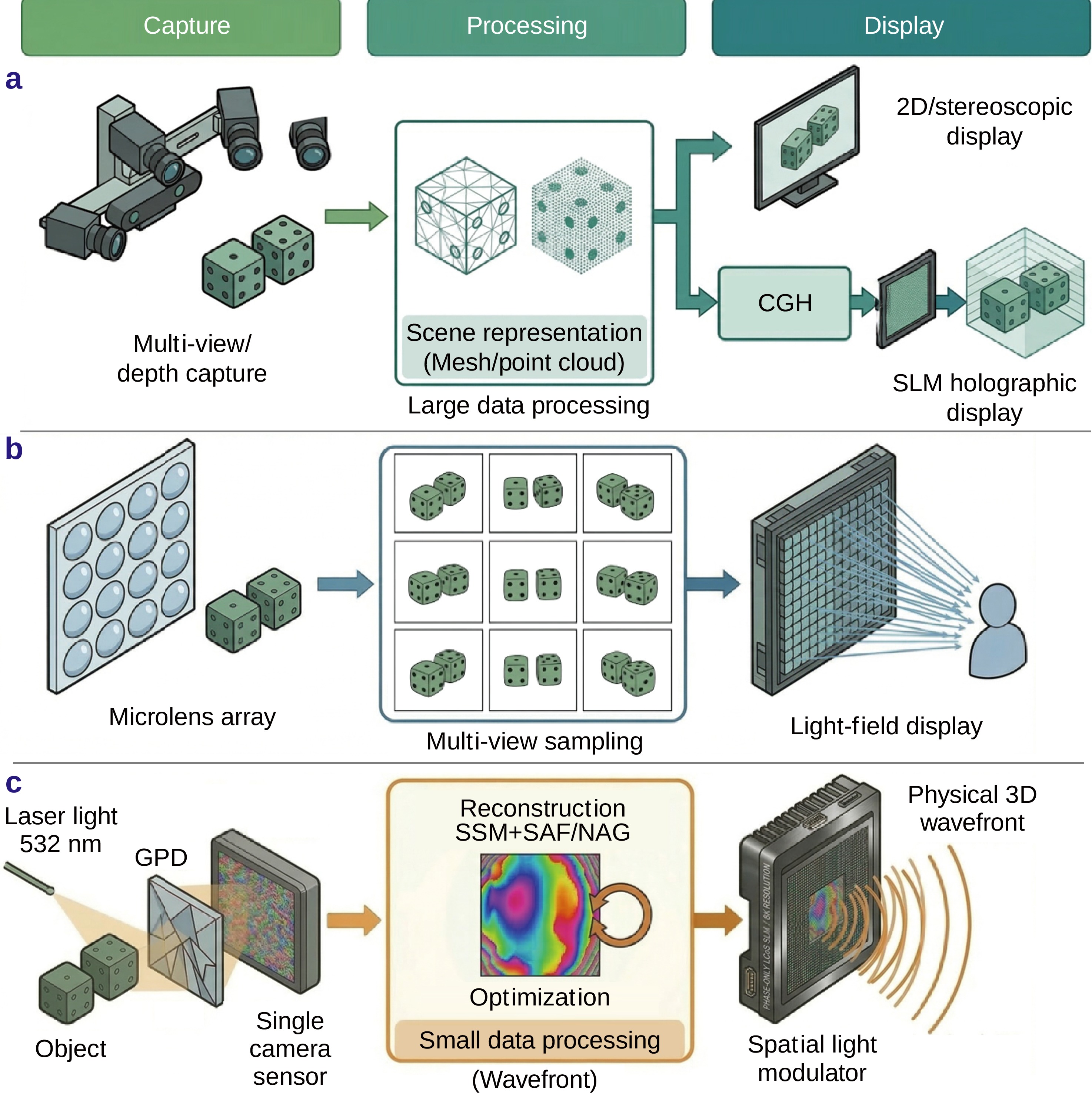
We present a reference-free holographic telepresence framework that captures and replays the complex optical wavefront of a three-dimensional scene from a single intensity speckle measurement. A pre-characterized geometric phase diffuser encodes the incident field into a deterministic speckle pattern, enabling reference-free acquisition through a calibrated, invertible forward model.
The wavefront is recovered via scattering-matrix inversion with smoothed amplitude flow and Nesterov acceleration, and directly projected onto a spatial light modulator for holographic replay. This measurement-driven pipeline eliminates interferometric reference beams and multi-frame acquisition, enabling single-shot operation at video rate (~28 fps) with sub-gigabit bandwidth. We experimentally demonstrate volumetric refocusing and dynamic three-dimensional reconstruction, confirming that the recovered field preserves physically consistent propagation behavior.
Although image quality is currently limited by coherent speckle, both experiments and simulations show systematic improvement with temporal averaging and system scaling. These results establish real-time, measurement-based wavefront capture and replay as a viable and complementary approach to model-based holographic telepresence.
Ultrafast all-optical modulation of wide-bandwidth pulses enabled by silicon-metasurfaces
Kaloyan Georgiev, Khosro Zangeneh Kamali, Anton A. Trifonov, Giulia Crotti, Lyuben Petrov, Stefan Georgiev, Hristo Iliev, Lei Xu, Unai Arregui Leon, Mohsen Rahmani, Giuseppe Della Valle, Ivan Buchvarov, Dragomir Neshev
Opto-Electronic Advances
2026-09-15
Physics-informed neural fields enable blind aberration correction for partially coherent quantitative phase imaging
Shun Zhou, Xingyu Huang, Linpeng Lu, Habib Ullah, Kaiyu Du, Maciej Trusiak, Malgorzata Kujawinska, Yuzhen Zhang, Yao Fan, Qian Chen, Qinrong Zhang, Chao Zuo
Opto-Electronic Science
2026-08-26
Heterogeneously integrated micro-ring with SnS₂ for dual-functional optical modulation and photodetection
Jinyi Du, Lidan Lu, Xu Zhang, Bofei Zhu, Wenbo Bo, Yingjie Xu, Guang Chen, Yanlin He, Guanghui Ren, Xiaoping Lou, Zheng You, Lianqing Zhu
Opto-Electronic Advances
2026-08-25
Hardware-aware lightweight photonic spiking neural network for pattern classification
Shuiying Xiang, Yahui Zhang, Shangxuan Shi, Haowen Zhao, Dianzhuang Zheng, Xingxing Guo, Yanan Han, Ye Tian, Liyue Zhang, Yuechun Shi, Yue Hao
Opto-Electronic Advances
2026-08-25
PhyspeNet: An empirical physics-aware network for adaptive speckle reconstructive spectrometry
Junrui Liang, Min Jiang, Jun Li, Zhongming Huang, Junhong He, Yanting Guo, Yanzhao Ke, Jun Ye, Jiangming Xu, Jinyong Leng, Pu Zhou
Opto-Electronic Advances
2026-08-25
A 36 × 240 Gbps hybrid mode/wavelength division multiplexing transmitter using lithium niobate on insulator
Mingyu Zhu, Weihan Wang, Ruitao Ma, Aoyun Gao, Chun Gao, Zexu Wang, Fei Huang, Zhenyuan Bao, Dajian Liu, Jiaxuan Gan, Zejie Yu, Huan Li, Weike Zhao, Daoxin Dai
Opto-Electronic Advances
2026-08-25