(Peer-Reviewed) Scalable spatiotemporal interleaving network for high-density integrated photonic convolution
Hudi Liu 刘虎迪, Jingchi Li 李靖驰, Hua Zhong 钟华, Yu He 何宇, Yikai Su 苏翼凯
State Key Laboratory of Photonics and Communications, School of Integrated Circuits, Shanghai Jiao Tong University, Shanghai 200240, China
中国 上海 上海交通大学集成电路学院 光子传输与通信全国重点实验室
Opto-Electronic Science
, 2026-07-24
Abstract
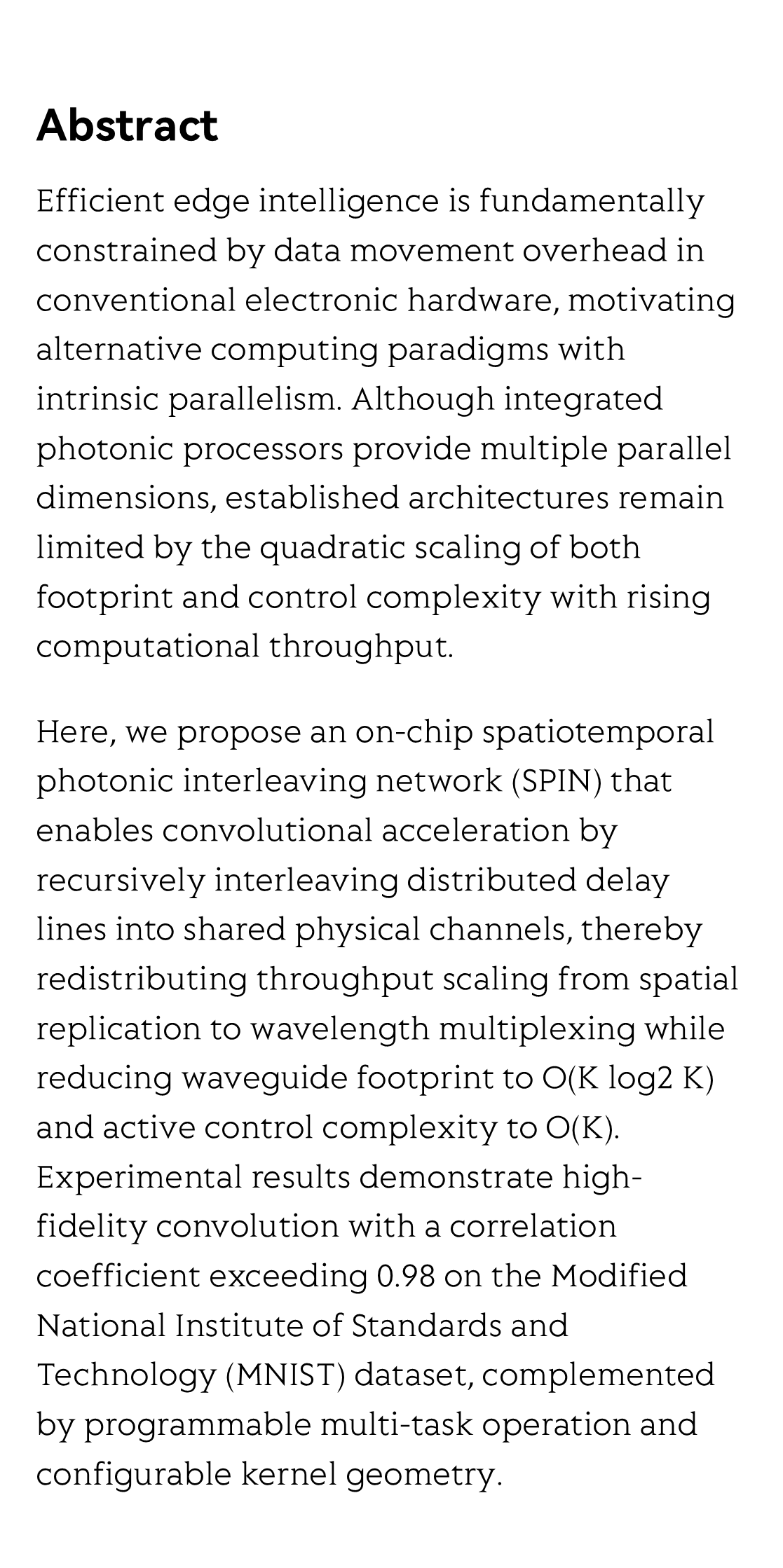
Efficient edge intelligence is fundamentally constrained by data movement overhead in conventional electronic hardware, motivating alternative computing paradigms with intrinsic parallelism. Although integrated photonic processors provide multiple parallel dimensions, established architectures remain limited by the quadratic scaling of both footprint and control complexity with rising computational throughput.
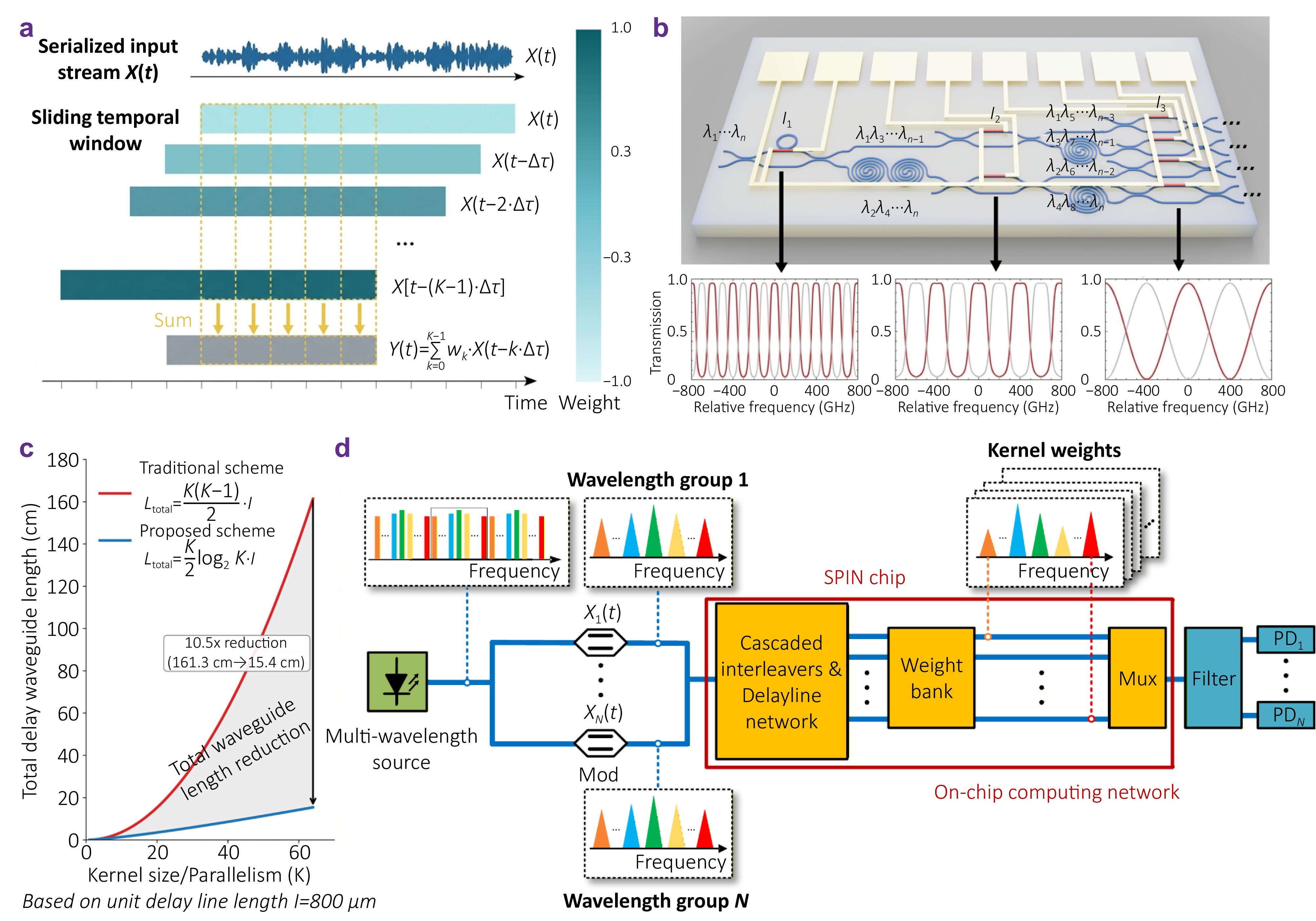
Here, we propose an on-chip spatiotemporal photonic interleaving network (SPIN) that enables convolutional acceleration by recursively interleaving distributed delay lines into shared physical channels, thereby redistributing throughput scaling from spatial replication to wavelength multiplexing while reducing waveguide footprint to O(K log2 K) and active control complexity to O(K). Experimental results demonstrate high-fidelity convolution with a correlation coefficient exceeding 0.98 on the Modified National Institute of Standards and Technology (MNIST) dataset, complemented by programmable multi-task operation and configurable kernel geometry.
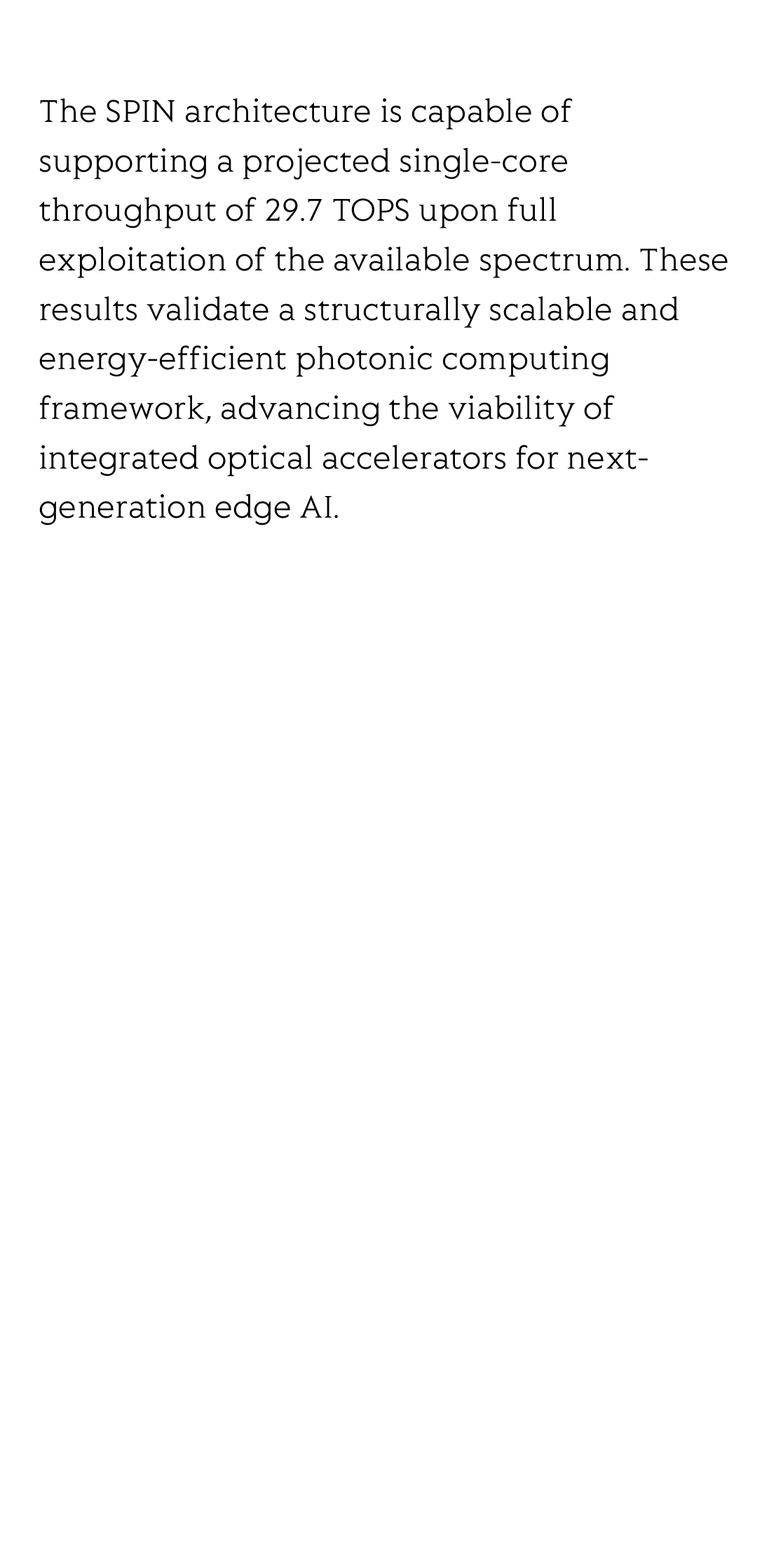
The SPIN architecture is capable of supporting a projected single-core throughput of 29.7 TOPS upon full exploitation of the available spectrum. These results validate a structurally scalable and energy-efficient photonic computing framework, advancing the viability of integrated optical accelerators for next-generation edge AI.
Ultrafast all-optical modulation of wide-bandwidth pulses enabled by silicon-metasurfaces
Kaloyan Georgiev, Khosro Zangeneh Kamali, Anton A. Trifonov, Giulia Crotti, Lyuben Petrov, Stefan Georgiev, Hristo Iliev, Lei Xu, Unai Arregui Leon, Mohsen Rahmani, Giuseppe Della Valle, Ivan Buchvarov, Dragomir Neshev
Opto-Electronic Advances
2026-09-15
Physics-informed neural fields enable blind aberration correction for partially coherent quantitative phase imaging
Shun Zhou, Xingyu Huang, Linpeng Lu, Habib Ullah, Kaiyu Du, Maciej Trusiak, Malgorzata Kujawinska, Yuzhen Zhang, Yao Fan, Qian Chen, Qinrong Zhang, Chao Zuo
Opto-Electronic Science
2026-08-26
Heterogeneously integrated micro-ring with SnS₂ for dual-functional optical modulation and photodetection
Jinyi Du, Lidan Lu, Xu Zhang, Bofei Zhu, Wenbo Bo, Yingjie Xu, Guang Chen, Yanlin He, Guanghui Ren, Xiaoping Lou, Zheng You, Lianqing Zhu
Opto-Electronic Advances
2026-08-25
Hardware-aware lightweight photonic spiking neural network for pattern classification
Shuiying Xiang, Yahui Zhang, Shangxuan Shi, Haowen Zhao, Dianzhuang Zheng, Xingxing Guo, Yanan Han, Ye Tian, Liyue Zhang, Yuechun Shi, Yue Hao
Opto-Electronic Advances
2026-08-25
PhyspeNet: An empirical physics-aware network for adaptive speckle reconstructive spectrometry
Junrui Liang, Min Jiang, Jun Li, Zhongming Huang, Junhong He, Yanting Guo, Yanzhao Ke, Jun Ye, Jiangming Xu, Jinyong Leng, Pu Zhou
Opto-Electronic Advances
2026-08-25
A 36 × 240 Gbps hybrid mode/wavelength division multiplexing transmitter using lithium niobate on insulator
Mingyu Zhu, Weihan Wang, Ruitao Ma, Aoyun Gao, Chun Gao, Zexu Wang, Fei Huang, Zhenyuan Bao, Dajian Liu, Jiaxuan Gan, Zejie Yu, Huan Li, Weike Zhao, Daoxin Dai
Opto-Electronic Advances
2026-08-25