(Peer-Reviewed) From non-resonant to resonant meta-devices: imaging, color routing, displaying, and beyond
Weihan Liu 刘唯汉 ¹, Yao Liang 梁尧 ¹, Borui Leng 冷柏鋭 ¹, Shufan Chen 陈舒凡 ¹, Peng-Yi Feng 冯芃轶 ¹ ², Din Ping Tsai 蔡定平 ¹ ³ ⁴
¹ Department of Electrical Engineering and State Key Laboratory of Terahertz and Millimeter Waves, City University of Hong Kong, Hong Kong SAR 999077, China
中国 香港 香港城市大学电机工程系 太赫兹及毫米波全国重点实验室
² State Key Laboratory of Precision Measurement Technology and Instruments, Department of Precision Instrument, Tsinghua University, Beijing 100084, China
中国 北京 清华大学精密仪器系 精密测试技术及仪器全国重点实验室
³ Department of Physics and State Key Laboratory of Optical Quantum Materials, City University of Hong Kong, Kowloon, Hong Kong SAR 999077, China
中国 香港 香港城市大学物理系 光量子物质全国重点实验
⁴ Shenzhen Research Institute, City University of Hong Kong, Shenzhen 518057, China
中国 深圳 香港城市大学深圳研究院
Opto-Electronic Science
, 2026-07-24
Abstract
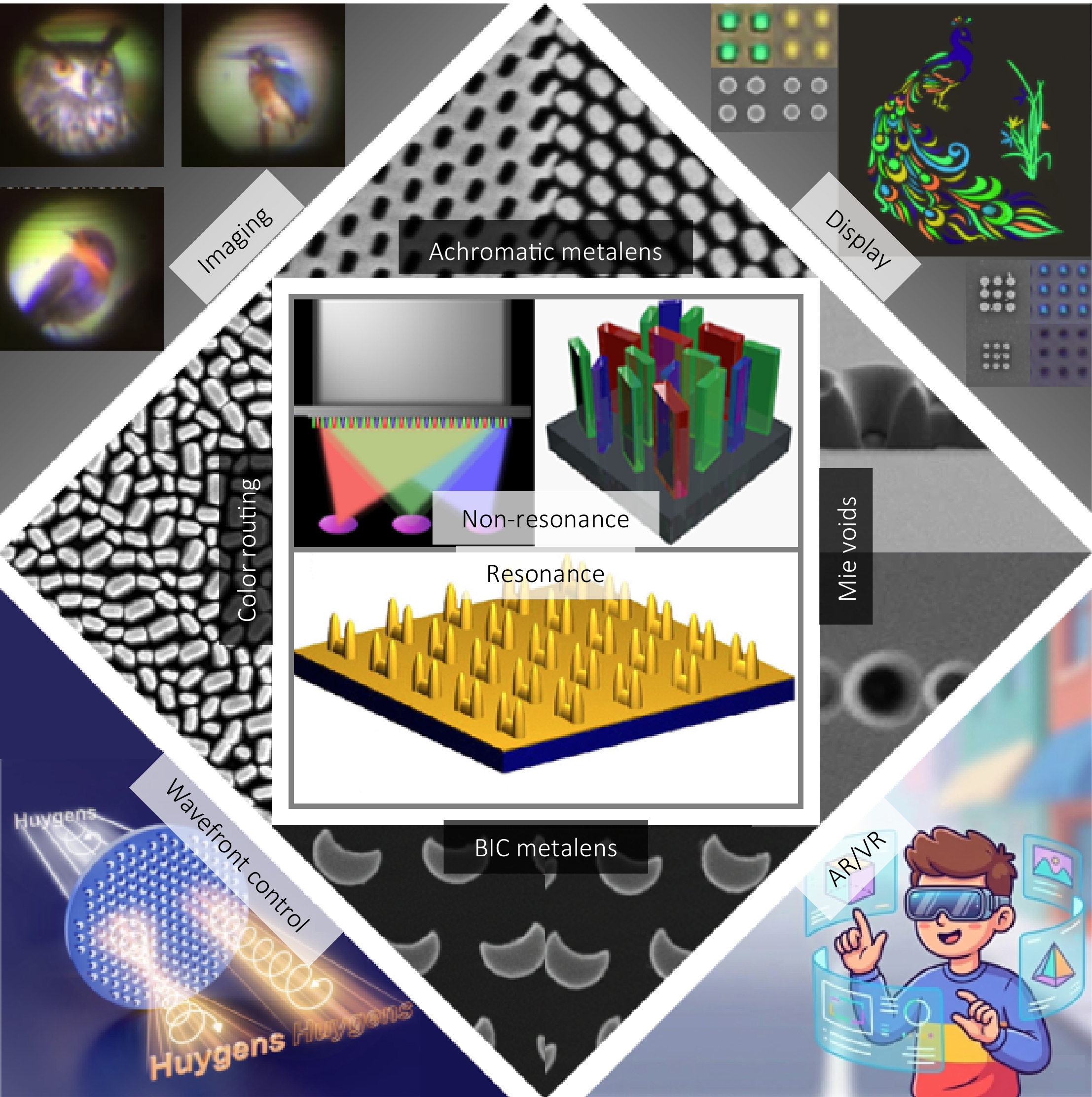
The rapid evolution of meta-optics has been largely driven by non-resonant phase-control mechanisms, chiefly geometric and propagation phases, enabling high-efficiency, broadband devices such as achromatic metalenses and structural-color displays. Recently, however, resonant physics, especially bound states in the continuum (BICs) and local to nonlocal transition (LNT), has introduced a fundamentally new paradigm.
This review highlights how the shift from non-resonant to resonant meta-devices is reshaping imaging and display technologies. Resonant architectures unlock unprecedented functionalities that were previously inaccessible with conventional phase-only designs, including ultra-narrowband wavefront control, spectrally decoupled multiplexing, and pixel-level color routing with high spectral purity.
We systematically compare the underlying physics, illustrate key advances in resonant imaging, color manipulation, and structural-color displays, and discuss emerging applications in augmented/virtual reality (AR/VR) and sensing. Ultimately, we outline how resonant meta-optics is expanding the design landscape, offering new avenues toward dynamic, multifunctional, and wavelength-selective photonic systems.
Ultrafast all-optical modulation of wide-bandwidth pulses enabled by silicon-metasurfaces
Kaloyan Georgiev, Khosro Zangeneh Kamali, Anton A. Trifonov, Giulia Crotti, Lyuben Petrov, Stefan Georgiev, Hristo Iliev, Lei Xu, Unai Arregui Leon, Mohsen Rahmani, Giuseppe Della Valle, Ivan Buchvarov, Dragomir Neshev
Opto-Electronic Advances
2026-09-15
Physics-informed neural fields enable blind aberration correction for partially coherent quantitative phase imaging
Shun Zhou, Xingyu Huang, Linpeng Lu, Habib Ullah, Kaiyu Du, Maciej Trusiak, Malgorzata Kujawinska, Yuzhen Zhang, Yao Fan, Qian Chen, Qinrong Zhang, Chao Zuo
Opto-Electronic Science
2026-08-26
Heterogeneously integrated micro-ring with SnS₂ for dual-functional optical modulation and photodetection
Jinyi Du, Lidan Lu, Xu Zhang, Bofei Zhu, Wenbo Bo, Yingjie Xu, Guang Chen, Yanlin He, Guanghui Ren, Xiaoping Lou, Zheng You, Lianqing Zhu
Opto-Electronic Advances
2026-08-25
Hardware-aware lightweight photonic spiking neural network for pattern classification
Shuiying Xiang, Yahui Zhang, Shangxuan Shi, Haowen Zhao, Dianzhuang Zheng, Xingxing Guo, Yanan Han, Ye Tian, Liyue Zhang, Yuechun Shi, Yue Hao
Opto-Electronic Advances
2026-08-25
PhyspeNet: An empirical physics-aware network for adaptive speckle reconstructive spectrometry
Junrui Liang, Min Jiang, Jun Li, Zhongming Huang, Junhong He, Yanting Guo, Yanzhao Ke, Jun Ye, Jiangming Xu, Jinyong Leng, Pu Zhou
Opto-Electronic Advances
2026-08-25
A 36 × 240 Gbps hybrid mode/wavelength division multiplexing transmitter using lithium niobate on insulator
Mingyu Zhu, Weihan Wang, Ruitao Ma, Aoyun Gao, Chun Gao, Zexu Wang, Fei Huang, Zhenyuan Bao, Dajian Liu, Jiaxuan Gan, Zejie Yu, Huan Li, Weike Zhao, Daoxin Dai
Opto-Electronic Advances
2026-08-25