(Peer-Reviewed) Tunable compound eyes with coaxial lens-on-lens ommatidia for cooperative bi-focal imaging
Zhi-Juan Sun 孙智娟 ¹, Wei-Jian Zhong 钟伟健 ¹, Qing Cai 蔡晴 ², Yi-Fan Lu 鲁一樊 ² ³, Chang-Xu Li 李昌旭 ¹, Dong-Dong Han 韩冬冬 ¹, Yong-Lai Zhang 张永来 ¹
¹ State Key Laboratory of Integrated Optoelectronics, JLU Region, College of Electronic Science and Engineering, Jilin University, Changchun 130012, China
中国 长春 吉林大学电子科学与工程学院 集成光电子学国家重点实验室
² Department of Oral Implantology, School and Hospital of Stomatology, Jilin University, Changchun 130012, China
中国 长春 吉林大学口腔医学院 口腔种植科
³ Jilin Provincial Key Laboratory of Science and Technology for Stomatology Nanoengineering, Jilin University, Changchun 130012, China
中国 长春 吉林大学 吉林省口腔科学纳米工程重点实验室
Opto-Electronic Advances
, 2026-02-09
Abstract
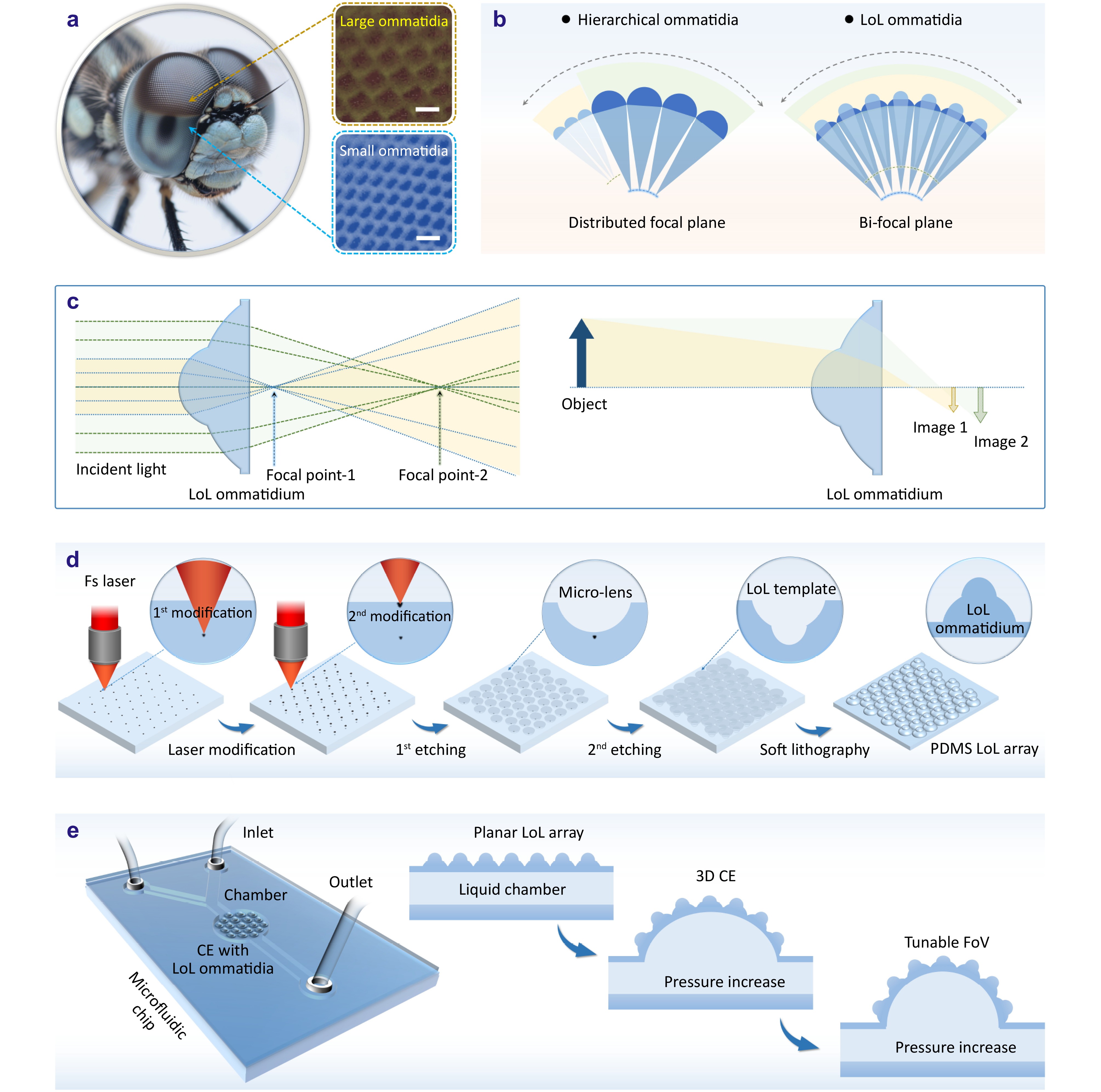
Compound eyes (CEs) offer a unique design paradigm for developing artificial micro-optical systems. However, current bionic CEs still fall significantly short of their insect counterparts in performance, particularly regarding ommatidial spatial arrangement, size distribution, visual field adaptability and environmental perception. Inspired by the CEs of Sympetrum frequens, we developed a tunable bionic CE with bi-focal ommatidia by integrating a flexible lens-on-lens (LoL) array with microfluidics, enabling simultaneous bi-focal imaging.
The polydimethylsiloxane (PDMS) LoL array was fabricated through sequential processing steps, including femtosecond laser dual-modification of quartz glass, two-step wet etching, and soft lithography using the resulting glass template. Integration of this flexible LoL array with a microfluidic chip produced a tunable CE with bi-focal ommatidia, allowing liquid-pressure modulation of CE configurations.
We systematically investigated the optical performance of both LoL ommatidia and the integrated CE, including bi-focal focusing/imaging properties, tunable field-of-view (FOV), large-FOV imaging, and moving target monitoring. This tunable CE with LoL ommatidia demonstrates significant potential for cutting-edge applications.
Ultrafast all-optical modulation of wide-bandwidth pulses enabled by silicon-metasurfaces
Kaloyan Georgiev, Khosro Zangeneh Kamali, Anton A. Trifonov, Giulia Crotti, Lyuben Petrov, Stefan Georgiev, Hristo Iliev, Lei Xu, Unai Arregui Leon, Mohsen Rahmani, Giuseppe Della Valle, Ivan Buchvarov, Dragomir Neshev
Opto-Electronic Advances
2026-09-15
Physics-informed neural fields enable blind aberration correction for partially coherent quantitative phase imaging
Shun Zhou, Xingyu Huang, Linpeng Lu, Habib Ullah, Kaiyu Du, Maciej Trusiak, Malgorzata Kujawinska, Yuzhen Zhang, Yao Fan, Qian Chen, Qinrong Zhang, Chao Zuo
Opto-Electronic Science
2026-08-26
Heterogeneously integrated micro-ring with SnS₂ for dual-functional optical modulation and photodetection
Jinyi Du, Lidan Lu, Xu Zhang, Bofei Zhu, Wenbo Bo, Yingjie Xu, Guang Chen, Yanlin He, Guanghui Ren, Xiaoping Lou, Zheng You, Lianqing Zhu
Opto-Electronic Advances
2026-08-25
Hardware-aware lightweight photonic spiking neural network for pattern classification
Shuiying Xiang, Yahui Zhang, Shangxuan Shi, Haowen Zhao, Dianzhuang Zheng, Xingxing Guo, Yanan Han, Ye Tian, Liyue Zhang, Yuechun Shi, Yue Hao
Opto-Electronic Advances
2026-08-25
PhyspeNet: An empirical physics-aware network for adaptive speckle reconstructive spectrometry
Junrui Liang, Min Jiang, Jun Li, Zhongming Huang, Junhong He, Yanting Guo, Yanzhao Ke, Jun Ye, Jiangming Xu, Jinyong Leng, Pu Zhou
Opto-Electronic Advances
2026-08-25
A 36 × 240 Gbps hybrid mode/wavelength division multiplexing transmitter using lithium niobate on insulator
Mingyu Zhu, Weihan Wang, Ruitao Ma, Aoyun Gao, Chun Gao, Zexu Wang, Fei Huang, Zhenyuan Bao, Dajian Liu, Jiaxuan Gan, Zejie Yu, Huan Li, Weike Zhao, Daoxin Dai
Opto-Electronic Advances
2026-08-25