(Peer-Reviewed) Non-volatile tunable multispectral compatible infrared camouflage based on the infrared radiation characteristics of Rosaceae plants
Xin Li 李鑫 ¹, Xinye Liao 廖欣叶 ¹, Junxiang Zeng 曾俊翔 ¹, Zao Yi 易早 ², Xin He 何新 ¹, Jiagui Wu 吴加贵 ³, Huan Chen 陈欢 ¹, Zhaojian Zhang 张兆健 ¹, Yang Yu 于洋 ¹, Zhengfu Zhang 张振福 ¹, Sha Huang 黄沙 ¹, Junbo Yang 杨俊波 ¹
¹ College of Science, National University of Defense Technology, Changsha 410073, China
中国 长沙 国防科技大学理学院
² Joint Laboratory for Extreme Conditions Matter Properties, Southwest University of Science and Technology, Mianyang 621010, China
中国 绵阳 西南科技大学 极端条件物质特性联合实验室
³ School of Physical Science and Technology, Southwest University, Chongqing 400715, China
中国 重庆 西南大学物理科学与技术学院
Opto-Electronic Advances
, 2025-07-09
Abstract
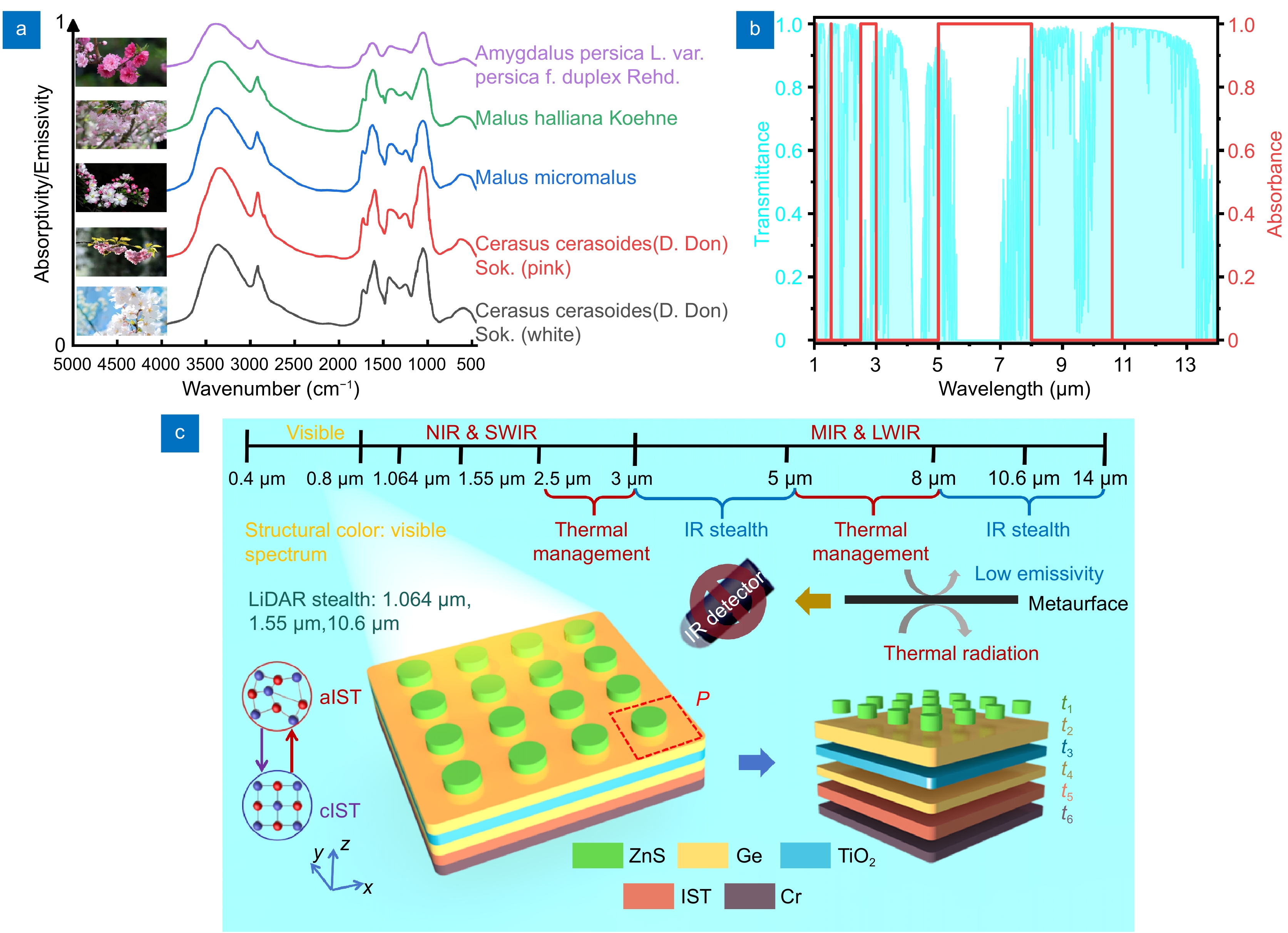
Most multispectral compatible infrared camouflage devices primarily focus on achieving low emissivity but neglect environmental emissivity matching when environmental emissivity exceeds that of the devices, this creates a "low-emissivity exposure" risk. To address this issue, we develop a tunable multispectral compatible infrared camouflage device using phase change material In3SbTe2 (IST).
Simulation and experimental results demonstrate that in both the amorphous (aIST) and crystalline (cIST) states, the device achieves simulated plant infrared camouflage and ultra-low emissivity infrared camouflage within the atmospheric window bands (3–5 µm and 8–14 µm). To address thermal management, it utilizes two non-atmospheric window bands (2.5–3 µm and 5–8 µm) for heat dissipation. Additionally, laser stealth is realized at three specific wavelengths (1.064 µm, 1.55 µm, and 10.6 µm).
In the visible spectrum, high absorptivity enables effective visible light camouflage. Adjusting the geometric parameters of top layer structure enables color variation. This work not only highlights potential applications in reversible switching, reconfigurable imaging, and dynamic coding using IST but also offers an effective strategy to counter multispectral detection technology.
Ultrafast all-optical modulation of wide-bandwidth pulses enabled by silicon-metasurfaces
Kaloyan Georgiev, Khosro Zangeneh Kamali, Anton A. Trifonov, Giulia Crotti, Lyuben Petrov, Stefan Georgiev, Hristo Iliev, Lei Xu, Unai Arregui Leon, Mohsen Rahmani, Giuseppe Della Valle, Ivan Buchvarov, Dragomir Neshev
Opto-Electronic Advances
2026-09-15
Physics-informed neural fields enable blind aberration correction for partially coherent quantitative phase imaging
Shun Zhou, Xingyu Huang, Linpeng Lu, Habib Ullah, Kaiyu Du, Maciej Trusiak, Malgorzata Kujawinska, Yuzhen Zhang, Yao Fan, Qian Chen, Qinrong Zhang, Chao Zuo
Opto-Electronic Science
2026-08-26
Heterogeneously integrated micro-ring with SnS₂ for dual-functional optical modulation and photodetection
Jinyi Du, Lidan Lu, Xu Zhang, Bofei Zhu, Wenbo Bo, Yingjie Xu, Guang Chen, Yanlin He, Guanghui Ren, Xiaoping Lou, Zheng You, Lianqing Zhu
Opto-Electronic Advances
2026-08-25
Hardware-aware lightweight photonic spiking neural network for pattern classification
Shuiying Xiang, Yahui Zhang, Shangxuan Shi, Haowen Zhao, Dianzhuang Zheng, Xingxing Guo, Yanan Han, Ye Tian, Liyue Zhang, Yuechun Shi, Yue Hao
Opto-Electronic Advances
2026-08-25
PhyspeNet: An empirical physics-aware network for adaptive speckle reconstructive spectrometry
Junrui Liang, Min Jiang, Jun Li, Zhongming Huang, Junhong He, Yanting Guo, Yanzhao Ke, Jun Ye, Jiangming Xu, Jinyong Leng, Pu Zhou
Opto-Electronic Advances
2026-08-25
A 36 × 240 Gbps hybrid mode/wavelength division multiplexing transmitter using lithium niobate on insulator
Mingyu Zhu, Weihan Wang, Ruitao Ma, Aoyun Gao, Chun Gao, Zexu Wang, Fei Huang, Zhenyuan Bao, Dajian Liu, Jiaxuan Gan, Zejie Yu, Huan Li, Weike Zhao, Daoxin Dai
Opto-Electronic Advances
2026-08-25