(Peer-Reviewed) Millisecond-level electrically switchable metalens for adaptive rotational depth mapping and diffraction-limited imaging
Yeseul Kim ¹, Jihae Lee ², Won-Sik Kim ², Hyeonsu Heo ¹, Dongmin Jeon ¹, Beomha Yang ³, Xiaotong Li 李小桐 ¹, Harit Keawmuang ¹, Shiqi Hu 胡示骐 ¹ ⁹, Young-Ki Kim ², Trevon Badloe ⁴ ⁵, Junsuk Rho 鲁埈锡 ¹ ² ⁶ ⁷ ⁸
¹ Department of Mechanical Engineering, Pohang University of Science and Technology (POSTECH), Pohang 37673, Republic of Korea
² Department of Chemical Engineering, Pohang University of Science and Technology (POSTECH), Pohang 37673, Republic of Korea
³ Department of Quantum Information Science, Pohang University of Science and Technology (POSTECH), Pohang 37673, Republic of Korea
⁴ Department of Electronics and Information Engineering, Korea University, Sejong 30019, Republic of Korea
⁵ Division of Smart Energy Convergence Engineering, Korea University, Sejong 30019, Republic of Korea
⁶ Department of Electrical Engineering, Pohang University of Science and Technology (POSTECH), Pohang 37673, Republic of Korea
⁷ POSCO-POSTECH-RIST Convergence Research Center for Flat Optics and Metaphotonics, Pohang 37673, Republic of Korea
⁸ National Institute of Nanomaterials Technology (NINT), Pohang 37673 Republic of Korea
⁹ Platform for Real-world Innovation in Smart Manufacturing and AI, Korea Advanced Institute of Science and Technology (KAIST), Daejeon, 34141, Republic of Korea
Opto-Electronic Advances
, 2026-02-12
Abstract
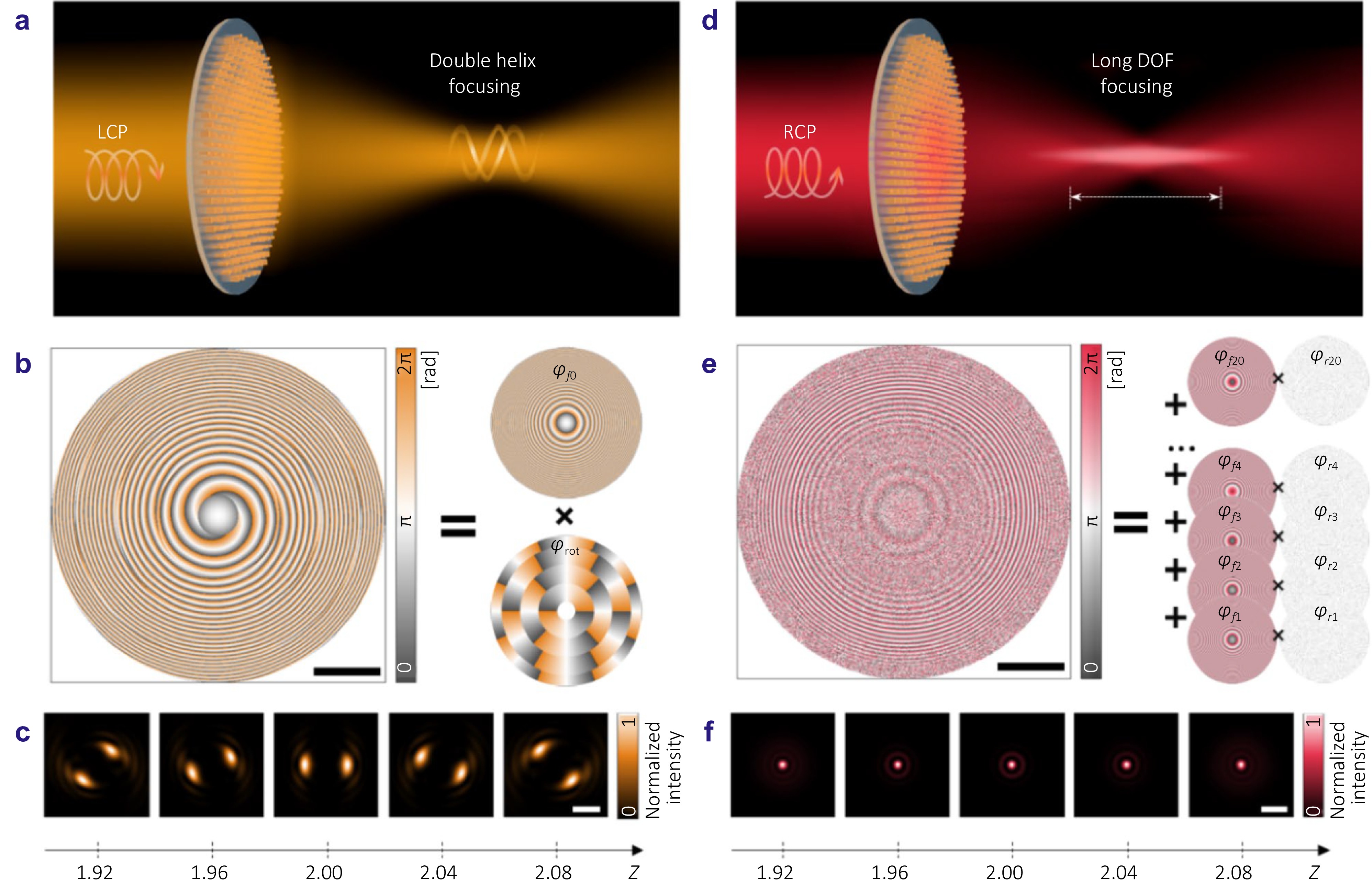
We demonstrate an electrically tunable dual-mode metalens capable of polarization-sensitive focal control, combining high-resolution imaging and depth-sensing functionalities into a single compact device. By integrating hydrogenated amorphous silicon (a-Si:H) meta-atoms with a liquid crystal (LC) modulator, the proposed metasurface independently manipulates left- and right-circularly polarized (LCP/RCP) incident light, generating a rotating double-helix focal distribution for LCP and an extended depth-of-focus (DOF) for RCP illumination.
The meta-atoms were rigorously optimized using propagation and geometric phases, enabling precise phase control and high transmittance at a wavelength of 635 nm. Experimental characterization confirmed near-diffraction-limited lateral and axial resolutions, closely aligning with theoretical predictions. The integrated LC cell facilitates milliseconds polarizationswitching between depth-sensitive double-helix and high-resolution DOF imaging modes. We further verified depth-extraction capabilities by analyzing rotation angles from dual-image focal spots under mixed-polarization illumination.
Depth-resolved imaging of a rubber-tree leaf, a skeletal-muscle cross-section, and a live planarian retrieved color-coded depths, demonstrating the effectiveness on complex biological tissues. This polarization-driven, electrically tunable metalens thus provides a versatile and effective optical platform suitable for advanced applications in biomedical imaging, three-dimensional sensing, adaptive optics, and compact imaging systems.
Ultrafast all-optical modulation of wide-bandwidth pulses enabled by silicon-metasurfaces
Kaloyan Georgiev, Khosro Zangeneh Kamali, Anton A. Trifonov, Giulia Crotti, Lyuben Petrov, Stefan Georgiev, Hristo Iliev, Lei Xu, Unai Arregui Leon, Mohsen Rahmani, Giuseppe Della Valle, Ivan Buchvarov, Dragomir Neshev
Opto-Electronic Advances
2026-09-15
Physics-informed neural fields enable blind aberration correction for partially coherent quantitative phase imaging
Shun Zhou, Xingyu Huang, Linpeng Lu, Habib Ullah, Kaiyu Du, Maciej Trusiak, Malgorzata Kujawinska, Yuzhen Zhang, Yao Fan, Qian Chen, Qinrong Zhang, Chao Zuo
Opto-Electronic Science
2026-08-26
Heterogeneously integrated micro-ring with SnS₂ for dual-functional optical modulation and photodetection
Jinyi Du, Lidan Lu, Xu Zhang, Bofei Zhu, Wenbo Bo, Yingjie Xu, Guang Chen, Yanlin He, Guanghui Ren, Xiaoping Lou, Zheng You, Lianqing Zhu
Opto-Electronic Advances
2026-08-25
Hardware-aware lightweight photonic spiking neural network for pattern classification
Shuiying Xiang, Yahui Zhang, Shangxuan Shi, Haowen Zhao, Dianzhuang Zheng, Xingxing Guo, Yanan Han, Ye Tian, Liyue Zhang, Yuechun Shi, Yue Hao
Opto-Electronic Advances
2026-08-25
PhyspeNet: An empirical physics-aware network for adaptive speckle reconstructive spectrometry
Junrui Liang, Min Jiang, Jun Li, Zhongming Huang, Junhong He, Yanting Guo, Yanzhao Ke, Jun Ye, Jiangming Xu, Jinyong Leng, Pu Zhou
Opto-Electronic Advances
2026-08-25
A 36 × 240 Gbps hybrid mode/wavelength division multiplexing transmitter using lithium niobate on insulator
Mingyu Zhu, Weihan Wang, Ruitao Ma, Aoyun Gao, Chun Gao, Zexu Wang, Fei Huang, Zhenyuan Bao, Dajian Liu, Jiaxuan Gan, Zejie Yu, Huan Li, Weike Zhao, Daoxin Dai
Opto-Electronic Advances
2026-08-25