(Peer-Reviewed) Multi-dimensional photodetection: from material intrinsic properties and metasurface engineering to silicon photonic integration
Wenqi Liu 刘文祺 ¹, Zilan Tang 唐梓岚 ¹, Qingzhao Hua 花清照 ¹, Liang Liu 刘靓 ¹, Xiaoxia Wang 王晓霞 ¹, Anlian Pan 潘安练 ¹ ²
¹ Hunan Institute of Optoelectronic Integration and Key Laboratory for MicroNano Physics and Technology of Hunan Province, State Key Laboratory of Chemo/Biosensing and Chemometrics, College of Materials Science and Engineering, Hunan University, Changsha 410082, China
中国 长沙 湖南大学材料科学与工程学院 微纳结构物理与应用技术湖南省重点实验室 湖南光电集成创新研究院 化学生物传感全国重点实验室
² School of Physics and Electronics, Hunan Normal University, Changsha 410081, China
中国 长沙 湖南师范大学物理与电子科学学院
Opto-Electronic Technology
, 2026-03-20
Abstract
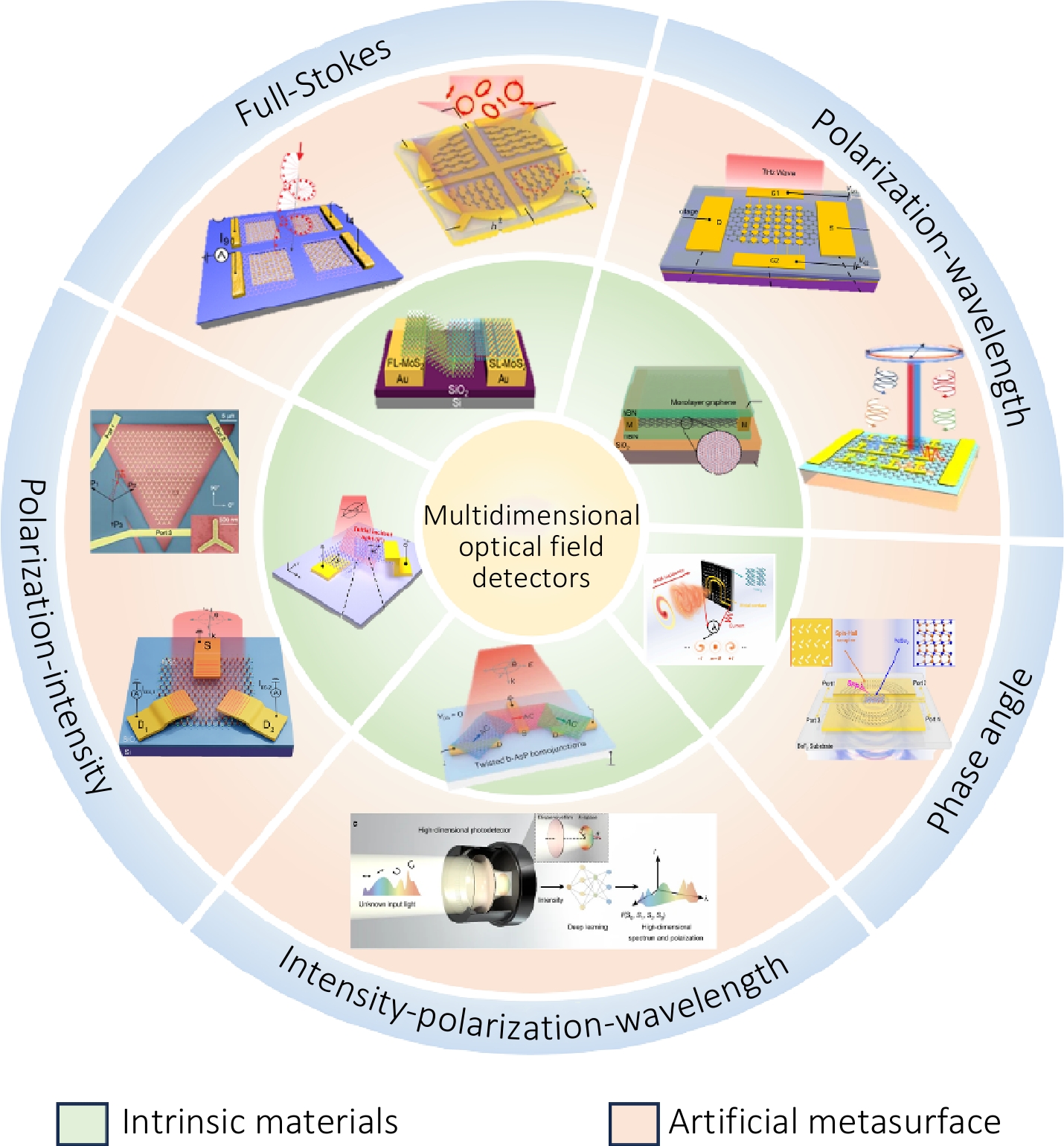
Integrated photodetectors capable of decoding multi-dimensional optical information are essential for modern information technologies and are widely applicable in areas such as autonomous driving, optical communications, and remote sensing. Recent progress in this field has been driven by the synergy among advances in low-dimensional materials, micro/nanofabrication technologies, and computational algorithms, which have enabled notable developments in integrable multidimensional optical-field detectors.
In this review, we first introduce some basic principles of multi-dimensional light detection and outline the critical strategies for frontend optical encoding and backend computational decoding. Subsequently, we discuss detection schemes based on the intrinsic optical properties of low-dimensional materials. We then move to metasurface architectures that use subwavelength structural engineering to enable multi-dimensional light field detection.
Furthermore, we summarize recent research on silicon-photonic integrated multidimensional photodetection that combines sensing and computing units. To conclude, we summarize key challenges, such as wafer-scale synthesis and interface engineering, and envision a future in which photodetectors evolve from simple signal converters into programmable, intelligent systems capable of comprehensive light-field perception.
Ultrafast all-optical modulation of wide-bandwidth pulses enabled by silicon-metasurfaces
Kaloyan Georgiev, Khosro Zangeneh Kamali, Anton A. Trifonov, Giulia Crotti, Lyuben Petrov, Stefan Georgiev, Hristo Iliev, Lei Xu, Unai Arregui Leon, Mohsen Rahmani, Giuseppe Della Valle, Ivan Buchvarov, Dragomir Neshev
Opto-Electronic Advances
2026-09-15
Physics-informed neural fields enable blind aberration correction for partially coherent quantitative phase imaging
Shun Zhou, Xingyu Huang, Linpeng Lu, Habib Ullah, Kaiyu Du, Maciej Trusiak, Malgorzata Kujawinska, Yuzhen Zhang, Yao Fan, Qian Chen, Qinrong Zhang, Chao Zuo
Opto-Electronic Science
2026-08-26
Heterogeneously integrated micro-ring with SnS₂ for dual-functional optical modulation and photodetection
Jinyi Du, Lidan Lu, Xu Zhang, Bofei Zhu, Wenbo Bo, Yingjie Xu, Guang Chen, Yanlin He, Guanghui Ren, Xiaoping Lou, Zheng You, Lianqing Zhu
Opto-Electronic Advances
2026-08-25
Hardware-aware lightweight photonic spiking neural network for pattern classification
Shuiying Xiang, Yahui Zhang, Shangxuan Shi, Haowen Zhao, Dianzhuang Zheng, Xingxing Guo, Yanan Han, Ye Tian, Liyue Zhang, Yuechun Shi, Yue Hao
Opto-Electronic Advances
2026-08-25
PhyspeNet: An empirical physics-aware network for adaptive speckle reconstructive spectrometry
Junrui Liang, Min Jiang, Jun Li, Zhongming Huang, Junhong He, Yanting Guo, Yanzhao Ke, Jun Ye, Jiangming Xu, Jinyong Leng, Pu Zhou
Opto-Electronic Advances
2026-08-25
A 36 × 240 Gbps hybrid mode/wavelength division multiplexing transmitter using lithium niobate on insulator
Mingyu Zhu, Weihan Wang, Ruitao Ma, Aoyun Gao, Chun Gao, Zexu Wang, Fei Huang, Zhenyuan Bao, Dajian Liu, Jiaxuan Gan, Zejie Yu, Huan Li, Weike Zhao, Daoxin Dai
Opto-Electronic Advances
2026-08-25