(Peer-Reviewed) High-speed and large-capacity visible light communication for 6G: advances and perspectives
Nan Chi 迟楠 ¹ ² ³, Zhilan Lu 卢芝蓝 ¹, Fujie Li 李甫杰 ¹, Haoyu Zhang 张昊宇 ¹, Yunkai Wang 汪昀楷 ¹, Xinyi Liu 刘心怡 ¹, Zhiwu Chen 陈志武 ¹, Zhe Feng 冯哲 ¹, Zhuoran Hu 胡卓然 ¹, Zhixue He 贺志学 ⁴, Ziwei Li 李子薇 ¹, Chao Shen 沈超 ¹, Junwen Zhang 张俊文 ¹
¹ Key Laboratory for the Information Science of Electromagnetic Waves (MoE), College of Future Information Technology, Fudan University, Shanghai 200433, China
中国 上海 复旦大学未来信息创新学院 电磁波信息科学教育部重点实验室
² Shanghai Engineering Research Center of Low-Earth-Orbit Satellite Communication and Applications, Shanghai 200433, China
中国 上海 上海低轨卫星通信与应用工程技术研究中心
³ Shanghai Collaborative Innovation Center of Low-Earth-Orbit Satellite Communication Technology, Shanghai 200433, China
中国 上海 上海市低轨卫星通信技术协同创新中心
⁴ Peng Cheng Laboratory, Shenzhen 518055, China
中国 深圳 鹏城实验室
Opto-Electronic Technology
, 2026-03-20
Abstract
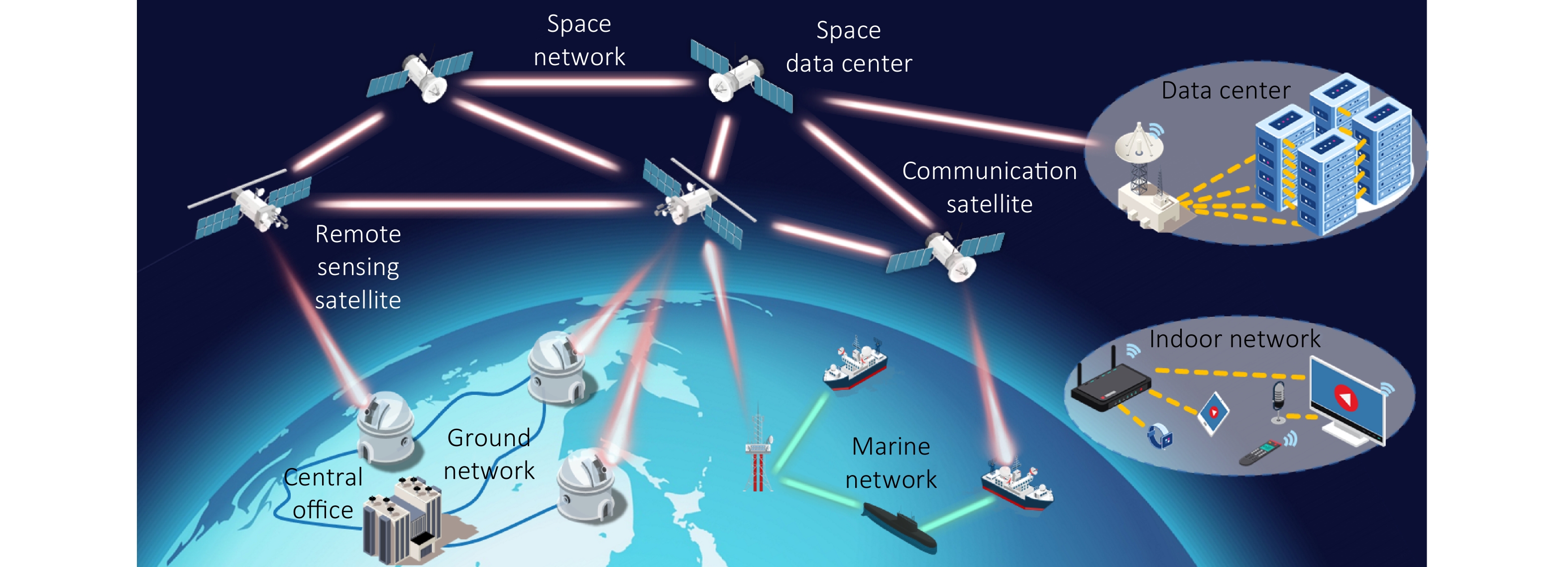
The sixth generation (6G) of mobile communications aims to establish high-speed, large-capacity space-air-ground-sea integrated networks (SAGSINs) to support the rapidly growing data traffic driven by big data and large-scale artificial intelligence. Visible light communication (VLC), operating in the 380–780 nm spectrum, has emerged as a promising optical wireless technology owing to its abundant spectral resources, high achievable data rates, and immunity to electromagnetic interference. These advantages make VLC a strong candidate for three-dimensional integrated communication networks.
This review summarizes recent advances in visible light communication, focusing on key enabling technologies including transmitter and receiver devices, advanced signal processing algorithms, multi-aperture reception, and beamforming techniques. Representative demonstrations of large-capacity VLC systems based on multi-dimensional multiplexing are reviewed. Finally, the challenges and future research directions of VLC are discussed.
Ultrafast all-optical modulation of wide-bandwidth pulses enabled by silicon-metasurfaces
Kaloyan Georgiev, Khosro Zangeneh Kamali, Anton A. Trifonov, Giulia Crotti, Lyuben Petrov, Stefan Georgiev, Hristo Iliev, Lei Xu, Unai Arregui Leon, Mohsen Rahmani, Giuseppe Della Valle, Ivan Buchvarov, Dragomir Neshev
Opto-Electronic Advances
2026-09-15
Physics-informed neural fields enable blind aberration correction for partially coherent quantitative phase imaging
Shun Zhou, Xingyu Huang, Linpeng Lu, Habib Ullah, Kaiyu Du, Maciej Trusiak, Malgorzata Kujawinska, Yuzhen Zhang, Yao Fan, Qian Chen, Qinrong Zhang, Chao Zuo
Opto-Electronic Science
2026-08-26
Heterogeneously integrated micro-ring with SnS₂ for dual-functional optical modulation and photodetection
Jinyi Du, Lidan Lu, Xu Zhang, Bofei Zhu, Wenbo Bo, Yingjie Xu, Guang Chen, Yanlin He, Guanghui Ren, Xiaoping Lou, Zheng You, Lianqing Zhu
Opto-Electronic Advances
2026-08-25
Hardware-aware lightweight photonic spiking neural network for pattern classification
Shuiying Xiang, Yahui Zhang, Shangxuan Shi, Haowen Zhao, Dianzhuang Zheng, Xingxing Guo, Yanan Han, Ye Tian, Liyue Zhang, Yuechun Shi, Yue Hao
Opto-Electronic Advances
2026-08-25
PhyspeNet: An empirical physics-aware network for adaptive speckle reconstructive spectrometry
Junrui Liang, Min Jiang, Jun Li, Zhongming Huang, Junhong He, Yanting Guo, Yanzhao Ke, Jun Ye, Jiangming Xu, Jinyong Leng, Pu Zhou
Opto-Electronic Advances
2026-08-25
A 36 × 240 Gbps hybrid mode/wavelength division multiplexing transmitter using lithium niobate on insulator
Mingyu Zhu, Weihan Wang, Ruitao Ma, Aoyun Gao, Chun Gao, Zexu Wang, Fei Huang, Zhenyuan Bao, Dajian Liu, Jiaxuan Gan, Zejie Yu, Huan Li, Weike Zhao, Daoxin Dai
Opto-Electronic Advances
2026-08-25