(Peer-Reviewed) Dual quasi-BIC resonances synergized laser cooling in halide perovskite metasurface
Ying Che 车颖 ¹ ², Peng Lu 卢鹏 ³, Yang Li 李洋 ¹ ², Junhao Zeng 曾浚壕 ¹ ², Mengxia Hu 胡孟霞 ¹ ², Fei Qin 秦飞 ¹ ², Tianyue Zhang 张天悦 ³ ⁴, Xiangping Li 李向平 ¹ ²
¹ Guangdong Provincial Key Laboratory of Optical Fiber Sensing and Communications, Institute of Photonics Technology, College of Physics & Optoelectronic Engineering, Jinan University, Guangzhou 510632, China
中国 广州 暨南大学物理与光电工程学院光子技术研究院 广东省光纤传感与通信技术重点实验室
² International Cooperation Joint Laboratory for Optoelectronic Hybrid Integrated Circuits, Jinan University, Guangzhou 510632, China
中国 广州 暨南大学 教育部光电混合集成电路国际合作联合实验室
³ School of Integrated Circuits, Beijing University of Posts and Telecommunications, Beijing 100876, China
中国 北京 北京邮电大学集成电路学院
⁴ State Key Laboratory of Information Photonics and Optical Communications, Beijing 100876, China
中国 北京 信息光子学与光通信国家重点实验室
Opto-Electronic Technology
, 2026-03-20
Abstract
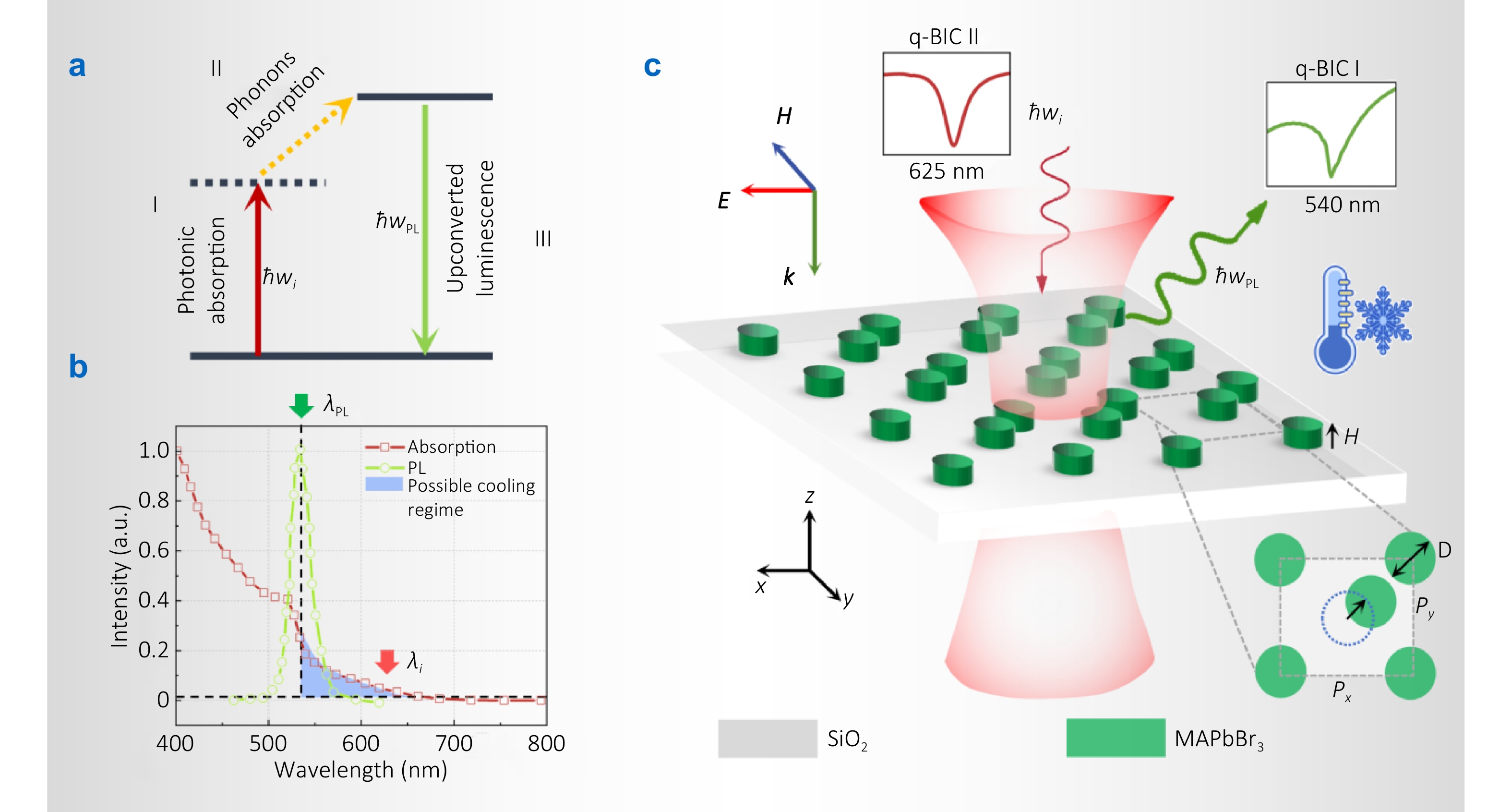
Halide perovskites, recognized for efficient upconversion photoluminescence and high quantum yields, present a promising platform for laser refrigeration. Their high refractive index further enables the design of nanostructures that support strong Mie-type resonances, leading to subwavelength light confinement and enhanced laser cooling performance.
In this work, we theoretically propose and numerically demonstrate a metasurface composed of nanostructured halide perovskite with tailored asymmetry, supporting dual-band quasi-bound states in the continuum (q-BICs) that simultaneously enhance optical excitation and upconversion photoluminescence. The perovskite metasurface exhibits a significant enhancement in optical absorption compared with the unpatterned perovskite film, along with a pronounced Purcell effect at the emission wavelength.
Thermodynamic modelling further indicates net cooling down to –201 °C from room temperature under continuous laser illumination, exceeding the liquid-nitrogen cooling threshold. These findings establish design principles for mechanically refrigerant-free thermal management and open a pathway toward integrated cryogenic photonic platforms.
Ultrafast all-optical modulation of wide-bandwidth pulses enabled by silicon-metasurfaces
Kaloyan Georgiev, Khosro Zangeneh Kamali, Anton A. Trifonov, Giulia Crotti, Lyuben Petrov, Stefan Georgiev, Hristo Iliev, Lei Xu, Unai Arregui Leon, Mohsen Rahmani, Giuseppe Della Valle, Ivan Buchvarov, Dragomir Neshev
Opto-Electronic Advances
2026-09-15
Physics-informed neural fields enable blind aberration correction for partially coherent quantitative phase imaging
Shun Zhou, Xingyu Huang, Linpeng Lu, Habib Ullah, Kaiyu Du, Maciej Trusiak, Malgorzata Kujawinska, Yuzhen Zhang, Yao Fan, Qian Chen, Qinrong Zhang, Chao Zuo
Opto-Electronic Science
2026-08-26
Heterogeneously integrated micro-ring with SnS₂ for dual-functional optical modulation and photodetection
Jinyi Du, Lidan Lu, Xu Zhang, Bofei Zhu, Wenbo Bo, Yingjie Xu, Guang Chen, Yanlin He, Guanghui Ren, Xiaoping Lou, Zheng You, Lianqing Zhu
Opto-Electronic Advances
2026-08-25
Hardware-aware lightweight photonic spiking neural network for pattern classification
Shuiying Xiang, Yahui Zhang, Shangxuan Shi, Haowen Zhao, Dianzhuang Zheng, Xingxing Guo, Yanan Han, Ye Tian, Liyue Zhang, Yuechun Shi, Yue Hao
Opto-Electronic Advances
2026-08-25
PhyspeNet: An empirical physics-aware network for adaptive speckle reconstructive spectrometry
Junrui Liang, Min Jiang, Jun Li, Zhongming Huang, Junhong He, Yanting Guo, Yanzhao Ke, Jun Ye, Jiangming Xu, Jinyong Leng, Pu Zhou
Opto-Electronic Advances
2026-08-25
A 36 × 240 Gbps hybrid mode/wavelength division multiplexing transmitter using lithium niobate on insulator
Mingyu Zhu, Weihan Wang, Ruitao Ma, Aoyun Gao, Chun Gao, Zexu Wang, Fei Huang, Zhenyuan Bao, Dajian Liu, Jiaxuan Gan, Zejie Yu, Huan Li, Weike Zhao, Daoxin Dai
Opto-Electronic Advances
2026-08-25