(Peer-Reviewed) Double topological phase singularities in highly absorbing ultra-thin film structures for ultrasensitive humidity sensing
Xiaowen Li 李晓温 ¹ ², Jie Sheng 盛洁 ², Zhengji Wen 文政绩 ³, Fangyuan Li 李方园 ², Xiran Huang 黄熙然 ², Mingqing Zhang 张名青 ¹, Yi Zhang 张毅 ², Duo Cao 曹铎 ², Xi Shi 石溪 ², Feng Liu 刘锋 ², Jiaming Hao 郝加明 ¹
¹ Institute of Optoelectronics & Department of Materials Science, Shanghai Frontiers Science Research Base of Intelligent Optoelectronics and Perception, Fudan University, Shanghai 200433, China
中国 上海 复旦大学 光电研究院 材料科学系 上海市智能光电与感知前沿科学研究基地
² Department of Physics, Shanghai Normal University, Shanghai 200234, China
中国 上海 上海师范大学物理系
³ State Key Laboratory of Infrared Physics, Shanghai Institute of Technical Physics, Chinese Academy of Sciences, Shanghai 200083, China
中国 上海 中国科学院上海技术物理研究所 红外物理国家重点实验室
Opto-Electronic Advances
, 2025-03-28
Abstract
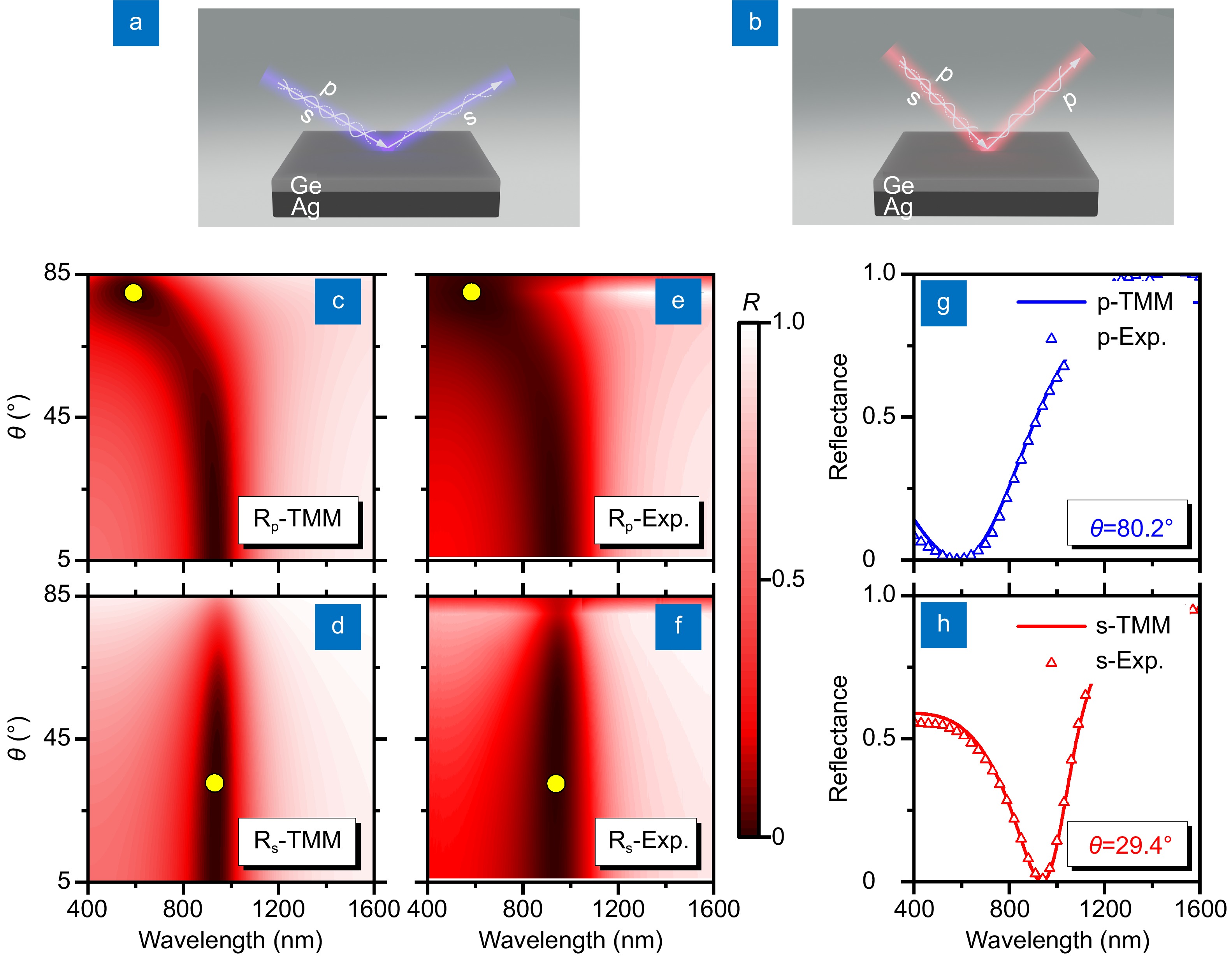
Phase singularities (PSs) in topological darkness-based sensors have received significant attention in optical sensing due to their rapid, ultra-sensitive, and label-free detection capabilities. Here, we present both experimental and theoretical investigations of an ultrasensitive and multiplexed phase-sensitive sensor utilizing dual topological PSs in the visible and near-infrared regions.
This sensor uses a simple structure, which consists of an ultra-thin highly absorbing film deposited on a metal substrate. We demonstrate the achievement of dual-polarization darkness points for s- and p-polarizations at different incident angles. Furthermore, we theoretically explain the double topological PSs accompanied by a perfect ±π-jump near a zero-reflection point, based on the temporal coupled-mode formalism.
To validate its multifunctional capabilities, humidity sensing tests were carried out. The results demonstrate that the sensor has a detection limit reaching the level of 0.12 ‰. These findings go beyond the scope of conventional interference optical coatings and highlight the potential applications of this technology in gas sensing and biosensing domains.
Ultrafast all-optical modulation of wide-bandwidth pulses enabled by silicon-metasurfaces
Kaloyan Georgiev, Khosro Zangeneh Kamali, Anton A. Trifonov, Giulia Crotti, Lyuben Petrov, Stefan Georgiev, Hristo Iliev, Lei Xu, Unai Arregui Leon, Mohsen Rahmani, Giuseppe Della Valle, Ivan Buchvarov, Dragomir Neshev
Opto-Electronic Advances
2026-09-15
Physics-informed neural fields enable blind aberration correction for partially coherent quantitative phase imaging
Shun Zhou, Xingyu Huang, Linpeng Lu, Habib Ullah, Kaiyu Du, Maciej Trusiak, Malgorzata Kujawinska, Yuzhen Zhang, Yao Fan, Qian Chen, Qinrong Zhang, Chao Zuo
Opto-Electronic Science
2026-08-26
Heterogeneously integrated micro-ring with SnS₂ for dual-functional optical modulation and photodetection
Jinyi Du, Lidan Lu, Xu Zhang, Bofei Zhu, Wenbo Bo, Yingjie Xu, Guang Chen, Yanlin He, Guanghui Ren, Xiaoping Lou, Zheng You, Lianqing Zhu
Opto-Electronic Advances
2026-08-25
Hardware-aware lightweight photonic spiking neural network for pattern classification
Shuiying Xiang, Yahui Zhang, Shangxuan Shi, Haowen Zhao, Dianzhuang Zheng, Xingxing Guo, Yanan Han, Ye Tian, Liyue Zhang, Yuechun Shi, Yue Hao
Opto-Electronic Advances
2026-08-25
PhyspeNet: An empirical physics-aware network for adaptive speckle reconstructive spectrometry
Junrui Liang, Min Jiang, Jun Li, Zhongming Huang, Junhong He, Yanting Guo, Yanzhao Ke, Jun Ye, Jiangming Xu, Jinyong Leng, Pu Zhou
Opto-Electronic Advances
2026-08-25
A 36 × 240 Gbps hybrid mode/wavelength division multiplexing transmitter using lithium niobate on insulator
Mingyu Zhu, Weihan Wang, Ruitao Ma, Aoyun Gao, Chun Gao, Zexu Wang, Fei Huang, Zhenyuan Bao, Dajian Liu, Jiaxuan Gan, Zejie Yu, Huan Li, Weike Zhao, Daoxin Dai
Opto-Electronic Advances
2026-08-25