(Peer-Reviewed) Multiphoton intravital microscopy in small animals of long-term mitochondrial dynamics based on super‐resolution radial fluctuations
Saeed Bohlooli Darian ¹, Jeongmin Oh ², Bjorn Paulson ², Minju Cho ¹, Globinna Kim ¹, Eunyoung Tak ¹ ², Inki Kim ³, Chan-Gi Pack ¹ ² Jung-Man Namgoong ⁴, In-Jeoung Baek ¹ ², Jun Ki Kim ¹ ²
¹ Department of Biomedical Engineering, Brain Korea 21 Project, University of Ulsan College of Medicine, Seoul 05505, Republic of Korea
² Convergence Medicine, Asan Institute for Life Sciences, Asan Medical Center, Seoul 05505, Republic of Korea
³ Department of Pharmacology, University of Ulsan College of Medicine, Seoul 05505, Republic of Korea
⁴ Department of Surgery, Asan Medical Center, University of Ulsan College of Medicine, Seoul 05505, Republic of Korea
Opto-Electronic Advances
, 2025-07-17
Abstract
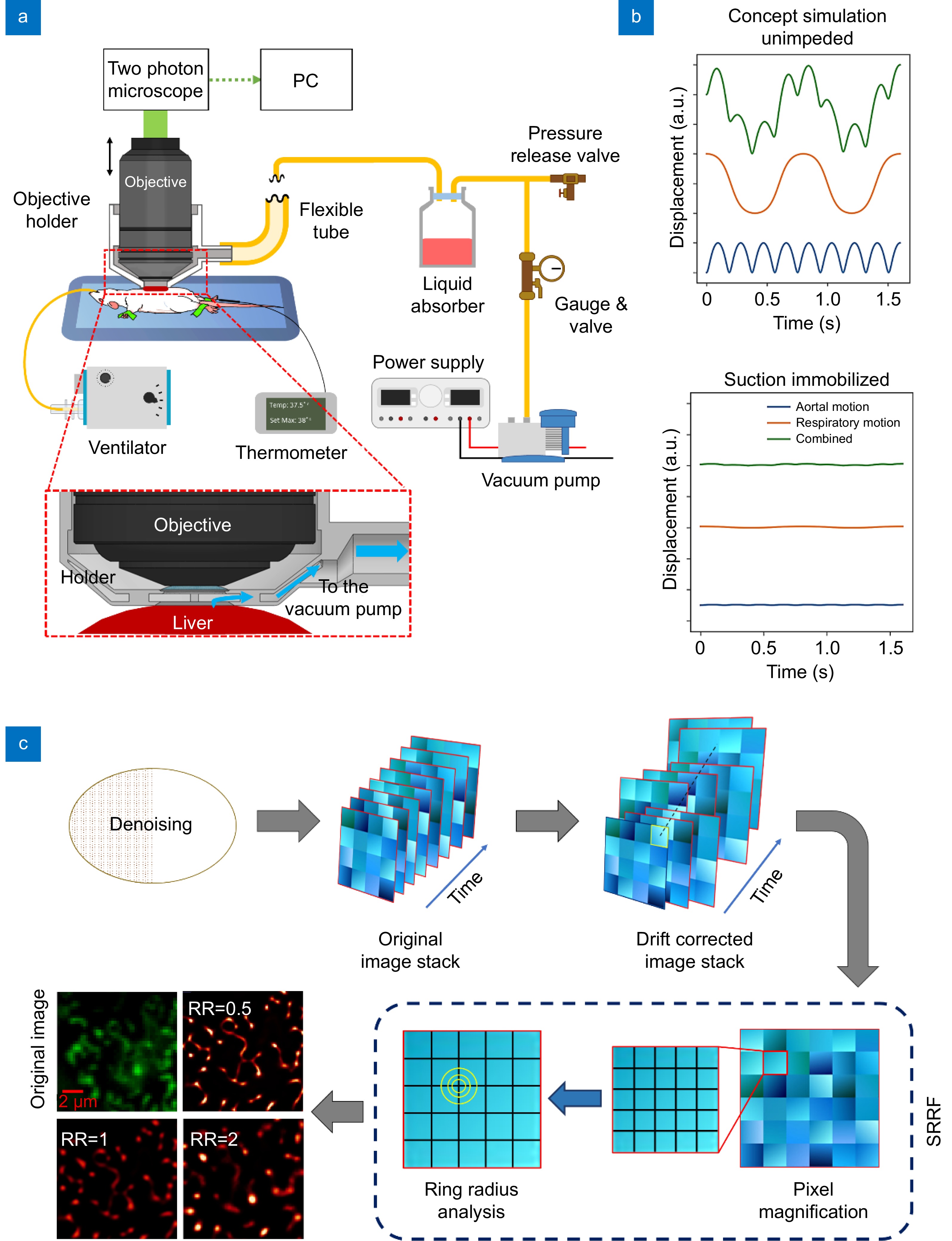
We developed an imaging technique combining two-photon computed super-resolution microscopy and suction-based stabilization to achieve the resolution of the single-cell level and organelles in vivo. To accomplish this, a conventional two-photon microscope was equipped with a 3D-printed holders, which stabilize the tissue surface within the focal plane of immersion objectives.
Further computational image stabilization and noise reduction were applied, followed by super-resolution radial fluctuations (SRRF) analysis, doubling image resolution, and enhancing signal-to-noise ratios for in vivo subcellular process investigation. Stabilization of < 1 µm was obtained by suction, and < 25 nm were achieved by subsequent algorithmic image stabilization. A Mito-Dendra2 mouse model, expressing green fluorescent protein (GFP) in mitochondria, demonstrated the potential of long-term intravital subcellular imaging.
In vivo mitochondrial fission and fusion, mitochondrial status migration, and the effects of alcohol consumption (modeled as an alcoholic liver disease) and berberine treatment on hepatocyte mitochondrial dynamics are directly observed intravitally. Suction-based stabilization in two-photon intravital imaging, coupled with computational super-resolution holds promise for advancing in vivo subcellular imaging studies.
Ultrafast all-optical modulation of wide-bandwidth pulses enabled by silicon-metasurfaces
Kaloyan Georgiev, Khosro Zangeneh Kamali, Anton A. Trifonov, Giulia Crotti, Lyuben Petrov, Stefan Georgiev, Hristo Iliev, Lei Xu, Unai Arregui Leon, Mohsen Rahmani, Giuseppe Della Valle, Ivan Buchvarov, Dragomir Neshev
Opto-Electronic Advances
2026-09-15
Physics-informed neural fields enable blind aberration correction for partially coherent quantitative phase imaging
Shun Zhou, Xingyu Huang, Linpeng Lu, Habib Ullah, Kaiyu Du, Maciej Trusiak, Malgorzata Kujawinska, Yuzhen Zhang, Yao Fan, Qian Chen, Qinrong Zhang, Chao Zuo
Opto-Electronic Science
2026-08-26
Heterogeneously integrated micro-ring with SnS₂ for dual-functional optical modulation and photodetection
Jinyi Du, Lidan Lu, Xu Zhang, Bofei Zhu, Wenbo Bo, Yingjie Xu, Guang Chen, Yanlin He, Guanghui Ren, Xiaoping Lou, Zheng You, Lianqing Zhu
Opto-Electronic Advances
2026-08-25
Hardware-aware lightweight photonic spiking neural network for pattern classification
Shuiying Xiang, Yahui Zhang, Shangxuan Shi, Haowen Zhao, Dianzhuang Zheng, Xingxing Guo, Yanan Han, Ye Tian, Liyue Zhang, Yuechun Shi, Yue Hao
Opto-Electronic Advances
2026-08-25
PhyspeNet: An empirical physics-aware network for adaptive speckle reconstructive spectrometry
Junrui Liang, Min Jiang, Jun Li, Zhongming Huang, Junhong He, Yanting Guo, Yanzhao Ke, Jun Ye, Jiangming Xu, Jinyong Leng, Pu Zhou
Opto-Electronic Advances
2026-08-25
A 36 × 240 Gbps hybrid mode/wavelength division multiplexing transmitter using lithium niobate on insulator
Mingyu Zhu, Weihan Wang, Ruitao Ma, Aoyun Gao, Chun Gao, Zexu Wang, Fei Huang, Zhenyuan Bao, Dajian Liu, Jiaxuan Gan, Zejie Yu, Huan Li, Weike Zhao, Daoxin Dai
Opto-Electronic Advances
2026-08-25