(Peer-Reviewed) Construction of bifunctional single-atom catalysts on the optimized β-Mo₂C surface for highly selective hydrogenation of CO₂ into ethanol
Xue Ye 叶雪 ¹ ², Junguo Ma 马俊国 ¹, Wenguang Yu ³, Xiaoli Pan 潘晓丽 ³, Chongya Yang 杨冲亚 ¹ ², Chang Wang 王畅 ³, Qinggang Liu 刘清港 ¹, Yanqiang Huang 黄延强 ¹
¹ CAS Key Laboratory of Science and Technology on Applied Catalysis, Dalian Institute of Chemical Physics, Chinese Academy of Sciences, Dalian 116023, China
中国 大连 中国科学院大连化学物理研究所 催化基础国家重点实验室
² China University of Chinese Academy of Science, Beijing 100049, China
中国 北京 中国科学院大学
³ Dalian Institute of Chemical Physics, Chinese Academy of Sciences, Dalian 116023, China
中国 大连 中国科学院大连化学物理研究所
Abstract
Green and economical CO₂ utilization is significant for CO₂ emission reduction and energy development. Here, the 1D Mo₂C nanowires with dominant (101) crystal surfaces were modified by the deposition of atomic functional components Rh and K. While unmodified βMo2C could only convert CO₂ to methanol, the designed catalyst of K₀.₂Rh₀.₂/β-Mo₂C exhibited up to 72.1% of ethanol selectivity at 150 °C. It was observed that the atomically dispersed Rh could form the bifunctional active centres with the active carrier βMo2C with the synergistic effects to achieve highly specific controlled C–C coupling.
By promoting the CO₂ adsorption and activation, the introduction of an alkali metal (K) mainly regulated the balanced performance of the two active centres, which in turn improved the hydrogenation selectivity. Overall, the controlled modification of βMo₂C provides a new design strategy for the highly efficient, low-temperature hydrogenation of CO₂ to ethanol with single-atom catalysts, which provides an excellent example for the rational design of the complex catalysts.
Graphical abstract
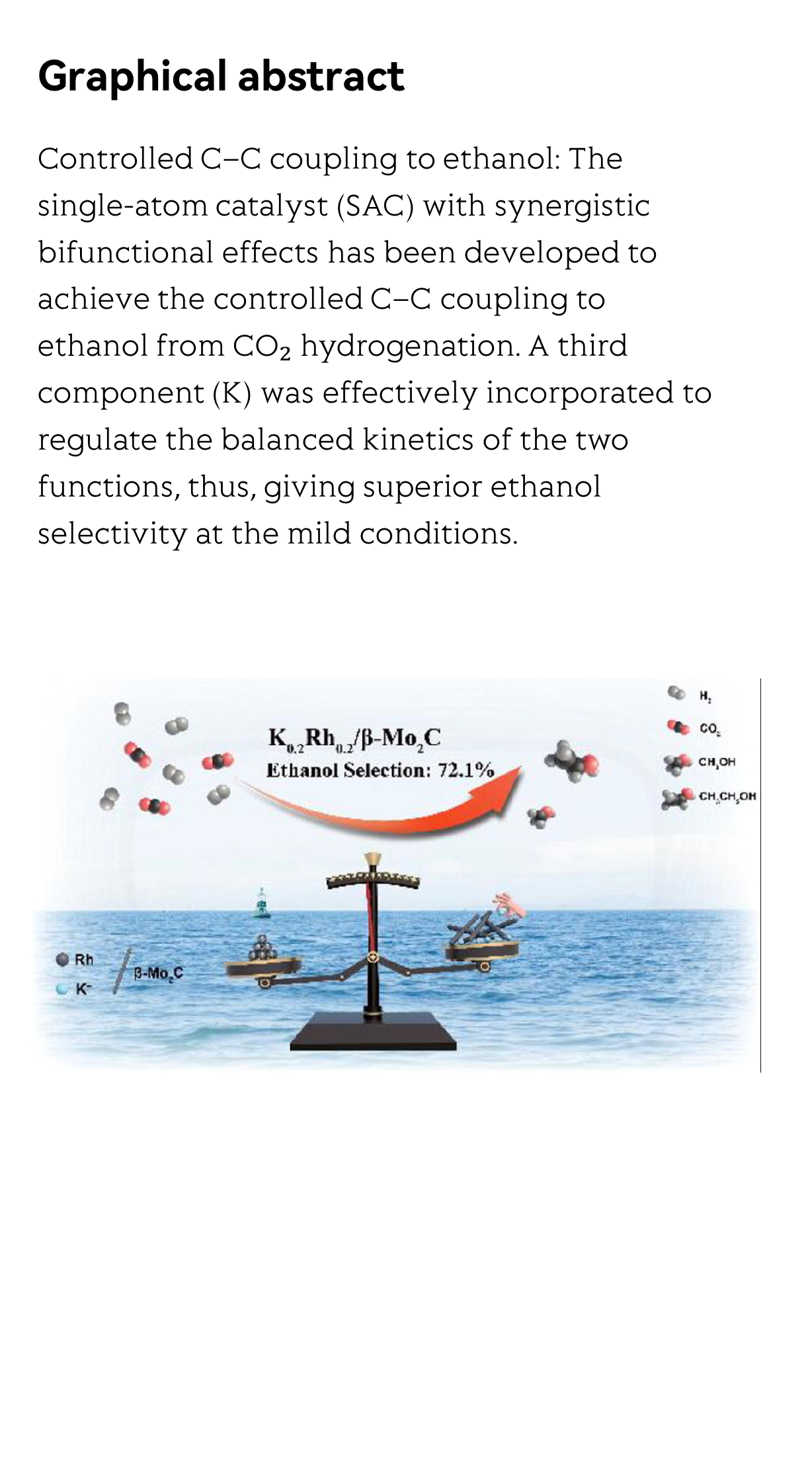
Controlled C–C coupling to ethanol: The single-atom catalyst (SAC) with synergistic bifunctional effects has been developed to achieve the controlled C–C coupling to ethanol from CO₂ hydrogenation. A third component (K) was effectively incorporated to regulate the balanced kinetics of the two functions, thus, giving superior ethanol selectivity at the mild conditions.
Ultrafast all-optical modulation of wide-bandwidth pulses enabled by silicon-metasurfaces
Kaloyan Georgiev, Khosro Zangeneh Kamali, Anton A. Trifonov, Giulia Crotti, Lyuben Petrov, Stefan Georgiev, Hristo Iliev, Lei Xu, Unai Arregui Leon, Mohsen Rahmani, Giuseppe Della Valle, Ivan Buchvarov, Dragomir Neshev
Opto-Electronic Advances
2026-09-15
Physics-informed neural fields enable blind aberration correction for partially coherent quantitative phase imaging
Shun Zhou, Xingyu Huang, Linpeng Lu, Habib Ullah, Kaiyu Du, Maciej Trusiak, Malgorzata Kujawinska, Yuzhen Zhang, Yao Fan, Qian Chen, Qinrong Zhang, Chao Zuo
Opto-Electronic Science
2026-08-26
Heterogeneously integrated micro-ring with SnS₂ for dual-functional optical modulation and photodetection
Jinyi Du, Lidan Lu, Xu Zhang, Bofei Zhu, Wenbo Bo, Yingjie Xu, Guang Chen, Yanlin He, Guanghui Ren, Xiaoping Lou, Zheng You, Lianqing Zhu
Opto-Electronic Advances
2026-08-25
Hardware-aware lightweight photonic spiking neural network for pattern classification
Shuiying Xiang, Yahui Zhang, Shangxuan Shi, Haowen Zhao, Dianzhuang Zheng, Xingxing Guo, Yanan Han, Ye Tian, Liyue Zhang, Yuechun Shi, Yue Hao
Opto-Electronic Advances
2026-08-25
PhyspeNet: An empirical physics-aware network for adaptive speckle reconstructive spectrometry
Junrui Liang, Min Jiang, Jun Li, Zhongming Huang, Junhong He, Yanting Guo, Yanzhao Ke, Jun Ye, Jiangming Xu, Jinyong Leng, Pu Zhou
Opto-Electronic Advances
2026-08-25
A 36 × 240 Gbps hybrid mode/wavelength division multiplexing transmitter using lithium niobate on insulator
Mingyu Zhu, Weihan Wang, Ruitao Ma, Aoyun Gao, Chun Gao, Zexu Wang, Fei Huang, Zhenyuan Bao, Dajian Liu, Jiaxuan Gan, Zejie Yu, Huan Li, Weike Zhao, Daoxin Dai
Opto-Electronic Advances
2026-08-25