(Peer-Reviewed) Unsupervised learning enabled label-free single-pixel imaging for resilient information transmission through unknown dynamic scattering media
Fujie Li 李甫杰 ¹, Haoyu Zhang 张昊宇 ¹, Zhilan Lu 卢芝蓝 ¹, Li Yao 姚力 ¹, Yuan Wei 魏圆 ¹, Ziwei Li 李子薇 ¹, Feng Bao 鲍峰 ¹, Junwen Zhang 张俊文 ¹, Yingjun Zhou 周盈君 ¹, Nan Chi 迟楠 ¹ ²
¹ Key Laboratory for the Information Science of Electromagnetic Waves (MoE), Department of Communication Science and Engineering, Fudan University, Shanghai 200433, China
中国 上海 复旦大学电磁波信息科学教育部重点实验室
² Shanghai Engineering Research Center of Low-Earth-Orbit Satellite Communication and Applications, and Shanghai Collaborative Innovation Center of Low-Earth-Orbit Satellite Communication Technology, Shanghai 200433, China
中国 上海 上海低轨卫星通信与应用工程技术研究中心 上海市低轨卫星通信技术协同创新中心
Opto-Electronic Advances
, 2025-10-25
Abstract
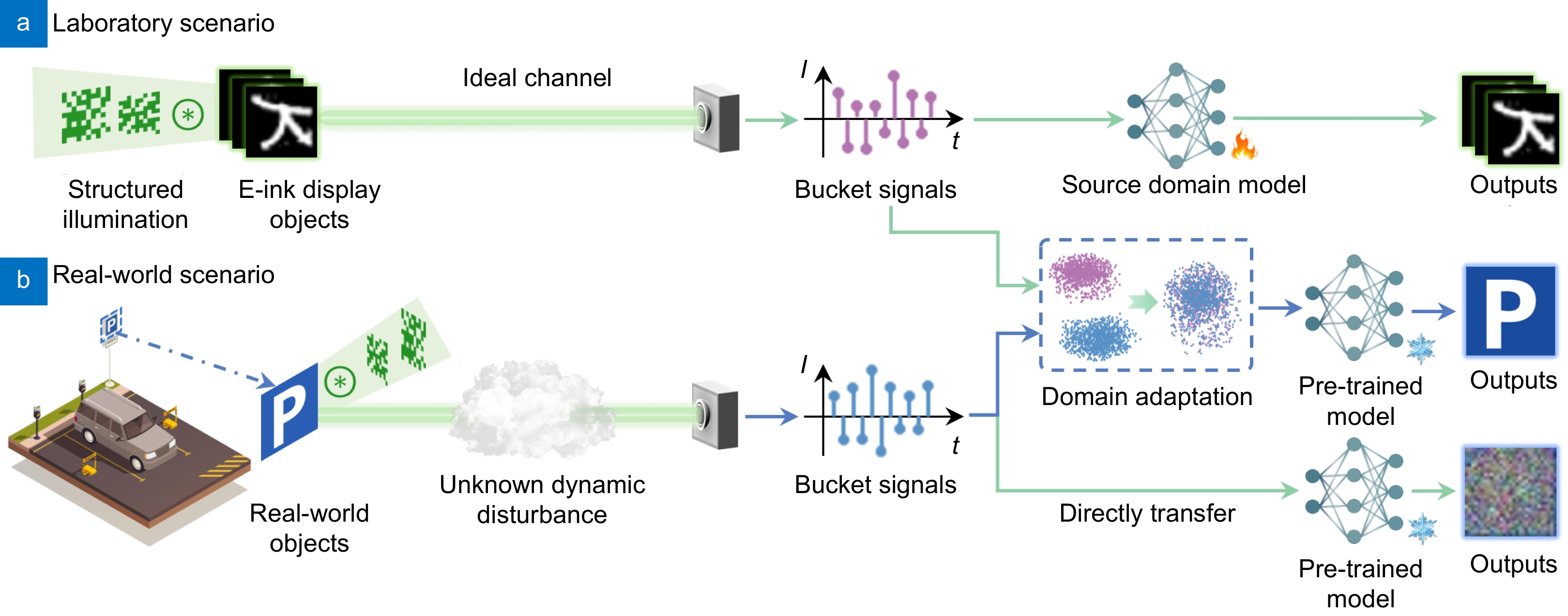
Single-pixel imaging (SPI) is a prominent scattering media imaging technique that allows image transmission via one-dimensional detection under structured illumination, with applications spanning from long-range imaging to microscopy. Recent advancements leveraging deep learning (DL) have significantly improved SPI performance, especially at low compression ratios. However, most DL-based SPI methods proposed so far rely heavily on extensive labeled datasets for supervised training, which are often impractical in real-world scenarios.
Here, we propose an unsupervised learning-enabled label-free SPI method for resilient information transmission through unknown dynamic scattering media. Additionally, we introduce a physics-informed autoencoder framework to optimize encoding schemes, further enhancing image quality at low compression ratios. Simulation and experimental results demonstrate that high-efficiency data transmission with structural similarity exceeding 0.9 is achieved through challenging turbulent channels.
Moreover, experiments demonstrate that in a 5 m underwater dynamic turbulent channel, USAF target imaging quality surpasses traditional methods by over 13 dB. The compressive encoded transmission of 720×720 resolution video exceeding 30 seconds with great fidelity is also successfully demonstrated. These preliminary results suggest that our proposed method opens up a new paradigm for resilient information transmission through unknown dynamic scattering media and holds potential for broader applications within many other scattering media imaging technologies.
Ultrafast all-optical modulation of wide-bandwidth pulses enabled by silicon-metasurfaces
Kaloyan Georgiev, Khosro Zangeneh Kamali, Anton A. Trifonov, Giulia Crotti, Lyuben Petrov, Stefan Georgiev, Hristo Iliev, Lei Xu, Unai Arregui Leon, Mohsen Rahmani, Giuseppe Della Valle, Ivan Buchvarov, Dragomir Neshev
Opto-Electronic Advances
2026-09-15
Physics-informed neural fields enable blind aberration correction for partially coherent quantitative phase imaging
Shun Zhou, Xingyu Huang, Linpeng Lu, Habib Ullah, Kaiyu Du, Maciej Trusiak, Malgorzata Kujawinska, Yuzhen Zhang, Yao Fan, Qian Chen, Qinrong Zhang, Chao Zuo
Opto-Electronic Science
2026-08-26
Heterogeneously integrated micro-ring with SnS₂ for dual-functional optical modulation and photodetection
Jinyi Du, Lidan Lu, Xu Zhang, Bofei Zhu, Wenbo Bo, Yingjie Xu, Guang Chen, Yanlin He, Guanghui Ren, Xiaoping Lou, Zheng You, Lianqing Zhu
Opto-Electronic Advances
2026-08-25
Hardware-aware lightweight photonic spiking neural network for pattern classification
Shuiying Xiang, Yahui Zhang, Shangxuan Shi, Haowen Zhao, Dianzhuang Zheng, Xingxing Guo, Yanan Han, Ye Tian, Liyue Zhang, Yuechun Shi, Yue Hao
Opto-Electronic Advances
2026-08-25
PhyspeNet: An empirical physics-aware network for adaptive speckle reconstructive spectrometry
Junrui Liang, Min Jiang, Jun Li, Zhongming Huang, Junhong He, Yanting Guo, Yanzhao Ke, Jun Ye, Jiangming Xu, Jinyong Leng, Pu Zhou
Opto-Electronic Advances
2026-08-25
A 36 × 240 Gbps hybrid mode/wavelength division multiplexing transmitter using lithium niobate on insulator
Mingyu Zhu, Weihan Wang, Ruitao Ma, Aoyun Gao, Chun Gao, Zexu Wang, Fei Huang, Zhenyuan Bao, Dajian Liu, Jiaxuan Gan, Zejie Yu, Huan Li, Weike Zhao, Daoxin Dai
Opto-Electronic Advances
2026-08-25