(Peer-Reviewed) Superchirality induced ultrasensitive chiral detection in high-Q optical cavities
Tianxu Jia 贾天旭 ¹ ², Youngsun Jeon ², Lv Feng 冯侣 ¹, Hongyoon Kim ², Bingjue Li 李冰珏 ³, Guanghao Rui 芮光浩 ¹, Junsuk Rho 鲁埈锡 ² ⁴ ⁵ ⁶
¹ Department of Optical Engineering, School of Electronic Science and Engineering, Southeast University, Nanjing 211189, China
中国 南京 东南大学电子科学与工程学院光学工程系
² Department of Mechanical Engineering, Pohang University of Science and Technology (POSTECH), Pohang 37673, Republic of Korea
³ School of Mechanical Engineering, Southeast University, Nanjing 211189, China
中国 南京 东南大学机械工程学院
⁴ Department of Chemical Engineering, Pohang University of Science and Technology (POSTECH), Pohang 37673, Republic of Korea
⁵ Department of Electrical Engineering, Pohang University of Science and Technology (POSTECH), Pohang 37673, Republic of Korea
⁶ POSCO-POSTECH-RIST Convergence Research Center for Flat Optics and Metaphotonics, Pohang 37673, Republic of Korea
Opto-Electronic Advances
, 2025-10-25
Abstract
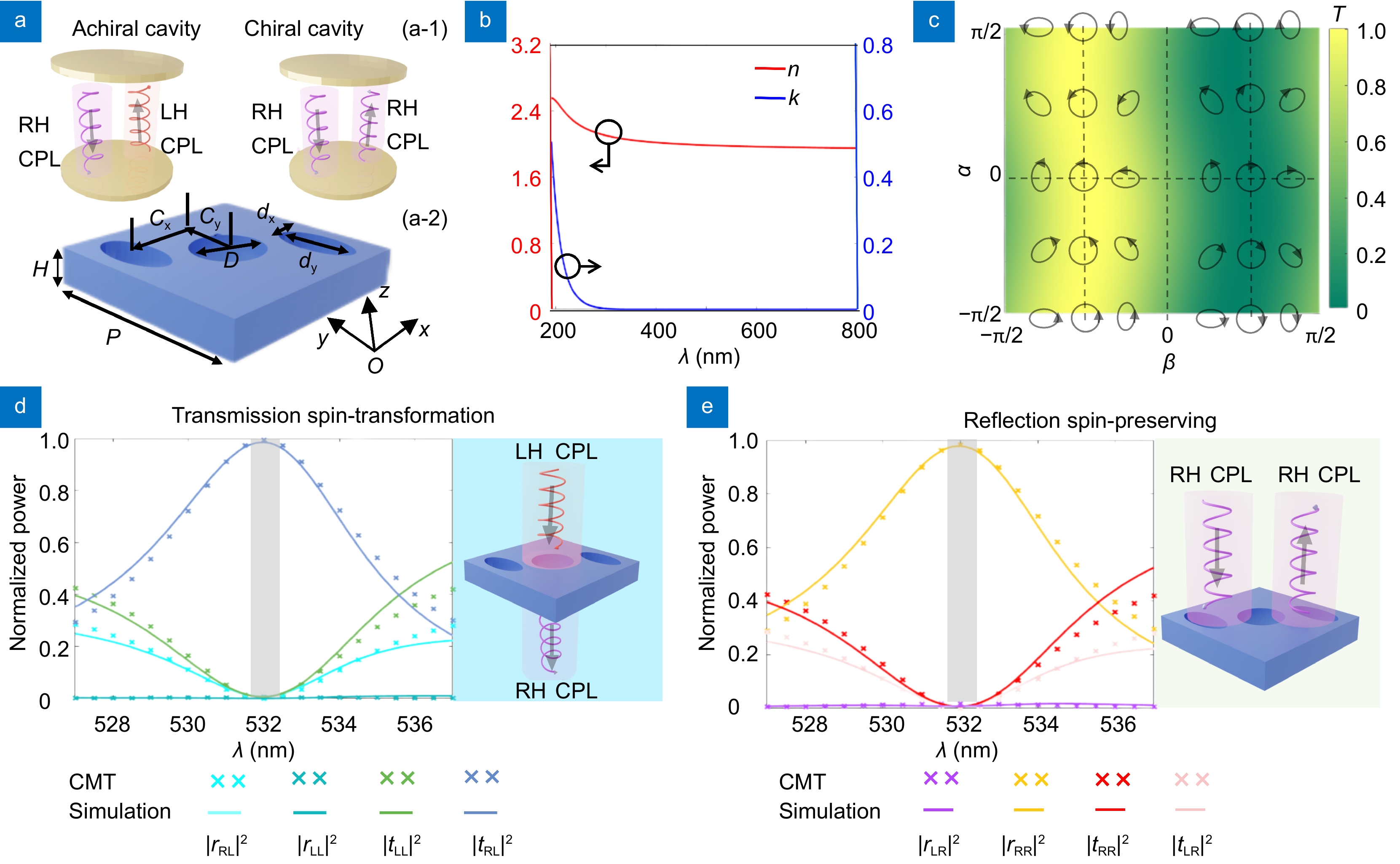
The scale mismatch between nanoscale biomolecules and sub-wavelength light hinders circular dichroism (CD) spectroscopy for chiral small molecule sensing. In this study, we propose a high quality-factor (Q-factor) optical cavity that offers a breakthrough solution to the intrinsic trade-off between optical chirality density and mode loss.
A spin-preserving chiral metasurface utilizes bound states in the continuum (BIC)-guided mode resonance (GMR) degenerate modes to achieve a high Q-factor, while ensuring the preservation of chirality purity for circularly polarized light propagating within the cavity via spin-locking mechanism. Experimental results demonstrate that the BIC-GMR degenerate state enables near-perfect transmission CD up to 0.99, without requiring symmetry breaking.
Full-wave simulations further predict that this synergistically enhanced system can achieve a Q-factor as high as 10,037 and generate a localized field in the molecular interaction region with an optical chirality density enhancement of up to 400-fold, leading to 5025-fold amplification of the CD signal. This study establishes a foundation for detecting low-concentration chiral molecules, reveals high-Q enhancement, and advances chiral toward single-molecule sensitivity, opening new research avenues in chiral biosensing.
Ultrafast all-optical modulation of wide-bandwidth pulses enabled by silicon-metasurfaces
Kaloyan Georgiev, Khosro Zangeneh Kamali, Anton A. Trifonov, Giulia Crotti, Lyuben Petrov, Stefan Georgiev, Hristo Iliev, Lei Xu, Unai Arregui Leon, Mohsen Rahmani, Giuseppe Della Valle, Ivan Buchvarov, Dragomir Neshev
Opto-Electronic Advances
2026-09-15
Physics-informed neural fields enable blind aberration correction for partially coherent quantitative phase imaging
Shun Zhou, Xingyu Huang, Linpeng Lu, Habib Ullah, Kaiyu Du, Maciej Trusiak, Malgorzata Kujawinska, Yuzhen Zhang, Yao Fan, Qian Chen, Qinrong Zhang, Chao Zuo
Opto-Electronic Science
2026-08-26
Heterogeneously integrated micro-ring with SnS₂ for dual-functional optical modulation and photodetection
Jinyi Du, Lidan Lu, Xu Zhang, Bofei Zhu, Wenbo Bo, Yingjie Xu, Guang Chen, Yanlin He, Guanghui Ren, Xiaoping Lou, Zheng You, Lianqing Zhu
Opto-Electronic Advances
2026-08-25
Hardware-aware lightweight photonic spiking neural network for pattern classification
Shuiying Xiang, Yahui Zhang, Shangxuan Shi, Haowen Zhao, Dianzhuang Zheng, Xingxing Guo, Yanan Han, Ye Tian, Liyue Zhang, Yuechun Shi, Yue Hao
Opto-Electronic Advances
2026-08-25
PhyspeNet: An empirical physics-aware network for adaptive speckle reconstructive spectrometry
Junrui Liang, Min Jiang, Jun Li, Zhongming Huang, Junhong He, Yanting Guo, Yanzhao Ke, Jun Ye, Jiangming Xu, Jinyong Leng, Pu Zhou
Opto-Electronic Advances
2026-08-25
A 36 × 240 Gbps hybrid mode/wavelength division multiplexing transmitter using lithium niobate on insulator
Mingyu Zhu, Weihan Wang, Ruitao Ma, Aoyun Gao, Chun Gao, Zexu Wang, Fei Huang, Zhenyuan Bao, Dajian Liu, Jiaxuan Gan, Zejie Yu, Huan Li, Weike Zhao, Daoxin Dai
Opto-Electronic Advances
2026-08-25