(Peer-Reviewed) Phase matching sampling algorithm for sampling rate reduction in time division multiplexing optical fiber sensor system
Junhui Wu 吴俊辉 ¹, Zhilin Xu 徐志林 ¹, Yi Shi 石易 ¹, Yurong Liang 梁浴榕 ¹, Qizhen Sun 孙琪真 ²
¹ National Gravitation Laboratory, MOE Key Laboratory of Fundamental Physical Quantities Measurement, and School of Physics, Huazhong University of Science and Technology, Wuhan 430074, China
中国 武汉 华中科技大学物理学院 基本物理量测量教育部重点实验室 国家精密重力测量科学中心
² National Engineering Research Center for Next Generation Internet Access System (NGIA), School of Optical and Electronic Information, Huazhong University of Science and Technology, Wuhan 430074, China
中国 武汉 华中科技大学光学与电子信息学院 下一代互联网接入系统国家工程研究中心(NGIA)
Opto-Electronic Technology
, 2025-09-18
Abstract
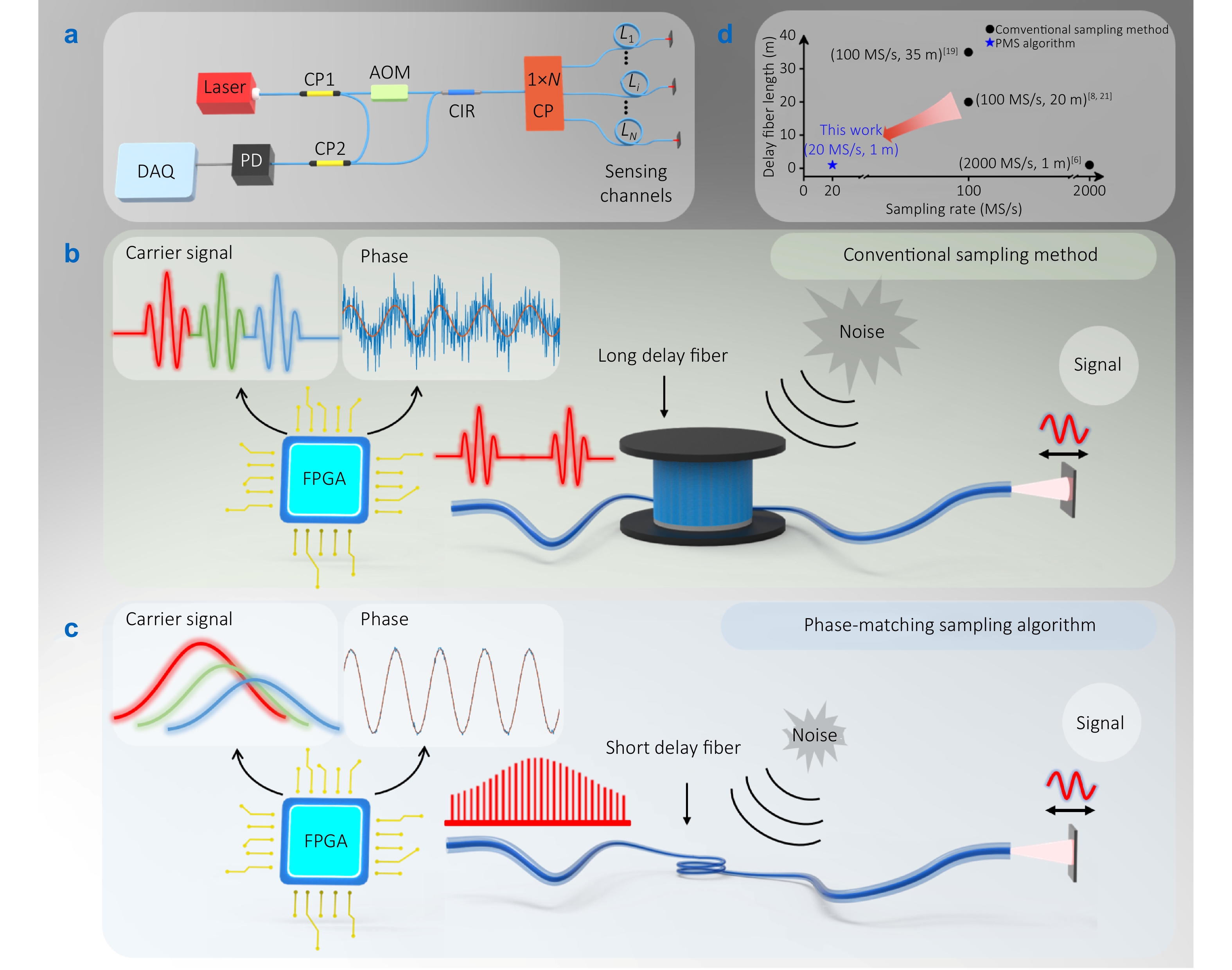
Time division multiplexing (TDM) architecture is an important approach to creating sensor arrays for massive scale monitoring. But it is paradoxical for the TDM interferometric sensor array to keep a short delay fiber for high sensing resolution and meanwhile use low sampling rate for practical applications.
In this paper, a phase matching sampling (PMS) paradigm is proposed to address the above contradiction. By matching the phase of the sampling clock with the delay fiber length, combining with multiple-pulses sampling strategy, the proposed PMS method can avoid collecting the redundant information, facilitating the decreasing of sampling rate as well as delay fiber length of the TDM sensing system.
The proof-of-concept experiments on an 8-channel TDM interferometric system demonstrate that when the sampling rate is fixed at 20 MS/s, by applying the PMS algorithm, the delay fiber length can be shortened from 100 m to 1 m, compared with applying the conventional sampling method. It reduced the phase noise of the system by a factor of 10 at 1 mHz and by a factor of 50 at 1 Hz. The PMS algorithm for greatly reducing the sampling rate is expected to fuel the TDM interferometric sensor arrays for many applications.
Ultrafast all-optical modulation of wide-bandwidth pulses enabled by silicon-metasurfaces
Kaloyan Georgiev, Khosro Zangeneh Kamali, Anton A. Trifonov, Giulia Crotti, Lyuben Petrov, Stefan Georgiev, Hristo Iliev, Lei Xu, Unai Arregui Leon, Mohsen Rahmani, Giuseppe Della Valle, Ivan Buchvarov, Dragomir Neshev
Opto-Electronic Advances
2026-09-15
Physics-informed neural fields enable blind aberration correction for partially coherent quantitative phase imaging
Shun Zhou, Xingyu Huang, Linpeng Lu, Habib Ullah, Kaiyu Du, Maciej Trusiak, Malgorzata Kujawinska, Yuzhen Zhang, Yao Fan, Qian Chen, Qinrong Zhang, Chao Zuo
Opto-Electronic Science
2026-08-26
Heterogeneously integrated micro-ring with SnS₂ for dual-functional optical modulation and photodetection
Jinyi Du, Lidan Lu, Xu Zhang, Bofei Zhu, Wenbo Bo, Yingjie Xu, Guang Chen, Yanlin He, Guanghui Ren, Xiaoping Lou, Zheng You, Lianqing Zhu
Opto-Electronic Advances
2026-08-25
Hardware-aware lightweight photonic spiking neural network for pattern classification
Shuiying Xiang, Yahui Zhang, Shangxuan Shi, Haowen Zhao, Dianzhuang Zheng, Xingxing Guo, Yanan Han, Ye Tian, Liyue Zhang, Yuechun Shi, Yue Hao
Opto-Electronic Advances
2026-08-25
PhyspeNet: An empirical physics-aware network for adaptive speckle reconstructive spectrometry
Junrui Liang, Min Jiang, Jun Li, Zhongming Huang, Junhong He, Yanting Guo, Yanzhao Ke, Jun Ye, Jiangming Xu, Jinyong Leng, Pu Zhou
Opto-Electronic Advances
2026-08-25
A 36 × 240 Gbps hybrid mode/wavelength division multiplexing transmitter using lithium niobate on insulator
Mingyu Zhu, Weihan Wang, Ruitao Ma, Aoyun Gao, Chun Gao, Zexu Wang, Fei Huang, Zhenyuan Bao, Dajian Liu, Jiaxuan Gan, Zejie Yu, Huan Li, Weike Zhao, Daoxin Dai
Opto-Electronic Advances
2026-08-25