(Peer-Reviewed) Seasonal Cumulative Effect of Ural Blocking Episodes on the Frequent Cold events in China during the Early Winter of 2020/21
Yao Yao 姚遥 ¹ ², Wenqi Zhang ¹ ², Dehai Luo 罗德海 ¹ ², Linhao Zhong 钟霖浩 ¹ ², Lin Pei 裴琳 ³
¹ Key Laboratory of Regional Climate-Environment for Temperate East Asia, Institute of Atmospheric Physics, Chinese Academy of Sciences, Beijing, 100029, China
中国 北京 中国科学院大气物理研究所 东亚区域气候-环境重点实验室
² University of Chinese Academy of Sciences, Beijing, 100029, China
中国 北京 中国科学院大学
³ Institute of Urban Meteorology, China Meteorological Administration, Beijing, 100029, China
中国 北京 中国气象局 北京城市气象研究所
Abstract
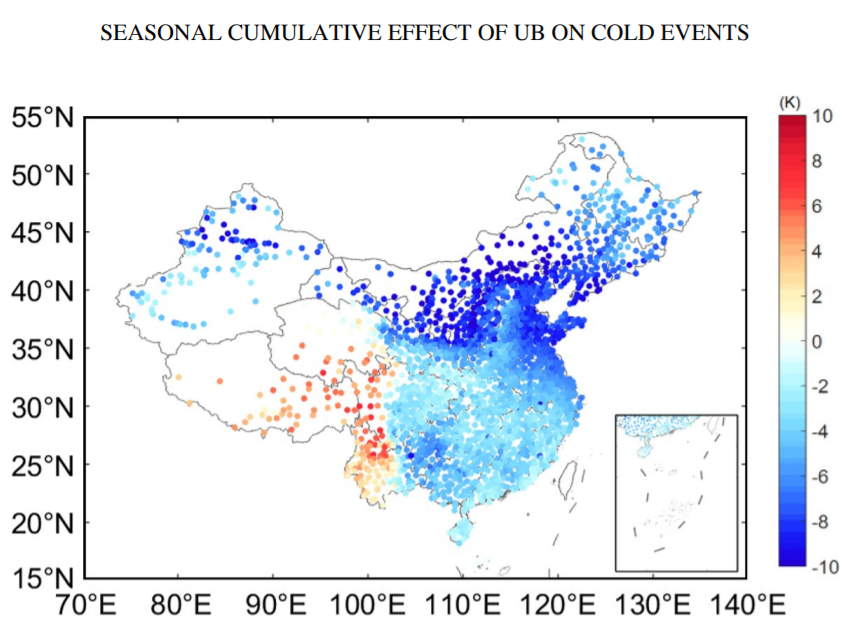
Starting in mid-November, China was hit by several cold events during the early winter of 2020/21. The lowest temperature observed at Beijing station on 7 January reached −19.6°C. In this paper, we show that the outbreak of the record-breaking extreme cold event can be attributed to a huge merging Ural blocking (UB) ridge over the Eurasian region.
The sea-ice cover in the Kara and East Siberia Seas (KESS) in autumn was at its lowest value since 1979, which could have served as a precursor signal. Further analysis shows that several successive UB episodes occurred from 1 September 2020 to 10 January 2021. The persistent UB that occurred in late September/early October 2020 may have made an important contribution to the October historical minimum of sea ice in the KESS region.
Our results also show that, after each UB episode in winter, significant upward propagation of wave activity occurred around 60°E, which resulted in weakening the stratospheric vortex. Meanwhile, each UB episode also caused a significant reduction in sea-ice extent in KESS and a significant weakening of the westerly jet in mid-high-latitude Eurasia.
Results suggest that the Arctic vortex, which is supposed to enhance seasonally, became weaker and more unstable than the climatic mean under the seasonal cumulative effects of UB episodes, KESS warming, and long-lasting negative-phase North Atlantic Oscillation (NAO-). Those seasonal cumulative effects, combined with the impact of La Niña winter, led to the frequent occurrence of extreme cold events.
Unlocking home-based nocturnal health management: A fiber-optic approach for early detection of cardiorespiratory rhythm disorders
Hanyu Jin, Hao Li, Zhuolin Chen, Liangye Li, Zurui Wang, Kai Zhou, Weijian Hang, Zhipeng Chen, Junfeng Chen, Kai Shen, Jianfeng Wen, Chen Chen, Cunzheng Fan, Zhijun Yan, Feng Wang, Qizhen Sun
Opto-Electronic Advances
2026-07-10
A flexible wireless system for prospective photodynamic therapy applications
Rolan Mansour, Bhavani Yalagala, Vikas Vikas, Nikolas Bruce, Fawziye Tarhini, Georgios N. Arvanitakis, Mohammed Mughal, Jamie Blanche, Ahmad Taha, Jonathan Copper, Muhammad Imran, Karin Williams, Karin Oien, Mahmoud Wagih, Hadi Heidari, Robert Hadfield, David Flynn
Opto-Electronic Advances
2026-07-10
Parallel bright-field and multi-order edge imaging via wide field-of-view trichannel metalens
Xiaotong Li, Yeseul Kim, Youngsun Jeon, Junhwa Seong, Jaekyung Kim, Peng Tang, Shiqi Hu, Harit Keawmuang, Beomha Yang, Dongmin Jeon, Le Dai, Weiyan Li, Xiaodong Cai, Jinhui Shi, Yong-Sang Ryu, Trevon Badloe, Junsuk Rho
Opto-Electronic Advances
2026-07-10