(Preprint) Dating the First Case of COVID-19 Epidemic from a Probabilistic Perspective
Zhouwang Yang 杨周旺 ¹, Yunhe Hu 胡云鹤 ¹, Zhiwei Ding 丁志伟 ¹, Tiande Guo 郭田德 ²
¹ University of Science and Technology of China
中国科学技术大学
² University of Chinese Academy of Sciences
中国科学院大学
ChinaXiv, 2021-09-22
Abstract
In the early days of the epidemic of coronavirus disease 2019 (COVID-19), due to insufficient
knowledge of the pandemic, inadequate nucleic acid tests, lack of timely data reporting, etc., the origin time of the onset of COVID-19 is difficult to determine. Therefore, source tracing is crucial for infectious disease prevention and control. The purpose of this paper is to infer the origin time of pandemic of COVID-19 based on a data and model hybrid driven method.
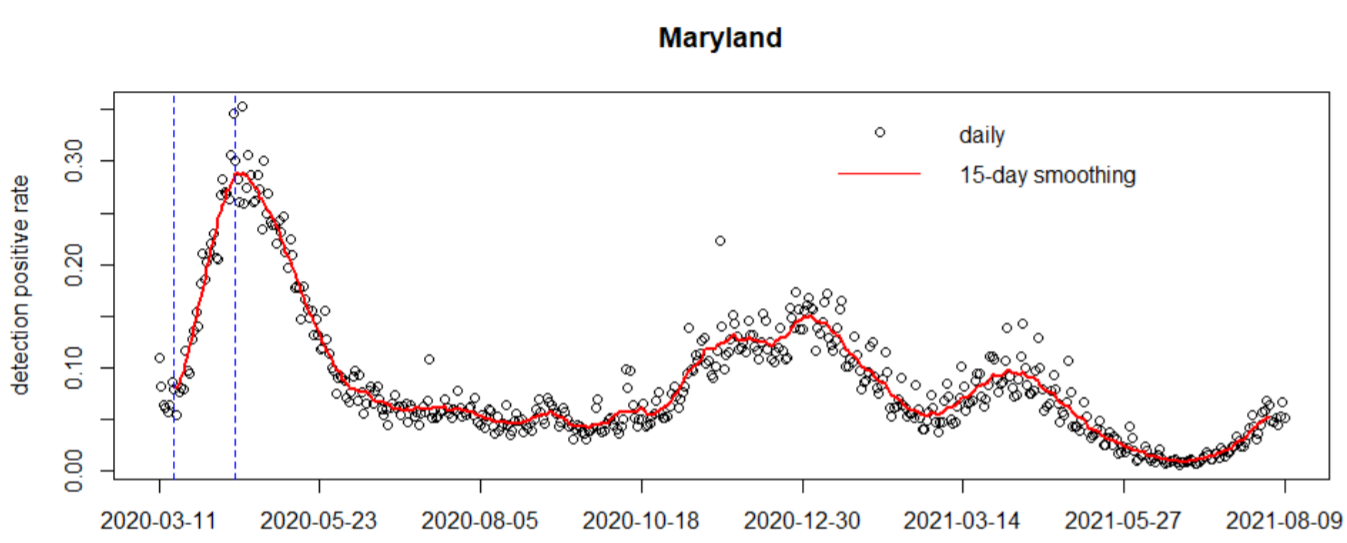
We model the testing positive rate to fit its actual trend, and use the least squares estimation toobtain the optimal model parameters. Further, the kernel density estimation is applied to infer the origin time of pandemic given the specific confidence probability.
By selecting 12 representative regions in the United States for analysis, the dates of the first
infected case with 50% confidence probability are mostly between August and October 2019, which are earlier than the officially announced date of the first confirmed case in the United States on January 20, 2020. The experimental results indicate that the COVID-19 pandemic in the United States starts to spread around September 2019 with a high confidence probability.
In addition, the existing confirmed cases are also used in Wuhan City and Zhejiang Province in China to infer the origin time of COVID-19 and provide the confidence probability. The results show that the spread of COVID-19 pandemic in China is likely to begin in late December 2019.
Ultrafast all-optical modulation of wide-bandwidth pulses enabled by silicon-metasurfaces
Kaloyan Georgiev, Khosro Zangeneh Kamali, Anton A. Trifonov, Giulia Crotti, Lyuben Petrov, Stefan Georgiev, Hristo Iliev, Lei Xu, Unai Arregui Leon, Mohsen Rahmani, Giuseppe Della Valle, Ivan Buchvarov, Dragomir Neshev
Opto-Electronic Advances
2026-09-15
Physics-informed neural fields enable blind aberration correction for partially coherent quantitative phase imaging
Shun Zhou, Xingyu Huang, Linpeng Lu, Habib Ullah, Kaiyu Du, Maciej Trusiak, Malgorzata Kujawinska, Yuzhen Zhang, Yao Fan, Qian Chen, Qinrong Zhang, Chao Zuo
Opto-Electronic Science
2026-08-26
Heterogeneously integrated micro-ring with SnS₂ for dual-functional optical modulation and photodetection
Jinyi Du, Lidan Lu, Xu Zhang, Bofei Zhu, Wenbo Bo, Yingjie Xu, Guang Chen, Yanlin He, Guanghui Ren, Xiaoping Lou, Zheng You, Lianqing Zhu
Opto-Electronic Advances
2026-08-25
Hardware-aware lightweight photonic spiking neural network for pattern classification
Shuiying Xiang, Yahui Zhang, Shangxuan Shi, Haowen Zhao, Dianzhuang Zheng, Xingxing Guo, Yanan Han, Ye Tian, Liyue Zhang, Yuechun Shi, Yue Hao
Opto-Electronic Advances
2026-08-25
PhyspeNet: An empirical physics-aware network for adaptive speckle reconstructive spectrometry
Junrui Liang, Min Jiang, Jun Li, Zhongming Huang, Junhong He, Yanting Guo, Yanzhao Ke, Jun Ye, Jiangming Xu, Jinyong Leng, Pu Zhou
Opto-Electronic Advances
2026-08-25
A 36 × 240 Gbps hybrid mode/wavelength division multiplexing transmitter using lithium niobate on insulator
Mingyu Zhu, Weihan Wang, Ruitao Ma, Aoyun Gao, Chun Gao, Zexu Wang, Fei Huang, Zhenyuan Bao, Dajian Liu, Jiaxuan Gan, Zejie Yu, Huan Li, Weike Zhao, Daoxin Dai
Opto-Electronic Advances
2026-08-25