(Peer-Reviewed) Finely regulated luminescent Ag-In-Ga-S quantum dots with green-red dual emission toward white light-emitting diodes
Zhi Wu 吴智, Leimeng Xu 许蕾梦, Jindi Wang 王金迪, Jizhong Song 宋继中
Key Laboratory of Materials Physics of Ministry of Education, Laboratory of Zhongyuan Light, School of Physics, Zhengzhou University, Daxue Road 75, Zhengzhou 450052, China
中国 郑州 郑州大学物理学院 中原之光实验室 材料物理教育部重点实验室
Opto-Electronic Advances, 2024-09-18
Abstract
Ag-In-Ga-S (AIGS) quantum dots (QDs) have recently attracted great interests due to the outstanding optical properties and eco-friendly components, which are considered as an alternative replacement for toxic Pb- and Cd-based QDs. However, enormous attention has been paid to how to narrow their broadband spectra, ignoring the application advantages of the broadband emission.
In this work, the AIGS QDs with controllable broad green-red dual-emission are first reported, which is achieved through adjusting the size distribution of QDs by controlling the nucleation and growth of AIGS crystals. Resultantly, the AIGS QDs exhibit broad dual-emission at green- and red- band evidenced by photoluminescence (PL) spectra, and the PL relative intensity and peak position can be finely adjusted.
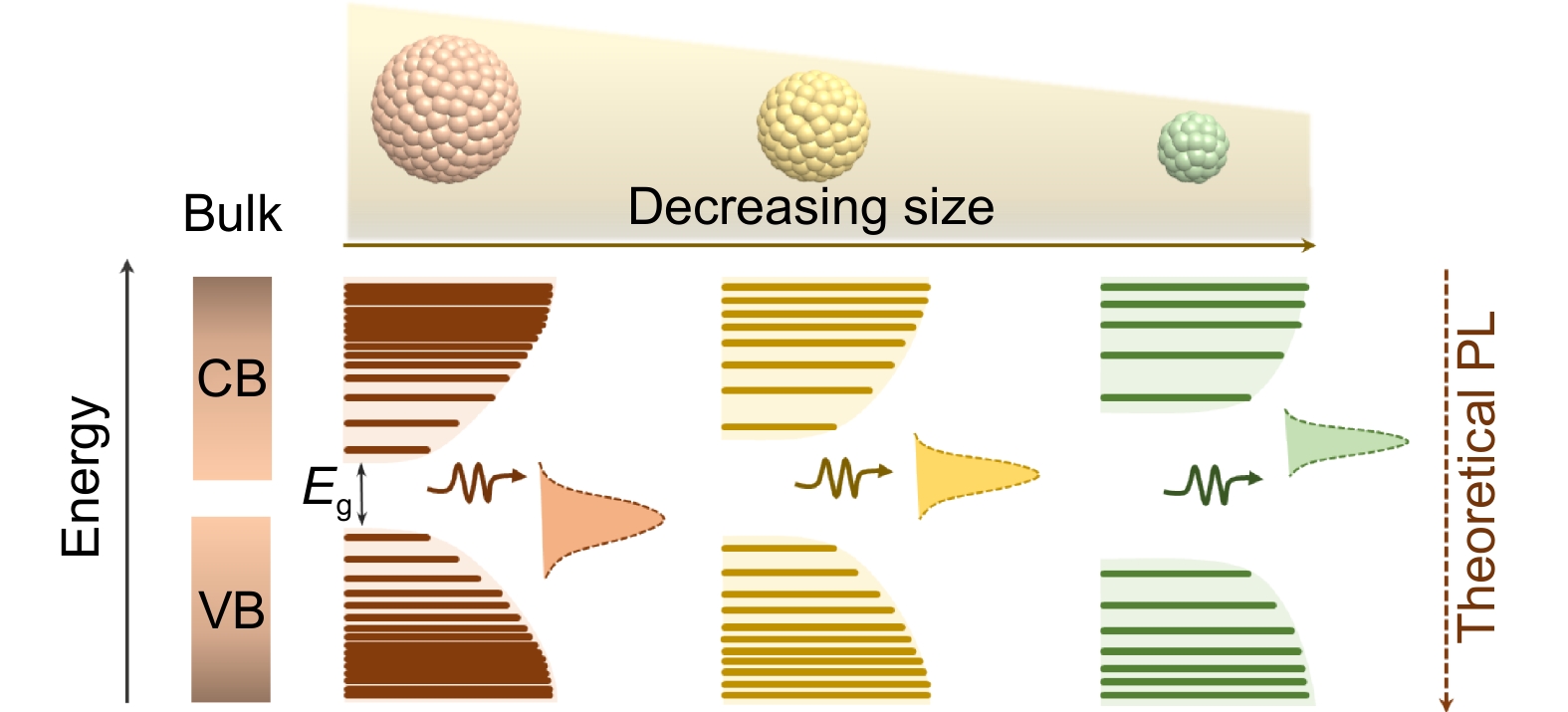
Furthermore, the dual-emission is the intrinsic characteristics from the difference in confinement effect of large particles and tiny particles confirmed by temperature-dependent PL spectra. Accordingly, the AIGS QDs (the size consists of 17 nm and 3.7 nm) with 530 nm and 630 nm emission could successfully be synthesized at 220 °C.
By combining the blue light-emitting diode (LED) chips and dual-emission AIGS QDs, the constructed white light-emitting devices (WLEDs) exhibit a continuous and broad spectrum like natural sunlight with the Commission Internationale de l’Eclairage (CIE) chromaticity coordinates of (0.33, 0.31), a correlated color temperature (CCT) of 5425 K, color rendering index (CRI) of 90, and luminous efficacy of radiation (LER) of 129 lm/W, which indicates that the AIGS QDs have huge potential for lighting applications.
Electrically switchable bright-field and interference-synthesized edge-enhanced imaging with a polarization-multiplexed metalens
Xiaotong Li, Junhwa Seong, Yeseul Kim, Kwang-Suk Oh, Shiqi Hu, Le Dai, Harit Keawmuang, Beomha Yang, Minseok Choi, Youngsun Jeon, Cherry Park, Weiyan Li, Tianxu Jia, Han Zhu, Xiaodong Cai, Qi Zheng, Jinhui Shi, Young-Ki Kim, Yuchuan Shao, Trevon Badloe, Junsuk Rho
Opto-Electronic Science
2026-09-20
3D-printed copper water cooling system assisted fabrication of 10.6-μm high-power CO₂ laser resistance reflectors
Hongfei Jiao, Binbin Jiang, Xinshang Niu, Yifan Wang, Dongdong Li, Jun Yu, Xiaochuan Ji, Jingjing Xia, Jinlong Zhang, Xinbin Cheng, Zhanshan Wang
Opto-Electronic Advances
2026-09-15
Ultrafast all-optical modulation of wide-bandwidth pulses enabled by silicon-metasurfaces
Kaloyan Georgiev, Khosro Zangeneh Kamali, Anton A. Trifonov, Giulia Crotti, Lyuben Petrov, Stefan Georgiev, Hristo Iliev, Lei Xu, Unai Arregui Leon, Mohsen Rahmani, Giuseppe Della Valle, Ivan Buchvarov, Dragomir Neshev
Opto-Electronic Advances
2026-09-15
Physics-informed neural fields enable blind aberration correction for partially coherent quantitative phase imaging
Shun Zhou, Xingyu Huang, Linpeng Lu, Habib Ullah, Kaiyu Du, Maciej Trusiak, Malgorzata Kujawinska, Yuzhen Zhang, Yao Fan, Qian Chen, Qinrong Zhang, Chao Zuo
Opto-Electronic Science
2026-08-26