(Peer-Reviewed) Multi-prior physics-enhanced neural network enables pixel super-resolution and twin-image-free phase retrieval from single-shot hologram
Xuan Tian 田璇 ¹ ², Runze Li 李润泽 ¹, Tong Peng 彭彤 ¹, Yuge Xue 薛雨阁 ¹ ², Junwei Min 闵俊伟 ¹, Xing Li 栗星 ¹, Chen Bai 柏晨 ¹ ², Baoli Yao 姚保利 ¹ ²
¹ State Key Laboratory of Transient Optics and Photonics, Xi’an Institute of Optics and Precision Mechanics, Chinese Academy of Sciences, Xi'an 710119, China
中国 西安 中国科学院西安光学精密机械研究所 瞬态光学与光子技术国家重点实验室
² University of Chinese Academy of Sciences, Beijing 100049, China
中国 北京 中国科学院大学
Opto-Electronic Advances, 2024-08-28
Abstract
Digital in-line holographic microscopy (DIHM) is a widely used interference technique for real-time reconstruction of living cells’ morphological information with large space-bandwidth product and compact setup. However, the need for a larger pixel size of detector to improve imaging photosensitivity, field-of-view, and signal-to-noise ratio often leads to the loss of sub-pixel information and limited pixel resolution.
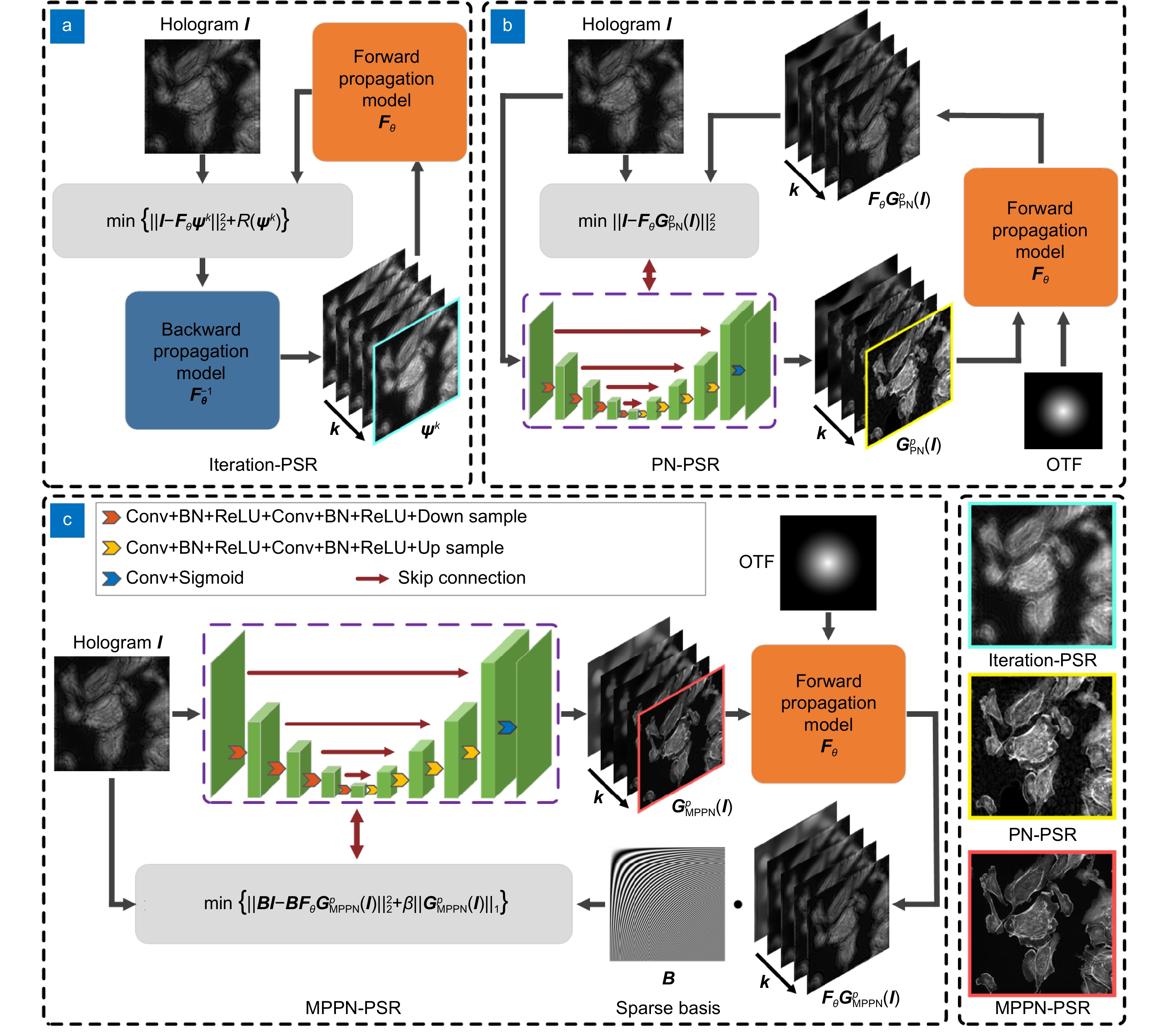
Additionally, the twin-image appearing in the reconstruction severely degrades the quality of the reconstructed image. The deep learning (DL) approach has emerged as a powerful tool for phase retrieval in DIHM, effectively addressing these challenges. However, most DL-based strategies are data-driven or end-to-end net approaches, suffering from excessive data dependency and limited generalization ability. Herein, a novel multi-prior physics-enhanced neural network with pixel super-resolution (MPPN-PSR) for phase retrieval of DIHM is proposed. It encapsulates the physical model prior, sparsity prior and deep image prior in an untrained deep neural network.
The effectiveness and feasibility of MPPN-PSR are demonstrated by comparing it with other traditional and learning-based phase retrieval methods. With the capabilities of pixel super-resolution, twin-image elimination and high-throughput jointly from a single-shot intensity measurement, the proposed DIHM approach is expected to be widely adopted in biomedical workflow and industrial measurement.
Ultrafast all-optical modulation of wide-bandwidth pulses enabled by silicon-metasurfaces
Kaloyan Georgiev, Khosro Zangeneh Kamali, Anton A. Trifonov, Giulia Crotti, Lyuben Petrov, Stefan Georgiev, Hristo Iliev, Lei Xu, Unai Arregui Leon, Mohsen Rahmani, Giuseppe Della Valle, Ivan Buchvarov, Dragomir Neshev
Opto-Electronic Advances
2026-09-15
Physics-informed neural fields enable blind aberration correction for partially coherent quantitative phase imaging
Shun Zhou, Xingyu Huang, Linpeng Lu, Habib Ullah, Kaiyu Du, Maciej Trusiak, Malgorzata Kujawinska, Yuzhen Zhang, Yao Fan, Qian Chen, Qinrong Zhang, Chao Zuo
Opto-Electronic Science
2026-08-26
Heterogeneously integrated micro-ring with SnS₂ for dual-functional optical modulation and photodetection
Jinyi Du, Lidan Lu, Xu Zhang, Bofei Zhu, Wenbo Bo, Yingjie Xu, Guang Chen, Yanlin He, Guanghui Ren, Xiaoping Lou, Zheng You, Lianqing Zhu
Opto-Electronic Advances
2026-08-25
Hardware-aware lightweight photonic spiking neural network for pattern classification
Shuiying Xiang, Yahui Zhang, Shangxuan Shi, Haowen Zhao, Dianzhuang Zheng, Xingxing Guo, Yanan Han, Ye Tian, Liyue Zhang, Yuechun Shi, Yue Hao
Opto-Electronic Advances
2026-08-25
PhyspeNet: An empirical physics-aware network for adaptive speckle reconstructive spectrometry
Junrui Liang, Min Jiang, Jun Li, Zhongming Huang, Junhong He, Yanting Guo, Yanzhao Ke, Jun Ye, Jiangming Xu, Jinyong Leng, Pu Zhou
Opto-Electronic Advances
2026-08-25
A 36 × 240 Gbps hybrid mode/wavelength division multiplexing transmitter using lithium niobate on insulator
Mingyu Zhu, Weihan Wang, Ruitao Ma, Aoyun Gao, Chun Gao, Zexu Wang, Fei Huang, Zhenyuan Bao, Dajian Liu, Jiaxuan Gan, Zejie Yu, Huan Li, Weike Zhao, Daoxin Dai
Opto-Electronic Advances
2026-08-25