(Preprint) Context-aware Telco Outdoor Localization
Yige Zhang 张奕格 ¹, Weixiong Rao 饶卫雄 ¹, Mingxuan Yuan 袁明轩 ², Jia Zeng 曾嘉 ², Pan Hui 许彬 ³ ⁴
¹ School of Software Engineering, Tongji University, Shanghai, China
中国 上海 同济大学软件学院
² Huawei Noahs Ark Lab, Hong Kong
香港 华为诺亚方舟实验室
³ Department of Computer Science and Engineering, Hong Kong University of Science and Technology
香港科技大学计算机科学与工程系
⁴ Department of Computer Science, University of Helsinki
arXiv, 2021-08-24
Abstract
Recent years have witnessed the fast growth in telecommunication (Telco) techniques from 2G to upcoming 5G. Precise outdoor localization is important for Telco operators to manage, operate and optimize Telco networks. Differing from GPS, Telco localization is a technique employed by Telco operators to localize outdoor mobile devices by using measurement report (MR) data. When given MR samples containing noisy signals (e.g., caused by Telco signal interference and attenuation), Telco localization often suffers from high errors.
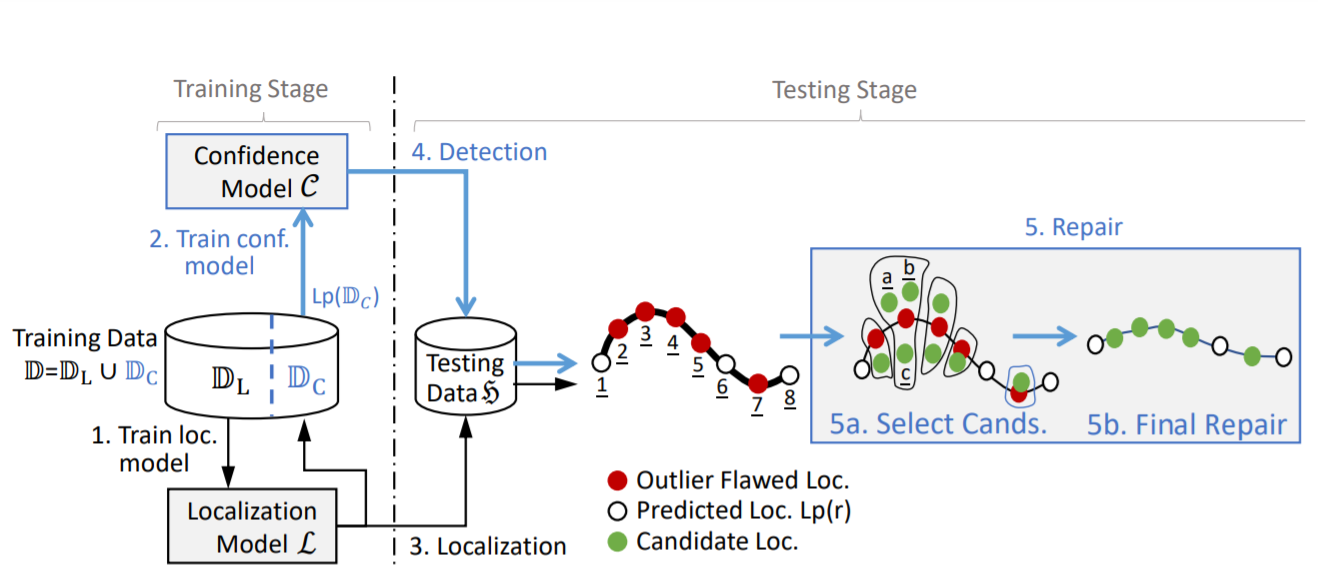
To this end, the main focus of this paper is how to improve Telco localization accuracy via the algorithms to detect and repair outlier positions with high errors. Specifically, we propose a context-aware Telco localization technique, namely RLoc, which consists of three main components: a machine-learning-based localization algorithm, a detection algorithm to find flawed samples, and a repair algorithm to replace outlier localization results by better ones (ideally ground truth positions).
Unlike most existing works to detect and repair every flawed MR sample independently, we instead take into account spatio-temporal locality of MR locations and exploit trajectory context to detect and repair flawed positions. Our experiments on the real MR data sets from 2G GSM and 4G LTE Telco networks verify that our work RLoc can greatly improve Telco location accuracy. For example, RLoc on a large 4G MR data set can achieve 32.2 meters of median errors, around 17.4% better than state-of-the-art.
Ultrafast all-optical modulation of wide-bandwidth pulses enabled by silicon-metasurfaces
Kaloyan Georgiev, Khosro Zangeneh Kamali, Anton A. Trifonov, Giulia Crotti, Lyuben Petrov, Stefan Georgiev, Hristo Iliev, Lei Xu, Unai Arregui Leon, Mohsen Rahmani, Giuseppe Della Valle, Ivan Buchvarov, Dragomir Neshev
Opto-Electronic Advances
2026-09-15
Physics-informed neural fields enable blind aberration correction for partially coherent quantitative phase imaging
Shun Zhou, Xingyu Huang, Linpeng Lu, Habib Ullah, Kaiyu Du, Maciej Trusiak, Malgorzata Kujawinska, Yuzhen Zhang, Yao Fan, Qian Chen, Qinrong Zhang, Chao Zuo
Opto-Electronic Science
2026-08-26
Heterogeneously integrated micro-ring with SnS₂ for dual-functional optical modulation and photodetection
Jinyi Du, Lidan Lu, Xu Zhang, Bofei Zhu, Wenbo Bo, Yingjie Xu, Guang Chen, Yanlin He, Guanghui Ren, Xiaoping Lou, Zheng You, Lianqing Zhu
Opto-Electronic Advances
2026-08-25
Hardware-aware lightweight photonic spiking neural network for pattern classification
Shuiying Xiang, Yahui Zhang, Shangxuan Shi, Haowen Zhao, Dianzhuang Zheng, Xingxing Guo, Yanan Han, Ye Tian, Liyue Zhang, Yuechun Shi, Yue Hao
Opto-Electronic Advances
2026-08-25
PhyspeNet: An empirical physics-aware network for adaptive speckle reconstructive spectrometry
Junrui Liang, Min Jiang, Jun Li, Zhongming Huang, Junhong He, Yanting Guo, Yanzhao Ke, Jun Ye, Jiangming Xu, Jinyong Leng, Pu Zhou
Opto-Electronic Advances
2026-08-25
A 36 × 240 Gbps hybrid mode/wavelength division multiplexing transmitter using lithium niobate on insulator
Mingyu Zhu, Weihan Wang, Ruitao Ma, Aoyun Gao, Chun Gao, Zexu Wang, Fei Huang, Zhenyuan Bao, Dajian Liu, Jiaxuan Gan, Zejie Yu, Huan Li, Weike Zhao, Daoxin Dai
Opto-Electronic Advances
2026-08-25