(Peer-Reviewed) Ultra-high resolution strain sensor network assisted with an LS-SVM based hysteresis model
Tao Liu 刘涛, Hao Li 李豪, Tao He 贺韬, Cunzheng Fan 范存政, Zhijun Yan 闫志君, Deming Liu 刘德明, Qizhen Sun 孙琪真
School of Optical and Electronic Information and Wuhan National Laboratory for Optoelectronics, Huazhong University of Science and Technology, Wuhan 430074, China
中国 武汉 华中科技大学光学与电子信息学院 武汉光电国家实验室
Opto-Electronic Advances, 2021-05-20
Abstract
Optical fiber sensor network has attracted considerable research interests for geoscience applications. However, the sensor capacity and ultra-low frequency noise limits the sensing performance for geoscience data acquisition.
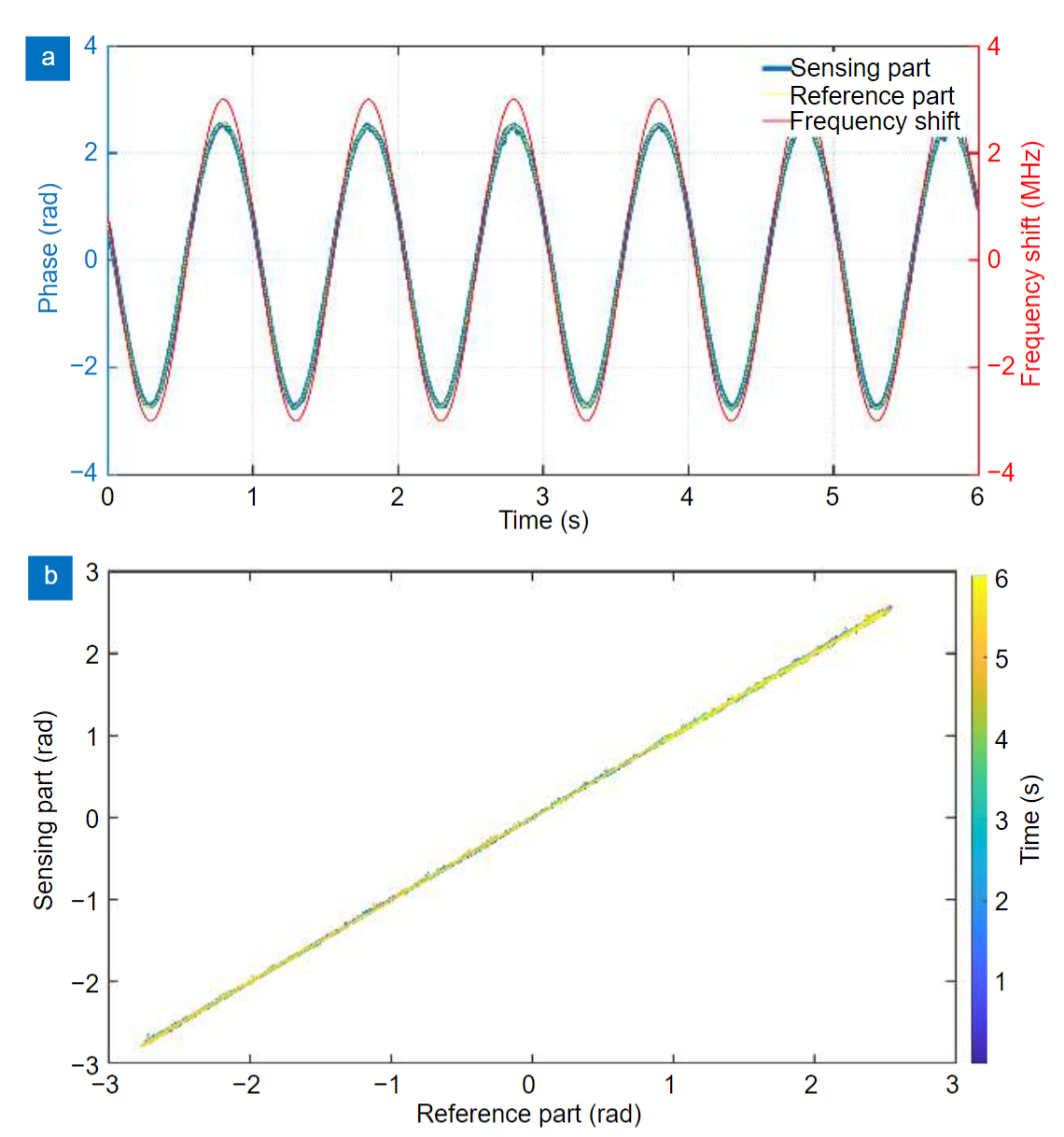
To achieve a high-resolution and lager sensing capacity, a strain sensor network is proposed based on phase-sensitive optical time domain reflectometer (φ-OTDR) technology and special packaged fiber with scatter enhanced points (SEPs) array. Specifically, an extra identical fiber with SEPs array which is free of strain is used as the reference fiber, for compensating the ultra-low frequency noise in the φ-OTDR system induced by laser source frequency shift and environment temperature change. Moreover, a hysteresis operator based least square support vector machine (LS-SVM) model is introduced to reduce the compensation residual error generated from the thermal hysteresis nonlinearity between the sensing fiber and reference fiber.
In the experiment, the strain sensor network possesses a sensing capacity with 55 sensor elements. The phase bias drift with frequency below 0.1 Hz is effectively compensated by LS-SVM based hysteresis model, and the signal to noise ratio (SNR) of a strain vibration at 0.01 Hz greatly increases by 24 dB compared to that of the sensing fiber for direct compensation. The proposed strain sensor network proves a high dynamic resolution of 10.5 pε·Hz-1/2 above 10 Hz, and ultra-low frequency sensing resolution of 166 pε at 0.001 Hz.
It is the first reported a large sensing capacity strain sensor network with sub-nε sensing resolution in mHz frequency range, to the best of our knowledge.
Unlocking home-based nocturnal health management: A fiber-optic approach for early detection of cardiorespiratory rhythm disorders
Hanyu Jin, Hao Li, Zhuolin Chen, Liangye Li, Zurui Wang, Kai Zhou, Weijian Hang, Zhipeng Chen, Junfeng Chen, Kai Shen, Jianfeng Wen, Chen Chen, Cunzheng Fan, Zhijun Yan, Feng Wang, Qizhen Sun
Opto-Electronic Advances
2026-07-10
A flexible wireless system for prospective photodynamic therapy applications
Rolan Mansour, Bhavani Yalagala, Vikas Vikas, Nikolas Bruce, Fawziye Tarhini, Georgios N. Arvanitakis, Mohammed Mughal, Jamie Blanche, Ahmad Taha, Jonathan Copper, Muhammad Imran, Karin Williams, Karin Oien, Mahmoud Wagih, Hadi Heidari, Robert Hadfield, David Flynn
Opto-Electronic Advances
2026-07-10
Parallel bright-field and multi-order edge imaging via wide field-of-view trichannel metalens
Xiaotong Li, Yeseul Kim, Youngsun Jeon, Junhwa Seong, Jaekyung Kim, Peng Tang, Shiqi Hu, Harit Keawmuang, Beomha Yang, Dongmin Jeon, Le Dai, Weiyan Li, Xiaodong Cai, Jinhui Shi, Yong-Sang Ryu, Trevon Badloe, Junsuk Rho
Opto-Electronic Advances
2026-07-10