(Peer-Reviewed) Significant influence of self-possessed moisture of limonitic nickel laterite on sintering performance and its action mechanism
Yu-xiao Xue 薛钰霄 ¹, De-qing Zhu 朱德庆 ¹, Jian Pan 潘建 ¹, Zheng-qi Guo 郭正启 ¹, Hong-yu Tian 田宏宇 ¹, Gen Li 李根 ¹, Qing-zhou Huang 黄庆周 ², Liao-ting Pan 潘料庭 ², Xue-zhong Huang 黄学忠 ²
¹ School of Minerals Processing and Bioengineering, Central South University, Changsha, 410083, Hunan, China
中国 湖南 长沙 中南大学资源加工与生物工程学院
² Guangxi Beibu Gulf New Material Co., Ltd., Beihai, 536000, Guangxi, China
中国 广西 北海 广西北港新材料有限公司
Abstract
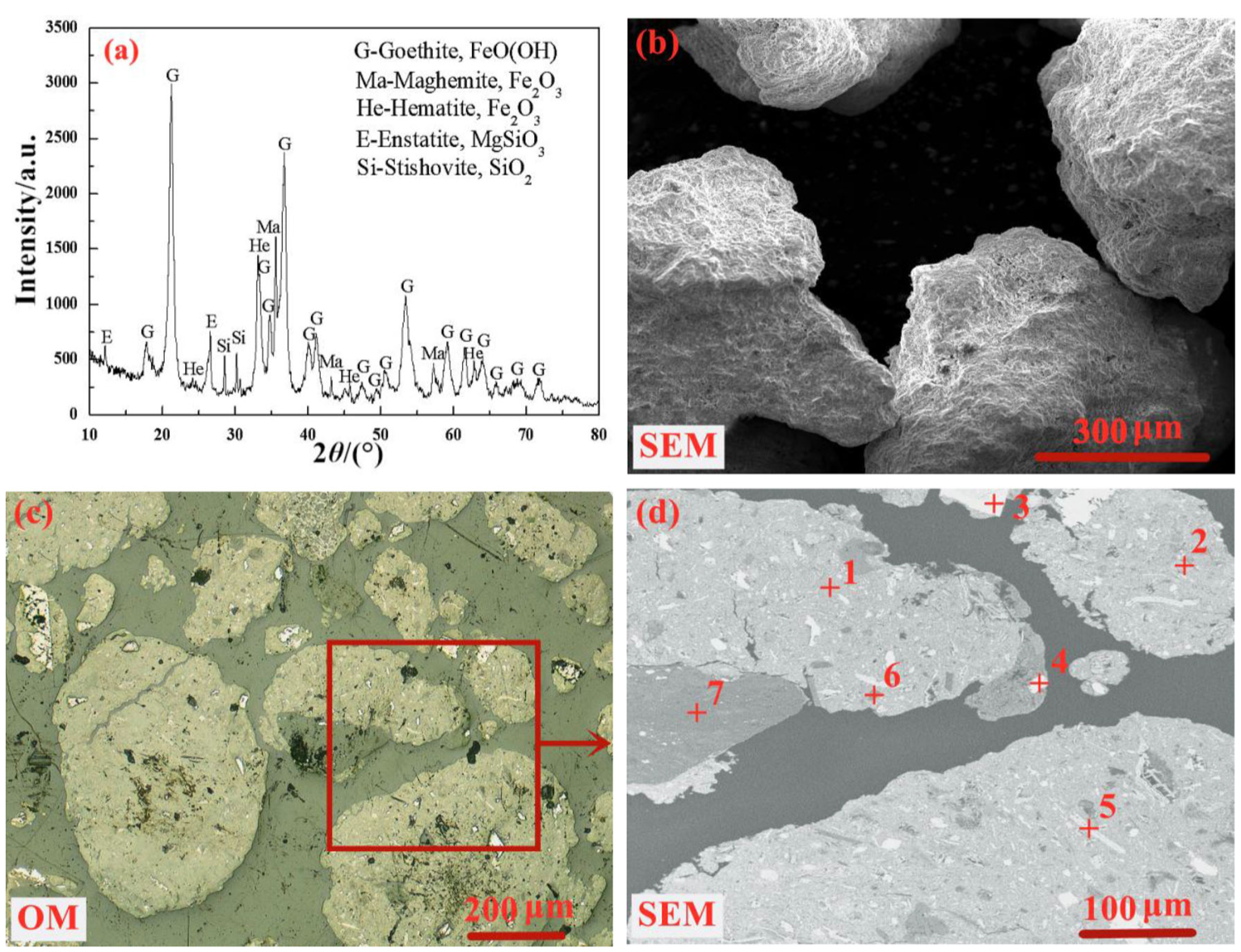
In consideration of the abundant moisture of limonitic nickel laterite mined, it is essential to determine whether the self-possessed moisture of limonitic nickel laterite after pre-dried is appropriate for sintering. Thus, based on the characterization of limonitic nickel laterite, the influence of its self-possessed moisture on sintering performance was expounded by sinter pot tests and the relevant mechanism was revealed by the systematical analyses of the granulation properties of sinter mixture, thermodynamic conditions during sintering and mineralogy of product sinter.
The results indicate that the self-possessed moisture of limonitic nickel laterite indeed has significant influence on its sintering performance. At the optimum self-possessed moisture of 21 mass%, sinter indices are relatively better with tumble index, productivity and solid fuel rate of 48.87%, 1.04 t m−2 h−1 and 136.52 kg t−1, respectively, due to the superior granulation properties of sinter mixture and thermodynamic conditions during sintering, relatively large amount of silico-ferrite of calcium and alumina and tighter sinter microstructure.
However, sintering performance of limonitic nickel laterite is still much poorer than that of ordinary iron ores. It is feasible to strengthen limonitic nickel laterite sintering by inhibiting the over-fast sintering speed and improving the thermodynamic conditions during sintering.
Electrically switchable bright-field and interference-synthesized edge-enhanced imaging with a polarization-multiplexed metalens
Xiaotong Li, Junhwa Seong, Yeseul Kim, Kwang-Suk Oh, Shiqi Hu, Le Dai, Harit Keawmuang, Beomha Yang, Minseok Choi, Youngsun Jeon, Cherry Park, Weiyan Li, Tianxu Jia, Han Zhu, Xiaodong Cai, Qi Zheng, Jinhui Shi, Young-Ki Kim, Yuchuan Shao, Trevon Badloe, Junsuk Rho
Opto-Electronic Science
2026-09-20
3D-printed copper water cooling system assisted fabrication of 10.6-μm high-power CO₂ laser resistance reflectors
Hongfei Jiao, Binbin Jiang, Xinshang Niu, Yifan Wang, Dongdong Li, Jun Yu, Xiaochuan Ji, Jingjing Xia, Jinlong Zhang, Xinbin Cheng, Zhanshan Wang
Opto-Electronic Advances
2026-09-15
Ultrafast all-optical modulation of wide-bandwidth pulses enabled by silicon-metasurfaces
Kaloyan Georgiev, Khosro Zangeneh Kamali, Anton A. Trifonov, Giulia Crotti, Lyuben Petrov, Stefan Georgiev, Hristo Iliev, Lei Xu, Unai Arregui Leon, Mohsen Rahmani, Giuseppe Della Valle, Ivan Buchvarov, Dragomir Neshev
Opto-Electronic Advances
2026-09-15
Physics-informed neural fields enable blind aberration correction for partially coherent quantitative phase imaging
Shun Zhou, Xingyu Huang, Linpeng Lu, Habib Ullah, Kaiyu Du, Maciej Trusiak, Malgorzata Kujawinska, Yuzhen Zhang, Yao Fan, Qian Chen, Qinrong Zhang, Chao Zuo
Opto-Electronic Science
2026-08-26