(Peer-Reviewed) A small microring array that performs large complex-valued matrix-vector multiplication
Junwei Cheng 成骏伟 ¹, Yuhe Zhao 赵雨赫 ¹, Wenkai Zhang ¹, Hailong Zhou 周海龙 ¹ ² ³, Dongmei Huang 黄冬梅 ³ ⁴, Qing Zhu ⁵, Yuhao Guo 郭宇昊 ⁵, Bo Xu ⁵, Jianji Dong 董建绩 ¹, Xinliang Zhang 张新亮 ¹
¹ Wuhan National Laboratory for Optoelectronics, School of Optical and Electronic Information, Huazhong University of Science and Technology, Wuhan 430074, China
中国 武汉 华中科技大学光学与电子信息学院 武汉光电国家实验室
² Photonics Research Centre, Department of Electronic and Information Engineering, The Hong Kong Polytechnic University, Hong Kong 999077, China
中国 香港 香港理工大学 电子及资讯工程学系 光子技术研究院
³ The Hong Kong Polytechnic University Shenzhen Research Institute, Shenzhen 518057, China
中国 深圳 香港理工大学深圳研究院
⁴ Photonics Research Centre, Department of Electrical Engineering, The Hong Kong Polytechnic University, Hong Kong 999077, China
中国 香港 香港理工大学 电机工程学系 光子技术研究院
⁵ Institute of Strategic Research, Huawei Technologies, Shenzhen 518129, China
中国 深圳 华为战略研究院
Abstract
As an important computing operation, photonic matrix–vector multiplication is widely used in photonic neutral networks and signal processing. However, conventional incoherent matrix–vector multiplication focuses on real-valued operations, which cannot work well in complex-valued neural networks and discrete Fourier transform.
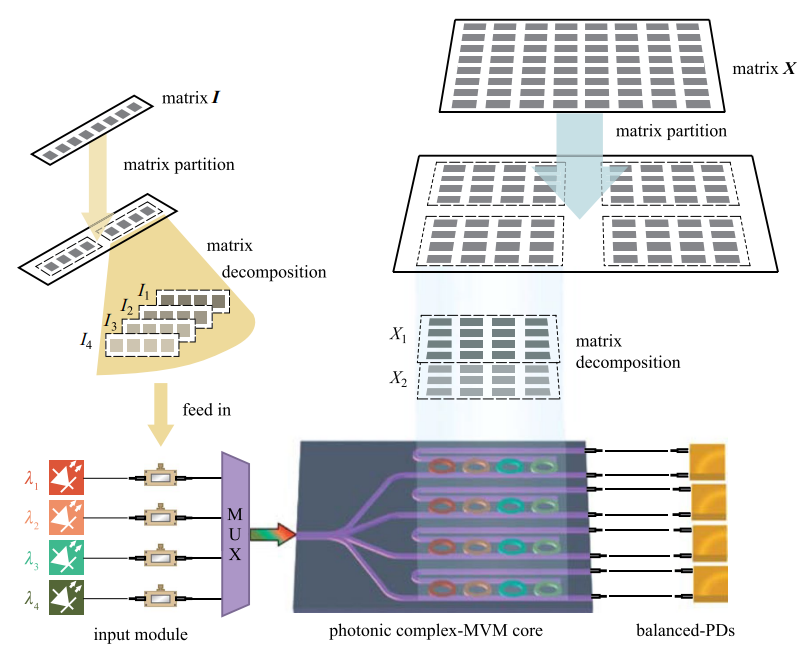
In this paper, we propose a systematic solution to extend the matrix computation of microring arrays from the real-valued field to the complex-valued field, and from small-scale (i.e., 4 × 4) to large-scale matrix computation (i.e., 16 × 16). Combining matrix decomposition and matrix partition, our photonic complex matrix–vector multiplier chip can support arbitrary large-scale and complex-valued matrix computation. We further demonstrate Walsh-Hardmard transform, discrete cosine transform, discrete Fourier transform, and image convolutional processing.
Our scheme provides a path towards breaking the limits of complex-valued computing accelerator in conventional incoherent optical architecture. More importantly, our results reveal that an integrated photonic platform is of huge potential for large-scale, complex-valued, artificial intelligence computing and signal processing.
Ultrafast all-optical modulation of wide-bandwidth pulses enabled by silicon-metasurfaces
Kaloyan Georgiev, Khosro Zangeneh Kamali, Anton A. Trifonov, Giulia Crotti, Lyuben Petrov, Stefan Georgiev, Hristo Iliev, Lei Xu, Unai Arregui Leon, Mohsen Rahmani, Giuseppe Della Valle, Ivan Buchvarov, Dragomir Neshev
Opto-Electronic Advances
2026-09-15
Physics-informed neural fields enable blind aberration correction for partially coherent quantitative phase imaging
Shun Zhou, Xingyu Huang, Linpeng Lu, Habib Ullah, Kaiyu Du, Maciej Trusiak, Malgorzata Kujawinska, Yuzhen Zhang, Yao Fan, Qian Chen, Qinrong Zhang, Chao Zuo
Opto-Electronic Science
2026-08-26
Heterogeneously integrated micro-ring with SnS₂ for dual-functional optical modulation and photodetection
Jinyi Du, Lidan Lu, Xu Zhang, Bofei Zhu, Wenbo Bo, Yingjie Xu, Guang Chen, Yanlin He, Guanghui Ren, Xiaoping Lou, Zheng You, Lianqing Zhu
Opto-Electronic Advances
2026-08-25
Hardware-aware lightweight photonic spiking neural network for pattern classification
Shuiying Xiang, Yahui Zhang, Shangxuan Shi, Haowen Zhao, Dianzhuang Zheng, Xingxing Guo, Yanan Han, Ye Tian, Liyue Zhang, Yuechun Shi, Yue Hao
Opto-Electronic Advances
2026-08-25
PhyspeNet: An empirical physics-aware network for adaptive speckle reconstructive spectrometry
Junrui Liang, Min Jiang, Jun Li, Zhongming Huang, Junhong He, Yanting Guo, Yanzhao Ke, Jun Ye, Jiangming Xu, Jinyong Leng, Pu Zhou
Opto-Electronic Advances
2026-08-25
A 36 × 240 Gbps hybrid mode/wavelength division multiplexing transmitter using lithium niobate on insulator
Mingyu Zhu, Weihan Wang, Ruitao Ma, Aoyun Gao, Chun Gao, Zexu Wang, Fei Huang, Zhenyuan Bao, Dajian Liu, Jiaxuan Gan, Zejie Yu, Huan Li, Weike Zhao, Daoxin Dai
Opto-Electronic Advances
2026-08-25