(Peer-Reviewed) Comprehensive review of distributed acoustic sensing technology: principles, configurations, applications and emerging trends
Arnaldo Leal-Junior ¹ ², Mariana Silveira ¹, Stanislav Kepak ³, Jan Nedoma ³, Radek Martinek ², Carlos Marques ⁴ ⁵
¹ Federal University of Espirito Santo, Fernando Ferrari Avenue, Vitoria 29075-910, Brazil
² Department of Cybernetics and Biomedical Engineering, Faculty of Electrical Engineering and Computer Science, VSB—Technical University of Ostrava, 17. listopadu 15, Ostrava 70800, Czech Republic
³ Department of Telecommunications, Faculty of Electrical Engineering and Computer Science, VSB—Technical University of Ostrava, 17. listopadu 15, Ostrava 70800, Czech Republic
⁴ CICECO, University of Aveiro, Campus Universitário de Santiago, Aveiro 3810-193, Portugal
⁵ Department of Physics, Faculty of Electrical Engineering and Computer Science, VSB—Technical University of Ostrava, 17. listopadu 15, Ostrava 70800, Czech Republic
Opto-Electronic Advances, 2026-10-25
Abstract
In recent years, distributed acoustic sensing (DAS) has been a preferred choice in many practical applications due to its versatility and the possibility of using existing infrastructure. This paper presents a thorough review on DAS technology of all aspects of such sensing system.
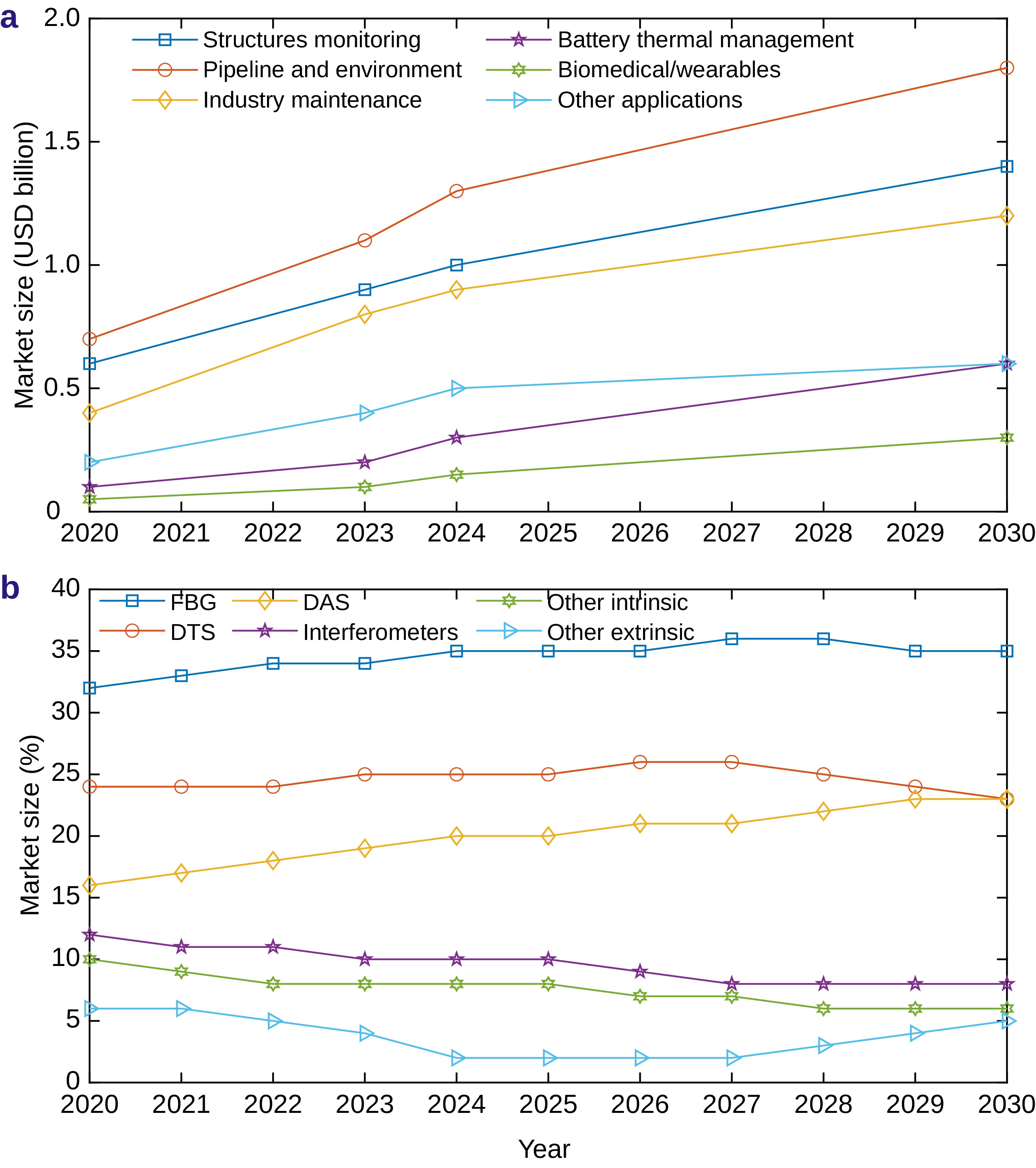
The review includes a market overview demonstrating the increasing trend in DAS market size (projected to USD 7.8 billion by 2030), focused on implementation in different fields. Then, the operation principles, fundamentals and theoretical background of the DAS systems are analyzed and compared in terms of different approaches. In addition, the myriads of DAS applications proposed in recent years are reviewed. Thereafter, current limitations and drawbacks of DAS are discussed and emerging technologies to address such drawbacks are analyzed in terms of benefits and future challenges for the next generation of DAS technology.
This review paper’s unique value is to comprehensively cover all aspects of DAS technology, from its theoretical basis and first laboratory demonstrations to practical implementation covering tens of kilometers. Such review can be used as a roadmap for DAS applications and to understand the application and implementation of ϕ-OTDR systems with critical perspective of the new possibilities of the next generation of DAS systems.
Electrically switchable bright-field and interference-synthesized edge-enhanced imaging with a polarization-multiplexed metalens
Xiaotong Li, Junhwa Seong, Yeseul Kim, Kwang-Suk Oh, Shiqi Hu, Le Dai, Harit Keawmuang, Beomha Yang, Minseok Choi, Youngsun Jeon, Cherry Park, Weiyan Li, Tianxu Jia, Han Zhu, Xiaodong Cai, Qi Zheng, Jinhui Shi, Young-Ki Kim, Yuchuan Shao, Trevon Badloe, Junsuk Rho
Opto-Electronic Science
2026-09-20
3D-printed copper water cooling system assisted fabrication of 10.6-μm high-power CO₂ laser resistance reflectors
Hongfei Jiao, Binbin Jiang, Xinshang Niu, Yifan Wang, Dongdong Li, Jun Yu, Xiaochuan Ji, Jingjing Xia, Jinlong Zhang, Xinbin Cheng, Zhanshan Wang
Opto-Electronic Advances
2026-09-15
Ultrafast all-optical modulation of wide-bandwidth pulses enabled by silicon-metasurfaces
Kaloyan Georgiev, Khosro Zangeneh Kamali, Anton A. Trifonov, Giulia Crotti, Lyuben Petrov, Stefan Georgiev, Hristo Iliev, Lei Xu, Unai Arregui Leon, Mohsen Rahmani, Giuseppe Della Valle, Ivan Buchvarov, Dragomir Neshev
Opto-Electronic Advances
2026-09-15
Physics-informed neural fields enable blind aberration correction for partially coherent quantitative phase imaging
Shun Zhou, Xingyu Huang, Linpeng Lu, Habib Ullah, Kaiyu Du, Maciej Trusiak, Malgorzata Kujawinska, Yuzhen Zhang, Yao Fan, Qian Chen, Qinrong Zhang, Chao Zuo
Opto-Electronic Science
2026-08-26
Heterogeneously integrated micro-ring with SnS₂ for dual-functional optical modulation and photodetection
Jinyi Du, Lidan Lu, Xu Zhang, Bofei Zhu, Wenbo Bo, Yingjie Xu, Guang Chen, Yanlin He, Guanghui Ren, Xiaoping Lou, Zheng You, Lianqing Zhu
Opto-Electronic Advances
2026-08-25