(Peer-Reviewed) Universal Adversarial Examples and Perturbations for Quantum Classifiers
Weiyuan Gong ¹, Dong-Ling Deng 邓东灵 ¹ ²
¹ Center for Quantum Information, IIIS, Tsinghua University, Beijing 100084, People's Republic of China 清华大学 交叉信息研究院 量子信息中心
² Shanghai Qi Zhi Institute, 41th Floor, AI Tower, No. 701 Yunjin Road, Xuhui District, Shanghai 200232, China 上海期智研究院
National Science Review, 2021-07-22
Abstract
Quantum machine learning explores the interplay between machine learning and quantum physics, which may lead to unprecedented perspectives for both fields. In fact, recent works have shown strong evidences that quantum computers could outperform classical computers in solving certain notable machine learning tasks. Yet, quantum learning systems may also suffer from the vulnerability problem: adding a tiny carefully-crafted perturbation to the legitimate input data would cause the systems to make incorrect predictions at a notably high confidence level.
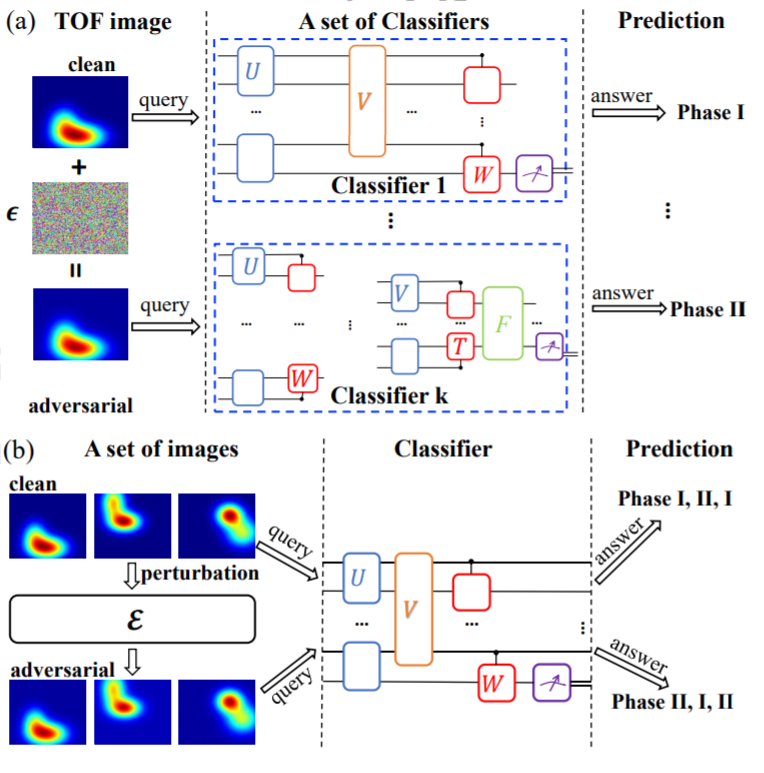
In this paper, we study the universality of adversarial examples and perturbations for quantum classifiers. Through concrete examples involving classifications of real-life images and quantum phases of matter, we show that there exist universal adversarial examples that can fool a set of different quantum classifiers. We prove that for a set of k classifiers with each receiving input data of n qubits, an O(ln k/2ⁿ) increase of the perturbation strength is enough to ensure a moderate universal adversarial risk.
In addition, for a given quantum classifier we show that there exist universal adversarial perturbations, which can be added to different legitimate samples and make them to be adversarial examples for the classifier.
Our results reveal the universality perspective of adversarial attacks for quantum machine learning systems, which would be crucial for practical applications of both near-term and future quantum technologies in solving machine learning problems.
Light-perception-based interactive control of an underwater digital twin hand
Jinlong Lu, Chao Zhang, Hengchang Nong, Dongying Wang, Hongyu Zhou, Junjie Weng, Yuehua Deng, Yang Yu, Qiang Bian, Jianfa Zhang, Chaofan Zhang, Zhenrong Zhang, Junbo Yang
Opto-Electronic Advances
2026-07-10
Unlocking home-based nocturnal health management: A fiber-optic approach for early detection of cardiorespiratory rhythm disorders
Hanyu Jin, Hao Li, Zhuolin Chen, Liangye Li, Zurui Wang, Kai Zhou, Weijian Hang, Zhipeng Chen, Junfeng Chen, Kai Shen, Jianfeng Wen, Chen Chen, Cunzheng Fan, Zhijun Yan, Feng Wang, Qizhen Sun
Opto-Electronic Advances
2026-07-10
A flexible wireless system for prospective photodynamic therapy applications
Rolan Mansour, Bhavani Yalagala, Vikas Vikas, Nikolas Bruce, Fawziye Tarhini, Georgios N. Arvanitakis, Mohammed Mughal, Jamie Blanche, Ahmad Taha, Jonathan Copper, Muhammad Imran, Karin Williams, Karin Oien, Mahmoud Wagih, Hadi Heidari, Robert Hadfield, David Flynn
Opto-Electronic Advances
2026-07-10
Parallel bright-field and multi-order edge imaging via wide field-of-view trichannel metalens
Xiaotong Li, Yeseul Kim, Youngsun Jeon, Junhwa Seong, Jaekyung Kim, Peng Tang, Shiqi Hu, Harit Keawmuang, Beomha Yang, Dongmin Jeon, Le Dai, Weiyan Li, Xiaodong Cai, Jinhui Shi, Yong-Sang Ryu, Trevon Badloe, Junsuk Rho
Opto-Electronic Advances
2026-07-10