Year
Month
(Peer-Reviewed) Application of the frequency-matching method in the probability forecast of landfalling typhoon rainfall
Rong GUO 郭蓉, Hui YU 余晖, Zifeng YU 喻自凤, Jie TANG 汤杰, Lina BAI 白莉娜
Shanghai Typhoon Institute, and Key Laboratory of Numerical Modeling for Tropical Cyclone of China Meteorological Administration, Shanghai 200030, China
中国 上海 中国气象局上海台风研究所 台风数值预报重点实验室
Abstract

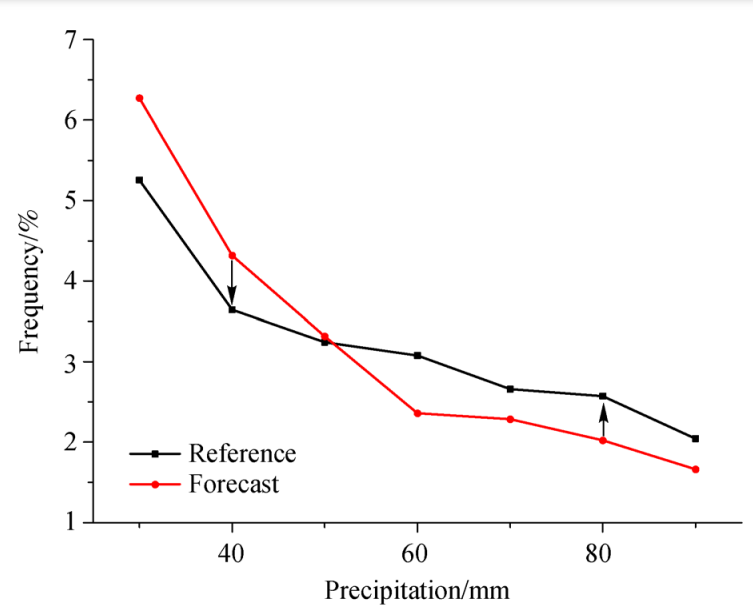
In this paper, a revised method for typhoon precipitation probability forecast, based on the frequency-matching method, is developed by combining the screening and the neighborhood methods. The frequency of the high-resolution precipitation forecasts is used as the reference frequency, and the frequency of the low-resolution ensemble forecasts is used as the forecast frequency.

Based on frequency–matching method, the frequency of rainfall above the rainstorm magnitude increases. The forecast members are then selected by using the typhoon tracks of the short-term predictions, and the precipitation probability is calculated for each member using a combination of the neighbor and the traditional probability statistical methods. Moreover, four landfalling typhoons (i.e., STY Lekima and STS Bailu in 2019, and TY Hagupit and Higos in 2020) were chose to test the rainfall probability forecast.

The results show that the method performs well with respect to the forecast rainfall area and magnitude for the four typhoons. The Brier and Brier skill scores are almost entirely positive for the probability forecast of 0.1–250 mm rainfall during Bailu, Hagupit and Higos (except for 0.1mm of Hagupit), and for<100 mm rainfall (except for 25 mm) during Lekima.
Application of the frequency-matching method in the probability forecast of landfalling typhoon rainfall_1
Application of the frequency-matching method in the probability forecast of landfalling typhoon rainfall_2
Application of the frequency-matching method in the probability forecast of landfalling typhoon rainfall_3
Application of the frequency-matching method in the probability forecast of landfalling typhoon rainfall_4
  • A hybrid integrated high-precision tunable semiconductor laser
  • Yiran Zhu, Botao Fu, Zhiwei Fang, Qiyue Hu, Jianping Yu, Yunpeng Song, Yu Ma, Min Wang, Kunpeng Jia, Zhenda Xie, Ya Cheng
  • Opto-Electronic Advances
  • 2026-02-12
  • Soft chiral superstructure enabled dynamic polychromatic holography
  • Chun-Ting Xu, Lu Li, Quan-Ming Chen, Guang-Yao Wang, Wei Hu
  • Opto-Electronic Advances
  • 2026-02-12
  • Millisecond-level electrically switchable metalens for adaptive rotational depth mapping and diffraction-limited imaging
  • Yeseul Kim, Jihae Lee, Won-Sik Kim, Hyeonsu Heo, Dongmin Jeon, Beomha Yang, Xiaotong Li, Harit Keawmuang, Shiqi Hu, Young-Ki Kim, Trevon Badloe, Junsuk Rho
  • Opto-Electronic Advances
  • 2026-02-12
  • Ambient-energy-driven space-time-coding metasurface for space-frequency-division multiplexing wireless communications
  • Han Wei Tian, Chao Song, Dong Jie Wang, Qian Zhu, Tie Jun Cui, Wei Xiang Jiang
  • Opto-Electronic Advances
  • 2026-02-12
  • Ultra-sensitive multi-band infrared polarization photodetector based on 1T'-MoTe₂/2H-MoTe₂ van der Waals heterostructure
  • Yuting Pan, Lidan Lu, Bofei Zhu, Chunhua An, Jing Yu, Guanghui Ren, Jian Zhen Ou, Mingli Dong, Zheng You, Lianqing Zhu
  • Opto-Electronic Advances
  • 2026-02-09
  • Tunable compound eyes with coaxial lens-on-lens ommatidia for cooperative bi-focal imaging
  • Zhi-Juan Sun, Wei-Jian Zhong, Qing Cai, Yi-Fan Lu, Chang-Xu Li, Dong-Dong Han, Yong-Lai Zhang
  • Opto-Electronic Advances
  • 2026-02-09
  • High-efficiency infrared upconversion imaging with nonlinear silicon metasurfaces empowered by quasi-bound states in the continuum
  • Tingting Liu, Jumin Qiu, Meibao Qin, Xu Tu Huifu Qiu, Feng Wu, Tianbao Yu, Qiegen Liu, Shuyuan Xiao
  • Opto-Electronic Advances
  • 2026-01-29
  • Timeshare surface-enhanced Raman scattering platform with sensitive and quantitative mode
  • Qianqian Ding, Xueyan Chen, Yunlu Jia, Hong Liu, Xiaochen Zhang, Ningtao Cheng, Shikuan Yang
  • Opto-Electronic Advances
  • 2026-01-27
  • Electric-field-induced second-harmonic generation
  • Hangkai Fan, Alexey Proskurin, Mingzhao Song, Andrey Bogdanov
  • Opto-Electronic Advances
  • 2026-01-27
  • Fiber-optic microstructured sensors based on abrupt field patterns: theory, fabrication, and applications
  • Yuxuan Yi, Wanlai Zhu, Zao Yi, Zigang Zhou, Shubo Cheng, Majid Niaz Akhtar, Sohail Ahmad
  • Opto-Electronic Science
  • 2026-01-23
  • Integrated metasurface-freeform system enabled multi-focal planes augmented reality display
  • Shifei Zhang, Lina Gao, Yidan Zhao, Yongdong Wang, Bo Wang, Junjie Li, Jiaxi Duan, Dewen Cheng, Cheng-Wei Qiu, Yongtian Wang, Tong Yang, Lingling Huang
  • Opto-Electronic Science
  • 2026-01-23
  • Decoding subject-invariant emotional information from cardiac signals detected by photonic sensing system
  • Yukun Long, Rui Min Kun Xiao, Zhuo Wang, Lanfang Liu, Yifan Sun, Xiaoli Li, Zhaohui Li, Zeev Zalevsky
  • Opto-Electronic Technology
  • 2025-12-25


  • Data network traffic analysis and optimization strategy of real-time power grid dynamic monitoring system for wide-frequency measurements                                Parallel generation of low-correlation wideband complex chaotic signals using CW laser and external-cavity laser with self-phase-modulated injection
    About
    |
    Contact
    |
    Copyright © PubCard