(Peer-Reviewed) Substrate damage and recovery after giant clam shell mining at remote coral reefs in the southern South China Sea
Shengnan Zhou 周胜男 ¹ ² ⁴, Qi Shi 施祺 ¹ ², Hongqiang Yang 杨红强 ¹ ² ³, Xiyang Zhang 张喜洋 ¹ ², Xiaoju Liu 刘小菊 ¹ ² ⁴, Fei Tan 谭飞 ¹ ² ⁴, Pin Yan 阎贫 ¹ ²
¹ Key Laboratory of Ocean and Marginal Sea Geology, South China Sea Institute of Oceanology, CAS, Guangzhou, 510301, China
中国 广州 中国科学院南海海洋研究所 边缘海与大洋地质重点实验室
² Southern Marine Science and Engineering Guangdong Laboratory (Guangzhou), Guangzhou, 511458, China
中国 广州 南方海洋科学与工程广东省实验室(广州)
³ Nansha Marine Ecological and Environmental Research Station, CAS, Sansha, Hainan, 573199, China
中国 海南 三沙 中国科学院南沙海洋生态环境实验站
⁴ University of Chinese Academy of Sciences, Beijing, 100049, China
中国科学院大学
Abstract
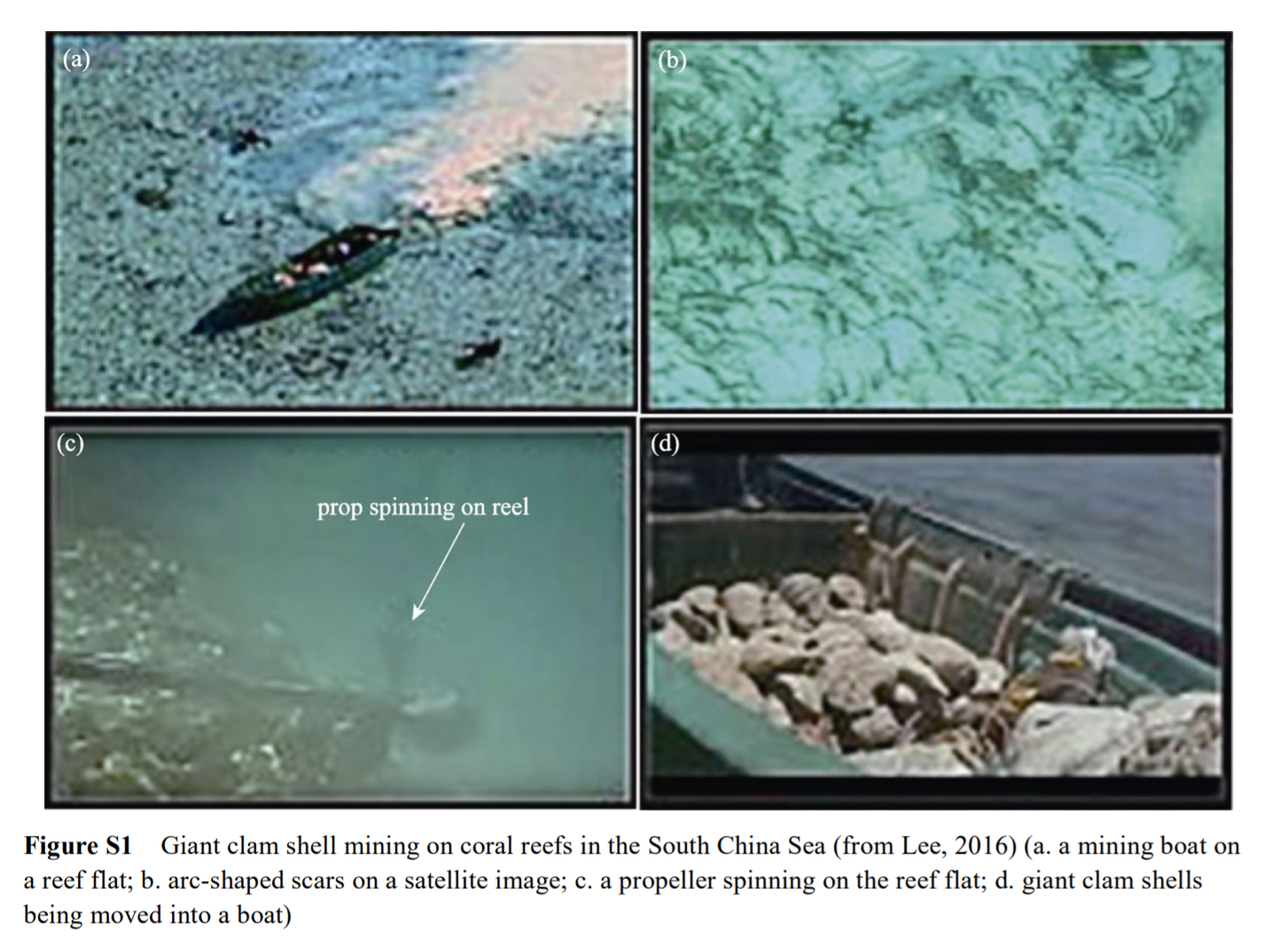
Giant clam shell mining (GCSM), a unique phenomenon occurring at remote coral reefs in the southern South China Sea (SCS), forms striking scars on the reef flats and damages the reef flat substrate. Through image analyses at three times (2004.02.02, 2014.02.26, and 2019.04.10) and in situ surveys at Ximen Reef, a representative site that has experienced GCSM, we quantified the GCSM-generated substrate damage and the corresponding recovery.
GCSM was estimated to have occurred sometime between 2012 and 2014, causing reduction in live coral subarea and formation of micro-relief as trenches and mounds. GCSM-generated damage was restricted to the reef flat. After GCSM, coral and algae subarea increased, and the trenches and mounds tended to be filled and eroded, representing a natural recovery of the substrate. The legal prohibition on human disturbances at the coral reefs contributed to substrate recovery at Ximen Reef. This case also implied that recovery of the other coral reefs that suffered from GCSM is possible.
Ultrafast all-optical modulation of wide-bandwidth pulses enabled by silicon-metasurfaces
Kaloyan Georgiev, Khosro Zangeneh Kamali, Anton A. Trifonov, Giulia Crotti, Lyuben Petrov, Stefan Georgiev, Hristo Iliev, Lei Xu, Unai Arregui Leon, Mohsen Rahmani, Giuseppe Della Valle, Ivan Buchvarov, Dragomir Neshev
Opto-Electronic Advances
2026-09-15
Physics-informed neural fields enable blind aberration correction for partially coherent quantitative phase imaging
Shun Zhou, Xingyu Huang, Linpeng Lu, Habib Ullah, Kaiyu Du, Maciej Trusiak, Malgorzata Kujawinska, Yuzhen Zhang, Yao Fan, Qian Chen, Qinrong Zhang, Chao Zuo
Opto-Electronic Science
2026-08-26
Heterogeneously integrated micro-ring with SnS₂ for dual-functional optical modulation and photodetection
Jinyi Du, Lidan Lu, Xu Zhang, Bofei Zhu, Wenbo Bo, Yingjie Xu, Guang Chen, Yanlin He, Guanghui Ren, Xiaoping Lou, Zheng You, Lianqing Zhu
Opto-Electronic Advances
2026-08-25
Hardware-aware lightweight photonic spiking neural network for pattern classification
Shuiying Xiang, Yahui Zhang, Shangxuan Shi, Haowen Zhao, Dianzhuang Zheng, Xingxing Guo, Yanan Han, Ye Tian, Liyue Zhang, Yuechun Shi, Yue Hao
Opto-Electronic Advances
2026-08-25
PhyspeNet: An empirical physics-aware network for adaptive speckle reconstructive spectrometry
Junrui Liang, Min Jiang, Jun Li, Zhongming Huang, Junhong He, Yanting Guo, Yanzhao Ke, Jun Ye, Jiangming Xu, Jinyong Leng, Pu Zhou
Opto-Electronic Advances
2026-08-25
A 36 × 240 Gbps hybrid mode/wavelength division multiplexing transmitter using lithium niobate on insulator
Mingyu Zhu, Weihan Wang, Ruitao Ma, Aoyun Gao, Chun Gao, Zexu Wang, Fei Huang, Zhenyuan Bao, Dajian Liu, Jiaxuan Gan, Zejie Yu, Huan Li, Weike Zhao, Daoxin Dai
Opto-Electronic Advances
2026-08-25