(Peer-Reviewed) High-Q resonances governed by the quasi-bound states in the continuum in all-dielectric metasurfaces
Cizhe Fang 方慈浙 ¹, Qiyu Yang ¹, Qingchen Yuan 元晴晨 ², Xuetao Gan 甘雪涛 ², Jianlin Zhao 赵建林 ², Yao Shao 邵瑶 ³, Yan Liu 刘艳 ¹, Genquan Han 韩根全 ¹, Yue Hao 郝跃 ¹
¹ State Key Discipline Laboratory of Wide Band Gap Semiconductor Technology, Shaanxi Joint Key Laboratory of Graphene, School of Microelectronics, Xidian University, Xi'an 710071, China
中国 西安 西安电子科技大学微电子学院 宽带隙半导体技术国家重点学科实验室 陕西省石墨烯联合实验室
² MOE Key Laboratory of Material Physics and Chemistry under Extraordinary Conditions, and Shaanxi Key Laboratory of Optical Information Technology, School of Physical Science and Technology, Northwestern Polytechnical University, Xi'an 710129, China
中国 西安 西北工业大学物理科学与技术学院 超常条件材料物理与化学教育部重点实验室 陕西省光信息技术重点实验室
³ Shanghai Energy Internet Research Institute of State Grid, 251 Libing Road, Pudong New Area, Shanghai 201210, China
中国 上海 国网上海能源互联网研究院
Opto-Electronic Advances, 2021-06-20
Abstract
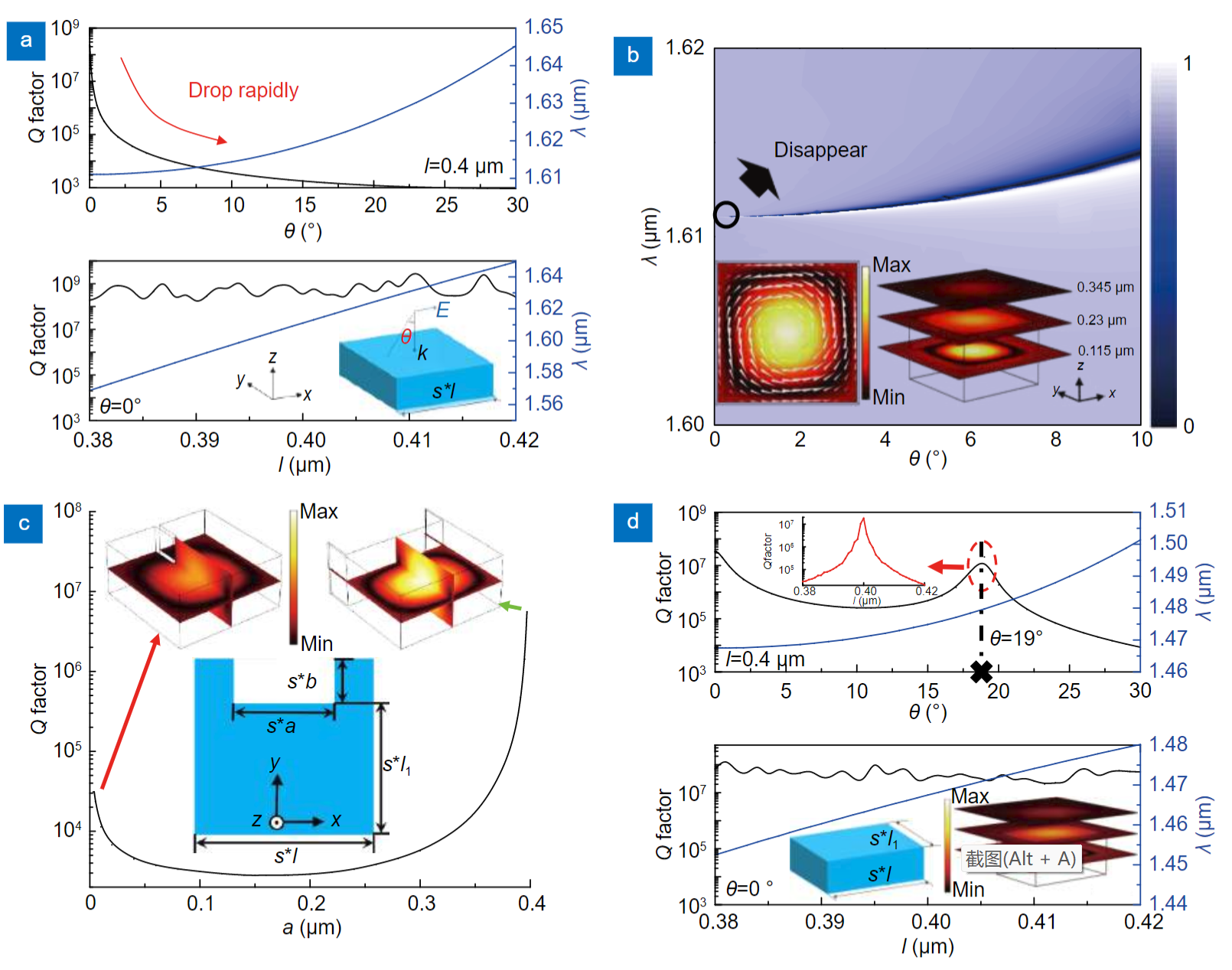
The realization of high-Q resonances in a silicon metasurface with various broken-symmetry blocks is reported. Theoretical analysis reveals that the sharp resonances in the metasurfaces originate from symmetry-protected bound in the continuum (BIC) and the magnetic dipole dominates these peculiar states. A smaller size of the defect in the broken-symmetry block gives rise to the resonance with a larger Q factor.
Importantly, this relationship can be tuned by changing the structural parameter, resulting from the modulation of the topological configuration of BICs. Consequently, a Q factor of more than 3,000 can be easily achieved by optimizing dimensions of the nanostructure. At this sharp resonance, the intensity of the third harmonic generation signal in the patterned structure can be 368 times larger than that of the flat silicon film.
The proposed strategy and underlying theory can open up new avenues to realize ultrasharp resonances, which may promote the development of the potential meta-devices for nonlinearity, lasing action, and sensing.
Light-perception-based interactive control of an underwater digital twin hand
Jinlong Lu, Chao Zhang, Hengchang Nong, Dongying Wang, Hongyu Zhou, Junjie Weng, Yuehua Deng, Yang Yu, Qiang Bian, Jianfa Zhang, Chaofan Zhang, Zhenrong Zhang, Junbo Yang
Opto-Electronic Advances
2026-07-10
Unlocking home-based nocturnal health management: A fiber-optic approach for early detection of cardiorespiratory rhythm disorders
Hanyu Jin, Hao Li, Zhuolin Chen, Liangye Li, Zurui Wang, Kai Zhou, Weijian Hang, Zhipeng Chen, Junfeng Chen, Kai Shen, Jianfeng Wen, Chen Chen, Cunzheng Fan, Zhijun Yan, Feng Wang, Qizhen Sun
Opto-Electronic Advances
2026-07-10
A flexible wireless system for prospective photodynamic therapy applications
Rolan Mansour, Bhavani Yalagala, Vikas Vikas, Nikolas Bruce, Fawziye Tarhini, Georgios N. Arvanitakis, Mohammed Mughal, Jamie Blanche, Ahmad Taha, Jonathan Copper, Muhammad Imran, Karin Williams, Karin Oien, Mahmoud Wagih, Hadi Heidari, Robert Hadfield, David Flynn
Opto-Electronic Advances
2026-07-10
Parallel bright-field and multi-order edge imaging via wide field-of-view trichannel metalens
Xiaotong Li, Yeseul Kim, Youngsun Jeon, Junhwa Seong, Jaekyung Kim, Peng Tang, Shiqi Hu, Harit Keawmuang, Beomha Yang, Dongmin Jeon, Le Dai, Weiyan Li, Xiaodong Cai, Jinhui Shi, Yong-Sang Ryu, Trevon Badloe, Junsuk Rho
Opto-Electronic Advances
2026-07-10