(Peer-Reviewed) Single-molecule optoelectronic devices: physical mechanism and beyond
Peihui Li 李佩慧 ¹, Yijian Chen ¹, Boyu Wang 汪博宇 ¹, Mengmeng Li 李萌萌 ¹, Dong Xiang 向东 ¹, Chuancheng Jia 贾传成 ¹, Xuefeng Guo 郭雪峰 ¹ ²
¹ Center of Single-Molecule Sciences, Institute of Modern Optics, Tianjin Key Laboratory of Micro-scale Optical Information Science and Technology, Frontiers Science Center for New Organic Matter, College of Electronic Information and Optical Engineering, Nankai University, Tianjin 300350, China
中国 天津 南开大学电子信息与光学工程学院 现代光学研究所 天津市微尺度光学信息技术科学重点实验室 有机新物质创造前沿科学中心 单分子科学中心
² Beijing National Laboratory for Molecular Sciences, State Key Laboratory for Structural Chemistry of Unstable and Stable Species, College of Chemistry and Molecular Engineering, Peking University, Beijing 100871, China
中国 北京 北京大学化学与分子工程学院 分子科学国家实验室 分子动态与稳态结构国家重点实验室
Opto-Electronic Advances
, 2022-05-20
Abstract
Single-molecule devices not only promise to provide an alternative strategy to break through the miniaturization and functionalization bottlenecks faced by traditional semiconductor devices, but also provide a reliable platform for exploration of the intrinsic properties of matters at the single-molecule level.
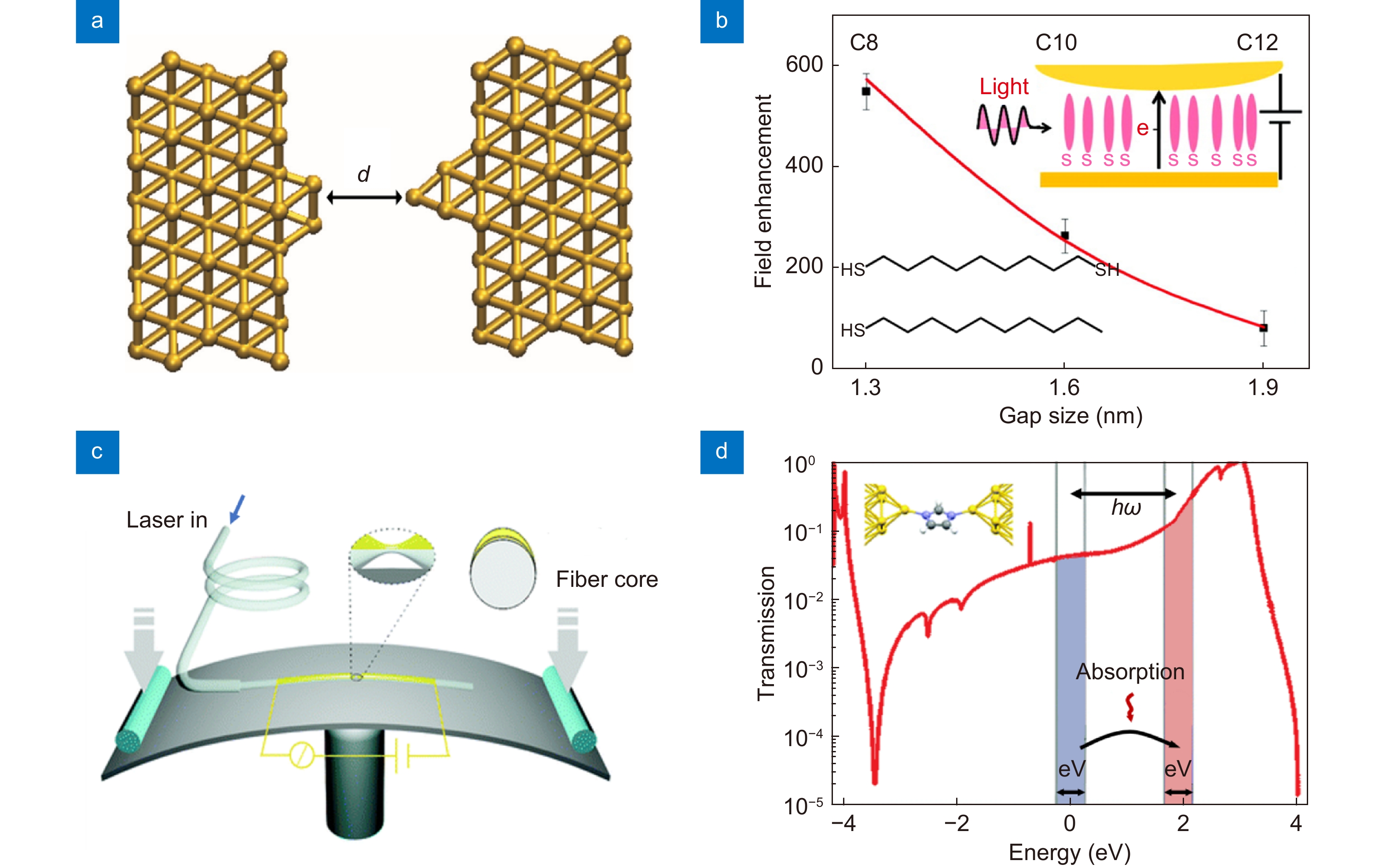
Because the regulation of the electrical properties of single-molecule devices will be a key factor in enabling further advances in the development of molecular electronics, it is necessary to clarify the interactions between the charge transport occurring in the device and the external fields, particularly the optical field. This review mainly introduces the optoelectronic effects that are involved in single-molecule devices, including photoisomerization switching, photoconductance, plasmon-induced excitation, photovoltaic effect, and electroluminescence.
We also summarize the optoelectronic mechanisms of single-molecule devices, with particular emphasis on the photoisomerization, photoexcitation, and photo-assisted tunneling processes. Finally, we focus the discussion on the opportunities and challenges arising in the single-molecule optoelectronics field and propose further possible breakthroughs.
Ultrafast all-optical modulation of wide-bandwidth pulses enabled by silicon-metasurfaces
Kaloyan Georgiev, Khosro Zangeneh Kamali, Anton A. Trifonov, Giulia Crotti, Lyuben Petrov, Stefan Georgiev, Hristo Iliev, Lei Xu, Unai Arregui Leon, Mohsen Rahmani, Giuseppe Della Valle, Ivan Buchvarov, Dragomir Neshev
Opto-Electronic Advances
2026-09-15
Physics-informed neural fields enable blind aberration correction for partially coherent quantitative phase imaging
Shun Zhou, Xingyu Huang, Linpeng Lu, Habib Ullah, Kaiyu Du, Maciej Trusiak, Malgorzata Kujawinska, Yuzhen Zhang, Yao Fan, Qian Chen, Qinrong Zhang, Chao Zuo
Opto-Electronic Science
2026-08-26
Heterogeneously integrated micro-ring with SnS₂ for dual-functional optical modulation and photodetection
Jinyi Du, Lidan Lu, Xu Zhang, Bofei Zhu, Wenbo Bo, Yingjie Xu, Guang Chen, Yanlin He, Guanghui Ren, Xiaoping Lou, Zheng You, Lianqing Zhu
Opto-Electronic Advances
2026-08-25
Hardware-aware lightweight photonic spiking neural network for pattern classification
Shuiying Xiang, Yahui Zhang, Shangxuan Shi, Haowen Zhao, Dianzhuang Zheng, Xingxing Guo, Yanan Han, Ye Tian, Liyue Zhang, Yuechun Shi, Yue Hao
Opto-Electronic Advances
2026-08-25
PhyspeNet: An empirical physics-aware network for adaptive speckle reconstructive spectrometry
Junrui Liang, Min Jiang, Jun Li, Zhongming Huang, Junhong He, Yanting Guo, Yanzhao Ke, Jun Ye, Jiangming Xu, Jinyong Leng, Pu Zhou
Opto-Electronic Advances
2026-08-25
A 36 × 240 Gbps hybrid mode/wavelength division multiplexing transmitter using lithium niobate on insulator
Mingyu Zhu, Weihan Wang, Ruitao Ma, Aoyun Gao, Chun Gao, Zexu Wang, Fei Huang, Zhenyuan Bao, Dajian Liu, Jiaxuan Gan, Zejie Yu, Huan Li, Weike Zhao, Daoxin Dai
Opto-Electronic Advances
2026-08-25