(Peer-Reviewed) A review on the forward osmosis applications and fouling control strategies for wastewater treatment
Linwei Zhu 朱林伟 ¹, Chun Ding 丁纯 ¹, Tengyang Zhu 朱腾阳 ¹, Yan Wang 王艳 ¹ ²
¹ Key Laboratory of Material Chemistry for Energy Conversion and Storage (Huazhong University of Science and Technology), Ministry of Education, Wuhan 430074, China
中国 武汉 华中科技大学 能量转换与存储材料化学教育部重点实验室
² Hubei Key Laboratory of Material Chemistry and Service Failure, School of Chemistry and Chemical Engineering, Huazhong University of Science and Technology, Wuhan 430074, China
中国 武汉 华中科技大学化学化工学院 材料化学与服役失效湖北省重点实验室
Abstract
During the last decades, the utilization of osmotic pressure-driven forward osmosis technology for wastewater treatment has drawn great interest, due to its high separation efficiency, low membrane fouling propensity, high water recovery and relatively low energy consumption.
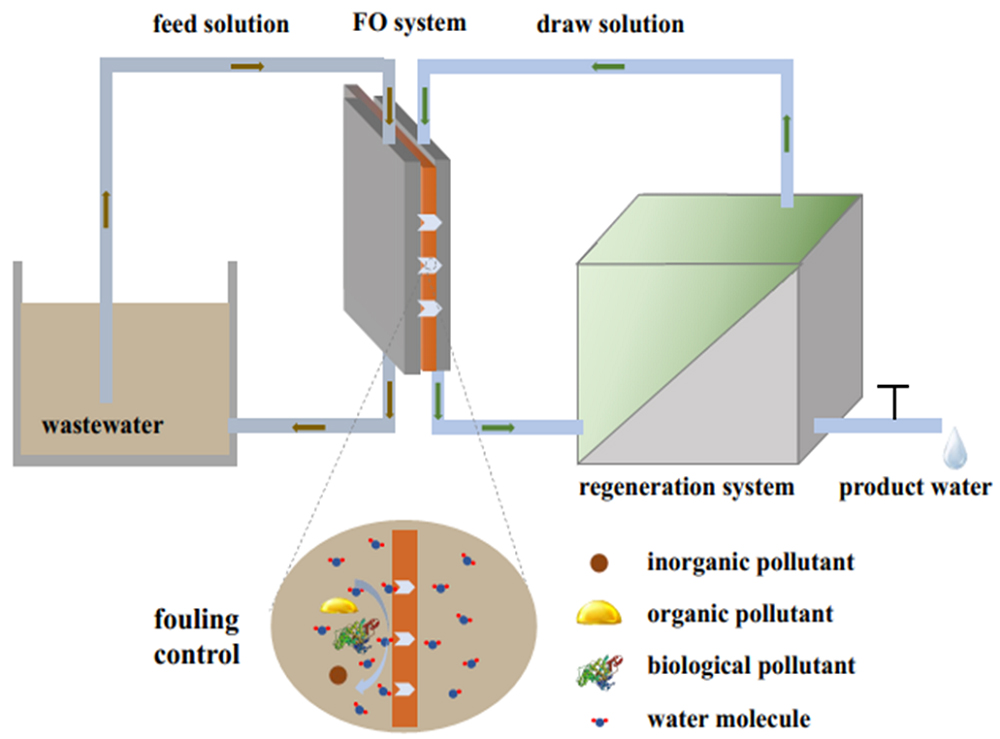
This review paper summarizes the implementation of forward osmosis technology for various wastewater treatment including municipal sewage, landfill leachate, oil/gas exploitation wastewater, textile wastewater, mine wastewater, and radioactive wastewater. However, membrane fouling is still a critical issue, which affects water flux stability, membrane life and operating cost. Different membrane fouling types and corresponding fouling mechanisms, including organic fouling, inorganic fouling, biofouling and combined fouling are therefore further discussed.
The fouling control strategies including feed pre-treatment, operation condition optimization, membrane selection and modification, membrane cleaning and tailoring the chemistry of draw solution are also reviewed comprehensively. At the end of paper, some recommendations are proposed.
Ultrafast all-optical modulation of wide-bandwidth pulses enabled by silicon-metasurfaces
Kaloyan Georgiev, Khosro Zangeneh Kamali, Anton A. Trifonov, Giulia Crotti, Lyuben Petrov, Stefan Georgiev, Hristo Iliev, Lei Xu, Unai Arregui Leon, Mohsen Rahmani, Giuseppe Della Valle, Ivan Buchvarov, Dragomir Neshev
Opto-Electronic Advances
2026-09-15
Physics-informed neural fields enable blind aberration correction for partially coherent quantitative phase imaging
Shun Zhou, Xingyu Huang, Linpeng Lu, Habib Ullah, Kaiyu Du, Maciej Trusiak, Malgorzata Kujawinska, Yuzhen Zhang, Yao Fan, Qian Chen, Qinrong Zhang, Chao Zuo
Opto-Electronic Science
2026-08-26
Heterogeneously integrated micro-ring with SnS₂ for dual-functional optical modulation and photodetection
Jinyi Du, Lidan Lu, Xu Zhang, Bofei Zhu, Wenbo Bo, Yingjie Xu, Guang Chen, Yanlin He, Guanghui Ren, Xiaoping Lou, Zheng You, Lianqing Zhu
Opto-Electronic Advances
2026-08-25
Hardware-aware lightweight photonic spiking neural network for pattern classification
Shuiying Xiang, Yahui Zhang, Shangxuan Shi, Haowen Zhao, Dianzhuang Zheng, Xingxing Guo, Yanan Han, Ye Tian, Liyue Zhang, Yuechun Shi, Yue Hao
Opto-Electronic Advances
2026-08-25
PhyspeNet: An empirical physics-aware network for adaptive speckle reconstructive spectrometry
Junrui Liang, Min Jiang, Jun Li, Zhongming Huang, Junhong He, Yanting Guo, Yanzhao Ke, Jun Ye, Jiangming Xu, Jinyong Leng, Pu Zhou
Opto-Electronic Advances
2026-08-25
A 36 × 240 Gbps hybrid mode/wavelength division multiplexing transmitter using lithium niobate on insulator
Mingyu Zhu, Weihan Wang, Ruitao Ma, Aoyun Gao, Chun Gao, Zexu Wang, Fei Huang, Zhenyuan Bao, Dajian Liu, Jiaxuan Gan, Zejie Yu, Huan Li, Weike Zhao, Daoxin Dai
Opto-Electronic Advances
2026-08-25