(Peer-Reviewed) Reconfigurable origami chiral response for holographic imaging and information encryption
Zhibiao Zhu 朱志标, Yongfeng Li 李勇峰, Jiafu Wang 王甲富, Ze Qin 秦喆, Lixin Jiang 蒋李鑫, Yang Chen 成洋, Shaobo Qu 屈绍波
Shaanxi Key Laboratory of Artificially-Structured Functional Materials and Devices, Air Force Engineering University, Xi'an 710051, China
中国人民解放军空军工程大学 陕西省人工结构功能材料与器件重点实验室
Opto-Electronic Science
, 2025-04-25
Abstract
With the rapid development of holographic technology, metasurface-based holographic communication schemes have demonstrated immense potential for electromagnetic (EM) multifunctionality. However, traditional passive metasurfaces are severely limited by their lack of reconfigurability, hindering the realization of versatile holographic applications.
Origami, an art form that mechanically induces spatial deformations, serves as a platform for multifunctional devices and has garnered significant attention in optics, physics, and materials science. The Miura-ori folding paradigm, characterized by its continuous reconfigurability in folded states, remains unexplored in the context of holographic imaging.
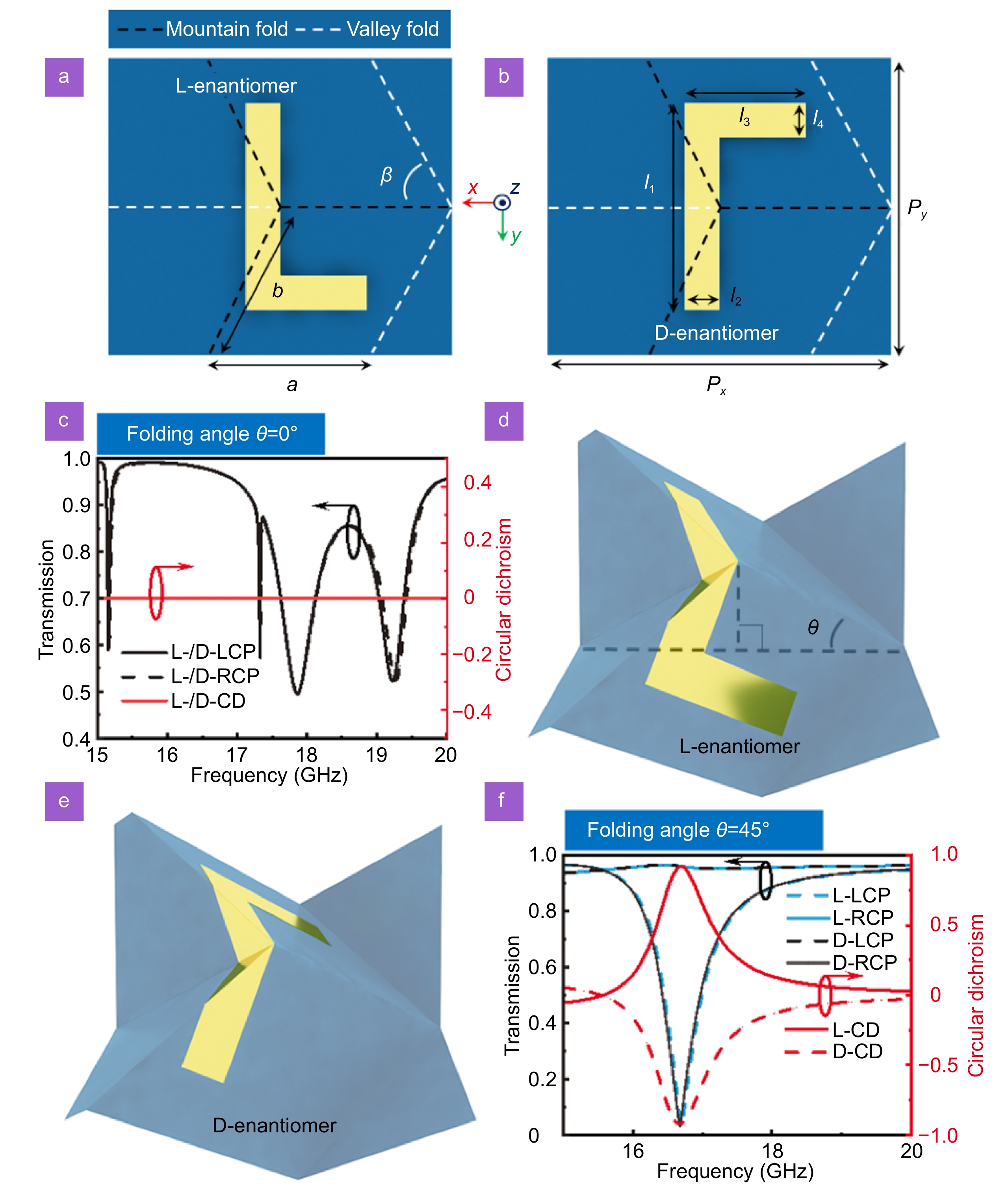
Herein, we integrate the principles of Rosenfeld with L- and D-metal chiral enantiomers on a Miura-ori surface to tailor the aperture distribution. Leveraging the continuously tunable nature of the Miura-ori's folded states, the chiral response of the metallic structures varies across different folding configurations, enabling distinct EM holographic imaging functionalities. In the planar state, holographic encryption is achieved. Under specific folding conditions and driven by spin circularly polarized (CP) waves at a particular frequency, multiplexed holographic images can be reconstructed on designated focal planes with CP selectivity.
Notably, the fabricated origami metasurface exhibits a large negative Poisson ratio, facilitating portability and deployment and offering novel avenues for spin-selective systems, camouflage, and information encryption.
Ultrafast all-optical modulation of wide-bandwidth pulses enabled by silicon-metasurfaces
Kaloyan Georgiev, Khosro Zangeneh Kamali, Anton A. Trifonov, Giulia Crotti, Lyuben Petrov, Stefan Georgiev, Hristo Iliev, Lei Xu, Unai Arregui Leon, Mohsen Rahmani, Giuseppe Della Valle, Ivan Buchvarov, Dragomir Neshev
Opto-Electronic Advances
2026-09-15
Physics-informed neural fields enable blind aberration correction for partially coherent quantitative phase imaging
Shun Zhou, Xingyu Huang, Linpeng Lu, Habib Ullah, Kaiyu Du, Maciej Trusiak, Malgorzata Kujawinska, Yuzhen Zhang, Yao Fan, Qian Chen, Qinrong Zhang, Chao Zuo
Opto-Electronic Science
2026-08-26
Heterogeneously integrated micro-ring with SnS₂ for dual-functional optical modulation and photodetection
Jinyi Du, Lidan Lu, Xu Zhang, Bofei Zhu, Wenbo Bo, Yingjie Xu, Guang Chen, Yanlin He, Guanghui Ren, Xiaoping Lou, Zheng You, Lianqing Zhu
Opto-Electronic Advances
2026-08-25
Hardware-aware lightweight photonic spiking neural network for pattern classification
Shuiying Xiang, Yahui Zhang, Shangxuan Shi, Haowen Zhao, Dianzhuang Zheng, Xingxing Guo, Yanan Han, Ye Tian, Liyue Zhang, Yuechun Shi, Yue Hao
Opto-Electronic Advances
2026-08-25
PhyspeNet: An empirical physics-aware network for adaptive speckle reconstructive spectrometry
Junrui Liang, Min Jiang, Jun Li, Zhongming Huang, Junhong He, Yanting Guo, Yanzhao Ke, Jun Ye, Jiangming Xu, Jinyong Leng, Pu Zhou
Opto-Electronic Advances
2026-08-25
A 36 × 240 Gbps hybrid mode/wavelength division multiplexing transmitter using lithium niobate on insulator
Mingyu Zhu, Weihan Wang, Ruitao Ma, Aoyun Gao, Chun Gao, Zexu Wang, Fei Huang, Zhenyuan Bao, Dajian Liu, Jiaxuan Gan, Zejie Yu, Huan Li, Weike Zhao, Daoxin Dai
Opto-Electronic Advances
2026-08-25