Year
Month

(Peer-Reviewed) Polariton lasing in Mie-resonant perovskite nanocavity
Mikhail A. Masharin ¹ ², Daria Khmelevskaia ², Valeriy I. Kondratiev ², Daria I. Markina ², Anton D. Utyushev ², Dmitriy M. Dolgintsev ², Alexey D. Dmitriev ², Vanik A. Shahnazaryan ² ³, Anatoly P. Pushkarev ², Furkan Isik ¹ ⁴, Ivan V. Iorsh ² ⁵, Ivan A. Shelykh ³ ⁶, Hilmi V. Demir ¹ ⁴, Anton K. Samusev ² ⁷, Sergey V. Makarov ² ⁸
¹ UNAM-Institute of Materials Science and Nanotechnology, National Nanotechnology Research Center, Department of Electrical and Electronics Engineering, Department of Physics, Bilkent University, Ankara 06800, Turkey
² ITMO University, School of Physics and Engineering, St. Petersburg 197101, Russia
³ Abrikosov Center for Theoretical Physics, MIPT, Dolgoprudnyi, Moscow Region 141701, Russia
⁴ LUMINOUS! Center of Excellence for Semiconductor Lighting and Displays, School of Electrical and Electronic Engineering, School of Physical and Mathematical Sciences, School of Materials Science and Engineering, Nanyang Technological University, 639798, Singapore
⁵ Department of Physics, Engineering Physics and Astronomy, Queen’s University, Kingston, Ontario K7L 3N6, Canada
⁶ Science Institute, University of Iceland, Dunhagi 3, IS-107, Reykjavik, Iceland
⁷ Experimentelle Physik 2, Technische Universität Dortmund, Dortmund 44227, Germany
⁸ Qingdao Innovation and Development Center, Harbin Engineering University, Qingdao 266000, China
中国 青岛 哈尔滨工程大学青岛创新发展基地
Opto-Electronic Advances , 2024-04-25

Abstract

Deeply subwavelength lasers (or nanolasers) are highly demanded for compact on-chip bioimaging and sensing at the nanoscale. One of the main obstacles for the development of single-particle nanolasers with all three dimensions shorter than the emitting wavelength in the visible range is the high lasing thresholds and the resulting overheating.

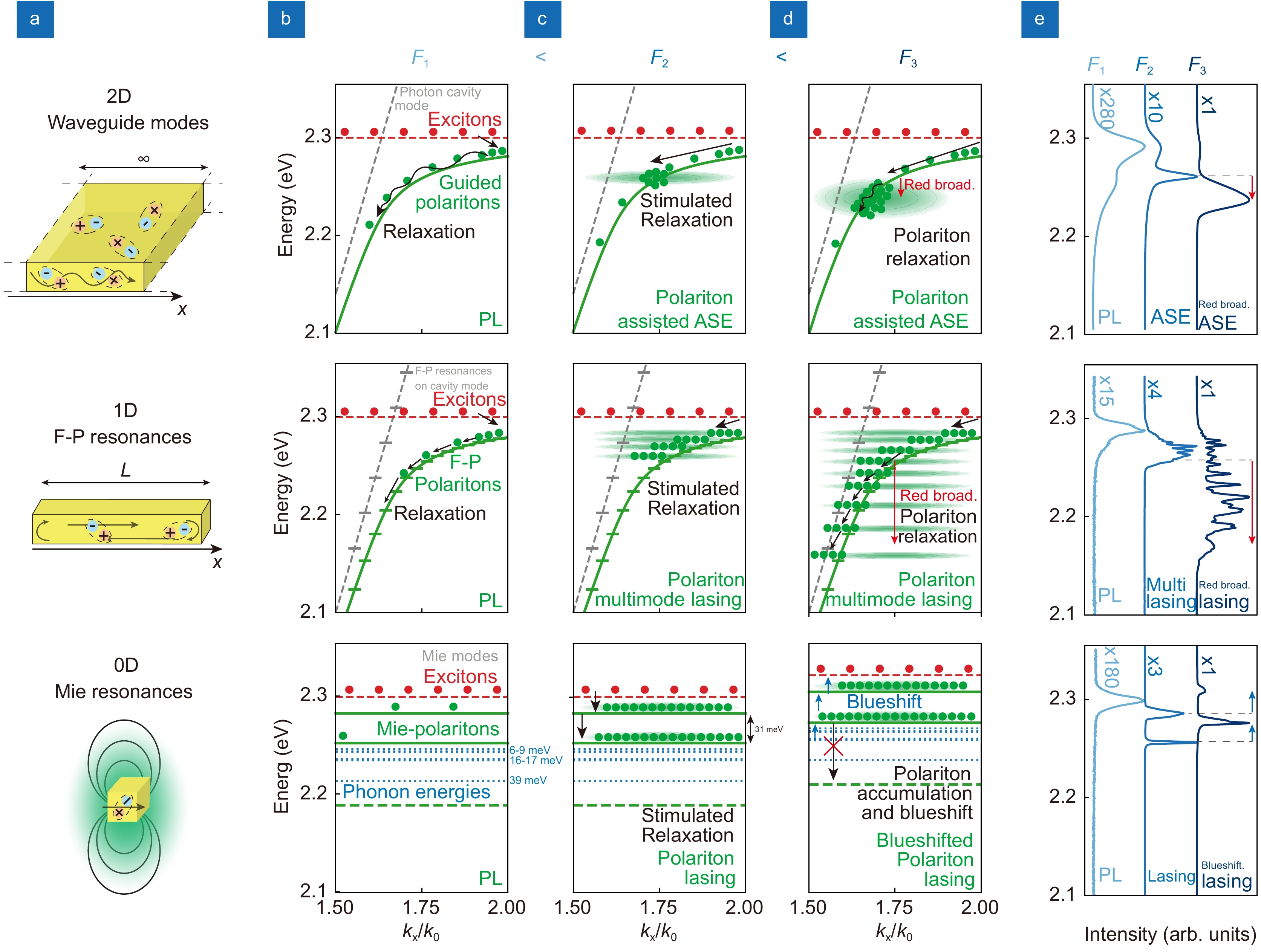
Here we exploit exciton-polariton condensation and mirror-image Mie modes in a cuboid CsPbBr3 nanoparticle to achieve coherent emission at the visible wavelength of around 0.53 μm from its ultra-small (≈0.007 μm3 or ≈λ3/20) semiconductor nanocavity. The polaritonic nature of the emission from the nanocavity localized in all three dimensions is proven by direct comparison with corresponding one-dimensional and two-dimensional waveguiding systems with similar material parameters.

Such a deeply subwavelength nanolaser is enabled not only by the high values for exciton binding energy (≈35 meV), refractive index (>2.5 at low temperature), and luminescence quantum yield of CsPbBr3, but also by the optimization of polaritons condensation on the Mie resonances with quality factors improved by the metallic substrate.

Moreover, the key parameters for optimal lasing conditions are intermode free spectral range and phonons spectrum in CsPbBr3, which govern polaritons condensation path. Such chemically synthesized colloidal CsPbBr3 nanolasers can be potentially deposited on arbitrary surfaces, which makes them a versatile tool for integration with various on-chip systems.
Polariton lasing in Mie-resonant perovskite nanocavity_1
Polariton lasing in Mie-resonant perovskite nanocavity_2
Polariton lasing in Mie-resonant perovskite nanocavity_3
Polariton lasing in Mie-resonant perovskite nanocavity_4
  • Fiber-optic microstructured sensors based on abrupt field patterns: theory, fabrication, and applications
  • Yuxuan Yi, Wanlai Zhu, Zao Yi, Zigang Zhou, Shubo Cheng, Majid Niaz Akhtar, Sohail Ahmad
  • Opto-Electronic Science
  • 2026-01-23
  • Integrated metasurface-freeform system enabled multi-focal planes augmented reality display
  • Shifei Zhang, Lina Gao, Yidan Zhao, Yongdong Wang, Bo Wang, Junjie Li, Jiaxi Duan, Dewen Cheng, Cheng-Wei Qiu, Yongtian Wang, Tong Yang, Lingling Huang
  • Opto-Electronic Science
  • 2026-01-23
  • Decoding subject-invariant emotional information from cardiac signals detected by photonic sensing system
  • Yukun Long, Rui Min Kun Xiao, Zhuo Wang, Lanfang Liu, Yifan Sun, Xiaoli Li, Zhaohui Li, Zeev Zalevsky
  • Opto-Electronic Technology
  • 2025-12-25
  • Integrated photonic synapses, neurons, memristors, and neural networks for photonic neuromorphic computing
  • Shufei Han, Weihong Shen, Min Gu, Qiming Zhang
  • Opto-Electronic Technology
  • 2025-12-25
  • Photoacoustic spectroscopy and light-induced thermoelastic spectroscopy based on inverted-triangular lithium niobate tuning fork
  • Junjie Mu, Guowei Han, Runqiu Wang, Shunda Qiao, Ying He Yufei Ma
  • Opto-Electronic Science
  • 2025-12-25
  • Thin-film lithium niobate-based detector: recent advances and perspectives
  • Xiaoli Sun, Yuechen Jia, Feng Chen
  • Opto-Electronic Science
  • 2025-12-25
  • In-situ and ex-situ twisted bilayer liquid crystal computing platform for reconfigurable image processing
  • Kang Zeng, Yougang Ke, Zhangming Hong, Linzhou Zeng, Xinxing Zhou
  • Opto-Electronic Advances
  • 2025-12-25
  • Highly textured single-crystal-like perovskite films for large-area, high-performance photodiodes
  • Runkai Liu, Feng Li, Rongkun Zheng
  • Opto-Electronic Advances
  • 2025-12-25
  • Robust performance of PTQ10:DTY6 in halogen-free photovoltaics across deposition techniques and configurations for industrial scale-up
  • Atiq Ur Rahman, Tanner M. Melody, Sydney Pfleiger, Acacia Patterson, Andrea Reale, Brian A. Collins
  • Opto-Electronic Advances
  • 2025-12-25
  • Surpassing the diffraction limit in long-range laser engineering via cross-scale vectorial optical field manipulation: perspectives and outlooks
  • Yinghui Guo, Mingbo Pu, Yang Li, Mingfeng Xu, Xiangang Luo
  • Opto-Electronic Advances
  • 2025-12-25
  • Spatiotemporal multiplexed photonic reservoir computing: parallel prediction for the high-dimensional dynamics of complex semiconductor laser network
  • Tong Yang, Li-Yue Zhang, Song-Sui Li, Wei Pan, Xi-Hua Zou, Lian-Shan Yan
  • Opto-Electronic Advances
  • 2025-12-25
  • Filament based ionizing radiation sensing
  • Pengfei Qi, Haiyi Liu, Jiewei Guo, Nan Zhang, Lu Sun, Shishi Tao, Binpeng Shang, Lie Lin Weiwei Liu
  • Opto-Electronic Advances
  • 2025-12-25


  • Fast source mask co-optimization method for high-NA EUV lithography        High-Q resonant Terahertz metasurfaces
    About
    |
    Contact
    |
    Copyright © PubCard