(Peer-Reviewed) Multi-photon neuron embedded bionic skin for high-precision complex texture and object reconstruction perception research
Hongyu Zhou 周泓宇 ¹ ², Chao Zhang 张超 ¹ ², Hengchang Nong 农恒昌 ¹ ², Junjie Weng 翁俊杰 ³, Dongying Wang 王冬迎 ⁴, Yang Yu 于洋 ¹, Jianfa Zhang 张检发 ⁵, Chaofan Zhang 张超凡 ⁶, Jinran Yu ⁶, Zhaojian Zhang 张兆健 ¹, Huan Chen 陈欢 ¹, Zhenrong Zhang 张振荣 ², Junbo Yang 杨俊波 ¹
¹ College of Science, National University of Defense Technology, Changsha 410073, China
中国 长沙 中国人民解放军国防科技大学理学院
² Key Laboratory of Multimedia Communication and Network Technology in Guangxi, School of Computer, Electronics and Information, Guangxi University, Nanning 530004, China
中国 南宁 广西大学计算机与电子信息学院 广西多媒体通信与网络技术重点实验室
³ College of Intelligence Science and Technology, National University of Defense Technology, Changsha 410073, China
中国 长沙 中国人民解放军国防科技大学智能科学学院
⁴ College of Meteorology and Oceanography, National University of Defense Technology, Changsha 410073, China
中国 长沙 中国人民解放军国防科技大学气象海洋学院
⁵ Hunan Provincial Key Laboratory of Novel Nano-Optoelectronic, Information Materials and Devices, National University of Defense Technology, Changsha 410073, China
中国 长沙 中国人民解放军国防科技大学新型纳米光电信息材料与器件湖南省重点实验室
⁶ College of Advanced Interdisciplinary Studies, National University of Defense Technology, Changsha 410073, China
中国 长沙 中国人民解放军国防科技大学前沿交叉学科学院
Opto-Electronic Advances
, 2025-01-22
Abstract
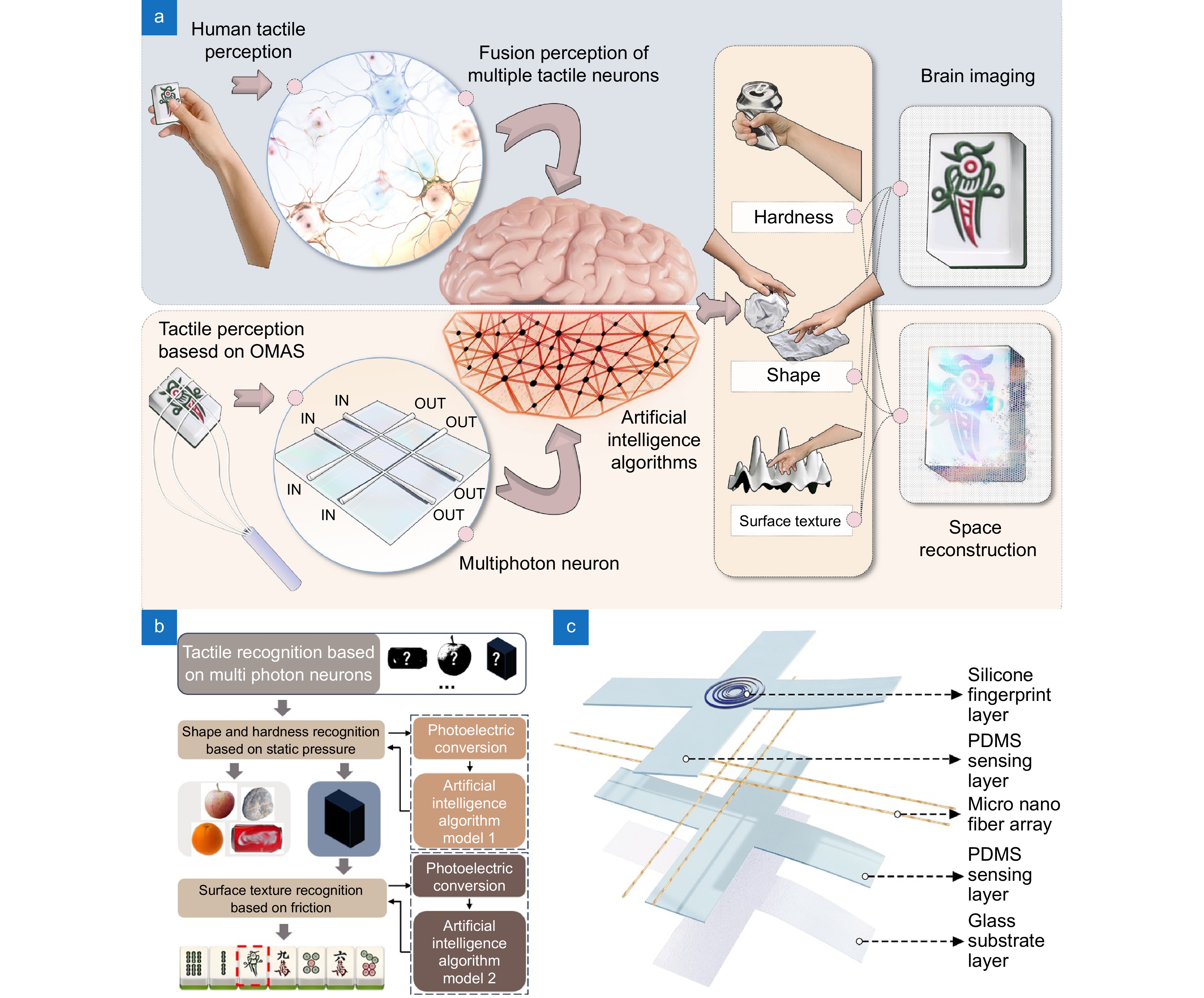
Attributable to the complex distribution of tactile vesicles under the skin and the ability of the brain to process specific tactile parameters (shape, hardness, and surface texture), human skin can have the capacity for tactile spatial reconstruction and visualization of complex object geometry and surface texture. However, current haptic sensor technologies are predominantly point sensors, which do not have an interlaced distribution structure similar to that of haptic vesicles, limiting their potential in human-computer interaction applications.
Here, we report an optical microfiber array skin (OMAS) imitating tactile vesicle interlaced structures for tactile visualization and object reconstruction sensing. This device is characterized by high sensitivity (−0.83 N/V) and fast response time (38 ms). We demonstrate that combining the signals collected by the OMAS with appropriate artificial intelligence algorithms enables the recognition of objects with different hardnesses and shapes with 100% accuracy.
It also allows for the classification of fabrics with different surface textures with 98.5% accuracy and Braille patterns with 99% accuracy. As a proof-of-concept, we integrated OMAS into a robot arm to select mahjong among six common objects and successfully recognize its suits by touch, which provides a new solution for tactile sensory processing for human-computer interaction.
Ultrafast all-optical modulation of wide-bandwidth pulses enabled by silicon-metasurfaces
Kaloyan Georgiev, Khosro Zangeneh Kamali, Anton A. Trifonov, Giulia Crotti, Lyuben Petrov, Stefan Georgiev, Hristo Iliev, Lei Xu, Unai Arregui Leon, Mohsen Rahmani, Giuseppe Della Valle, Ivan Buchvarov, Dragomir Neshev
Opto-Electronic Advances
2026-09-15
Physics-informed neural fields enable blind aberration correction for partially coherent quantitative phase imaging
Shun Zhou, Xingyu Huang, Linpeng Lu, Habib Ullah, Kaiyu Du, Maciej Trusiak, Malgorzata Kujawinska, Yuzhen Zhang, Yao Fan, Qian Chen, Qinrong Zhang, Chao Zuo
Opto-Electronic Science
2026-08-26
Heterogeneously integrated micro-ring with SnS₂ for dual-functional optical modulation and photodetection
Jinyi Du, Lidan Lu, Xu Zhang, Bofei Zhu, Wenbo Bo, Yingjie Xu, Guang Chen, Yanlin He, Guanghui Ren, Xiaoping Lou, Zheng You, Lianqing Zhu
Opto-Electronic Advances
2026-08-25
Hardware-aware lightweight photonic spiking neural network for pattern classification
Shuiying Xiang, Yahui Zhang, Shangxuan Shi, Haowen Zhao, Dianzhuang Zheng, Xingxing Guo, Yanan Han, Ye Tian, Liyue Zhang, Yuechun Shi, Yue Hao
Opto-Electronic Advances
2026-08-25
PhyspeNet: An empirical physics-aware network for adaptive speckle reconstructive spectrometry
Junrui Liang, Min Jiang, Jun Li, Zhongming Huang, Junhong He, Yanting Guo, Yanzhao Ke, Jun Ye, Jiangming Xu, Jinyong Leng, Pu Zhou
Opto-Electronic Advances
2026-08-25
A 36 × 240 Gbps hybrid mode/wavelength division multiplexing transmitter using lithium niobate on insulator
Mingyu Zhu, Weihan Wang, Ruitao Ma, Aoyun Gao, Chun Gao, Zexu Wang, Fei Huang, Zhenyuan Bao, Dajian Liu, Jiaxuan Gan, Zejie Yu, Huan Li, Weike Zhao, Daoxin Dai
Opto-Electronic Advances
2026-08-25