(Peer-Reviewed) Flexibility analysis for continuous ibuprofen manufacturing processes
Wenhui Yang 杨雯惠 ¹, Haoyu Yin ², Zhihong Yuan 袁志宏 ¹, Bingzhen Chen 陈丙珍 ³
¹ State Key Laboratory of Chemical Engineering, Department of Chemical Engineering, Tsinghua University, Beijing 100084, China
中国 北京 清华大学化学工程系 化学工程联合国家重点实验室
² School of Material Science and Engineering, Tsinghua University, Beijing 100084, China
中国 北京 清华大学材料学院
³ Department of Chemical Engineering, Tsinghua University, Beijing 100084, China
中国 北京 清华大学化学工程系
Abstract
Continuous ibuprofen (a widespread used analgesic drug) manufacturing is full of superiorities and is a fertile field both in industry and academia since it can not only effectively treat rheumatic and other chronic and painful diseases, but also shows great potential in dental diseases.
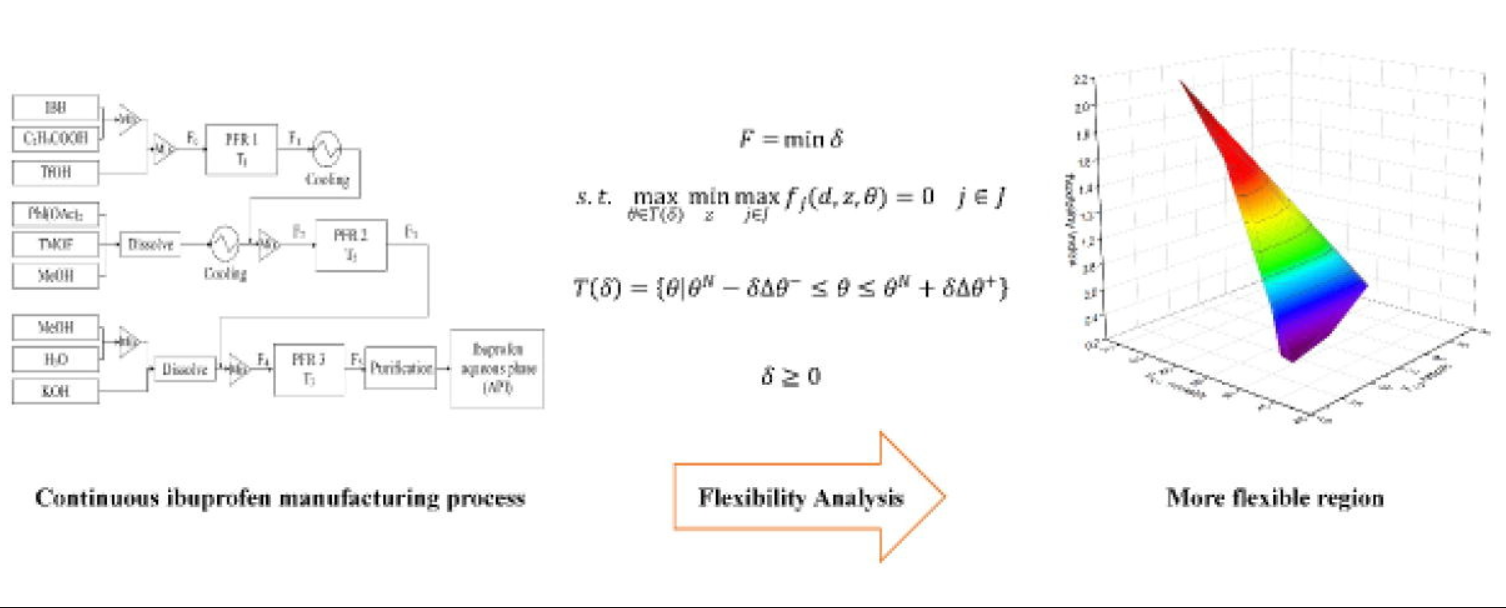
As one of central elements of operability analysis, flexibility analysis is in charge of the quantitative assessment of the capability to guarantee the feasible operation in face of variations on uncertain parameters. In this paper, we focus on the flexibility index calculation for the continuous ibuprofen manufacturing process. We update existing state-of-the-art formulations, which traditionally lead to the max-max-max optimization problem, to approach the calculation of the flexibility index with a favorable manner. Advantages regarding the size of the mathematical model and the computational CPU time of the modified method are examined by four cases.
In addition to identifying the flexibility index without any consideration of control variables, we also investigate the effects of different combinations of control variables on the flexibility property to reveal the benefits from taking recourse actions into account.
Results from systematic investigations are expected to provide a solid basis for the further control system design and optimal operation of continuous ibuprofen manufacturing.
Ultrafast all-optical modulation of wide-bandwidth pulses enabled by silicon-metasurfaces
Kaloyan Georgiev, Khosro Zangeneh Kamali, Anton A. Trifonov, Giulia Crotti, Lyuben Petrov, Stefan Georgiev, Hristo Iliev, Lei Xu, Unai Arregui Leon, Mohsen Rahmani, Giuseppe Della Valle, Ivan Buchvarov, Dragomir Neshev
Opto-Electronic Advances
2026-09-15
Physics-informed neural fields enable blind aberration correction for partially coherent quantitative phase imaging
Shun Zhou, Xingyu Huang, Linpeng Lu, Habib Ullah, Kaiyu Du, Maciej Trusiak, Malgorzata Kujawinska, Yuzhen Zhang, Yao Fan, Qian Chen, Qinrong Zhang, Chao Zuo
Opto-Electronic Science
2026-08-26
Heterogeneously integrated micro-ring with SnS₂ for dual-functional optical modulation and photodetection
Jinyi Du, Lidan Lu, Xu Zhang, Bofei Zhu, Wenbo Bo, Yingjie Xu, Guang Chen, Yanlin He, Guanghui Ren, Xiaoping Lou, Zheng You, Lianqing Zhu
Opto-Electronic Advances
2026-08-25
Hardware-aware lightweight photonic spiking neural network for pattern classification
Shuiying Xiang, Yahui Zhang, Shangxuan Shi, Haowen Zhao, Dianzhuang Zheng, Xingxing Guo, Yanan Han, Ye Tian, Liyue Zhang, Yuechun Shi, Yue Hao
Opto-Electronic Advances
2026-08-25
PhyspeNet: An empirical physics-aware network for adaptive speckle reconstructive spectrometry
Junrui Liang, Min Jiang, Jun Li, Zhongming Huang, Junhong He, Yanting Guo, Yanzhao Ke, Jun Ye, Jiangming Xu, Jinyong Leng, Pu Zhou
Opto-Electronic Advances
2026-08-25
A 36 × 240 Gbps hybrid mode/wavelength division multiplexing transmitter using lithium niobate on insulator
Mingyu Zhu, Weihan Wang, Ruitao Ma, Aoyun Gao, Chun Gao, Zexu Wang, Fei Huang, Zhenyuan Bao, Dajian Liu, Jiaxuan Gan, Zejie Yu, Huan Li, Weike Zhao, Daoxin Dai
Opto-Electronic Advances
2026-08-25