(Peer-Reviewed) Residual-stress relaxation mechanism and model description of 5052H32 Al alloy spun ellipsoidal heads during annealing treatment
Yong-Cheng Lin 蔺永诚, Jiang-Shan Zhu 朱江山, Jia-Yang Chen, Jun-Quan Wang
School of Mechanical and Electrical Engineering, Central South University, Changsha, 410083, People's Republic of China
中国 长沙 中南大学机电工程学院
Abstract
Marginal-restraint mandrel-free spinning is an advanced technology for manufacturing ellipsoidal heads with large diameter-thickness ratios. Nevertheless, the spinning-induced residual stress, which greatly influences the in-service performance of spun heads, should be removed.
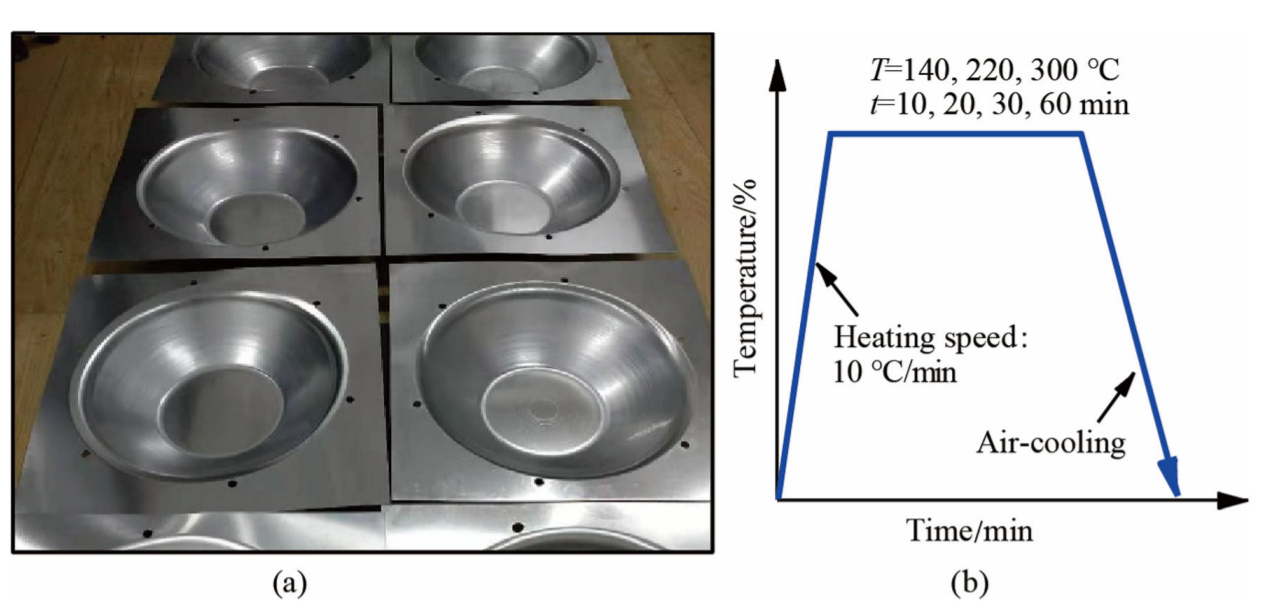
In this study, the effects of annealing on the residual-stress relaxation behavior of 5052H32 aluminum alloy spun heads were investigated. It is found that the residual stress first rapidly decreases and then remains steady with the increase in annealing time at the tested annealing temperatures. The relaxation of the residual stress becomes increasingly obvious with the increase in annealing temperature. When the annealing temperature is less than 220 °C, there are no obvious changes in grain size. Moreover, the spinning-induced dislocations are consumed by the static recovery behavior, which decreases the residual stress during annealing. When the annealing temperature is approximately 300 °C, the broken grains transform into equiaxed grains.
In addition, static recrystallization and recovery behaviors occur simultaneously to promote the relaxation of the residual stress. Considering the different stress relaxation mechanisms, a model based on the Zener-Wert-Avrami equation was established to predict the residual-stress relaxation behavior. Finally, the optimized annealing temperature and time were approximately 300 °C and 30 min, respectively.
Ultrafast all-optical modulation of wide-bandwidth pulses enabled by silicon-metasurfaces
Kaloyan Georgiev, Khosro Zangeneh Kamali, Anton A. Trifonov, Giulia Crotti, Lyuben Petrov, Stefan Georgiev, Hristo Iliev, Lei Xu, Unai Arregui Leon, Mohsen Rahmani, Giuseppe Della Valle, Ivan Buchvarov, Dragomir Neshev
Opto-Electronic Advances
2026-09-15
Physics-informed neural fields enable blind aberration correction for partially coherent quantitative phase imaging
Shun Zhou, Xingyu Huang, Linpeng Lu, Habib Ullah, Kaiyu Du, Maciej Trusiak, Malgorzata Kujawinska, Yuzhen Zhang, Yao Fan, Qian Chen, Qinrong Zhang, Chao Zuo
Opto-Electronic Science
2026-08-26
Heterogeneously integrated micro-ring with SnS₂ for dual-functional optical modulation and photodetection
Jinyi Du, Lidan Lu, Xu Zhang, Bofei Zhu, Wenbo Bo, Yingjie Xu, Guang Chen, Yanlin He, Guanghui Ren, Xiaoping Lou, Zheng You, Lianqing Zhu
Opto-Electronic Advances
2026-08-25
Hardware-aware lightweight photonic spiking neural network for pattern classification
Shuiying Xiang, Yahui Zhang, Shangxuan Shi, Haowen Zhao, Dianzhuang Zheng, Xingxing Guo, Yanan Han, Ye Tian, Liyue Zhang, Yuechun Shi, Yue Hao
Opto-Electronic Advances
2026-08-25
PhyspeNet: An empirical physics-aware network for adaptive speckle reconstructive spectrometry
Junrui Liang, Min Jiang, Jun Li, Zhongming Huang, Junhong He, Yanting Guo, Yanzhao Ke, Jun Ye, Jiangming Xu, Jinyong Leng, Pu Zhou
Opto-Electronic Advances
2026-08-25
A 36 × 240 Gbps hybrid mode/wavelength division multiplexing transmitter using lithium niobate on insulator
Mingyu Zhu, Weihan Wang, Ruitao Ma, Aoyun Gao, Chun Gao, Zexu Wang, Fei Huang, Zhenyuan Bao, Dajian Liu, Jiaxuan Gan, Zejie Yu, Huan Li, Weike Zhao, Daoxin Dai
Opto-Electronic Advances
2026-08-25