(Peer-Reviewed) Terahertz active multi-channel vortices with parity symmetry breaking and near/far field multiplexing based on a dielectric-liquid crystal-plasmonic metadevice
Yiming Wang 王一茗 ¹, Fei Fan 范飞 ¹ ², Huijun Zhao 赵慧君 ¹, Yunyun Ji 冀允允 ², Jing Liu 刘静 ¹, Shengjiang Chang 常胜江 ²
¹ Institute of Modern Optics, Nankai University, Tianjin Key Laboratory of Micro-scale Optical Information Science and Technology, Tianjin 300350, China
中国 天津 南开大学现代光学研究所 天津市微尺度光学信息技术科学重点实验室
² Tianjin Key Laboratory of Optoelectronic Sensor and Sensing Network Technology, Tianjin 300350, China
中国 天津 天津市光电传感器与传感网络技术重点实验室
Opto-Electronic Advances
, 2025-03-06
Abstract
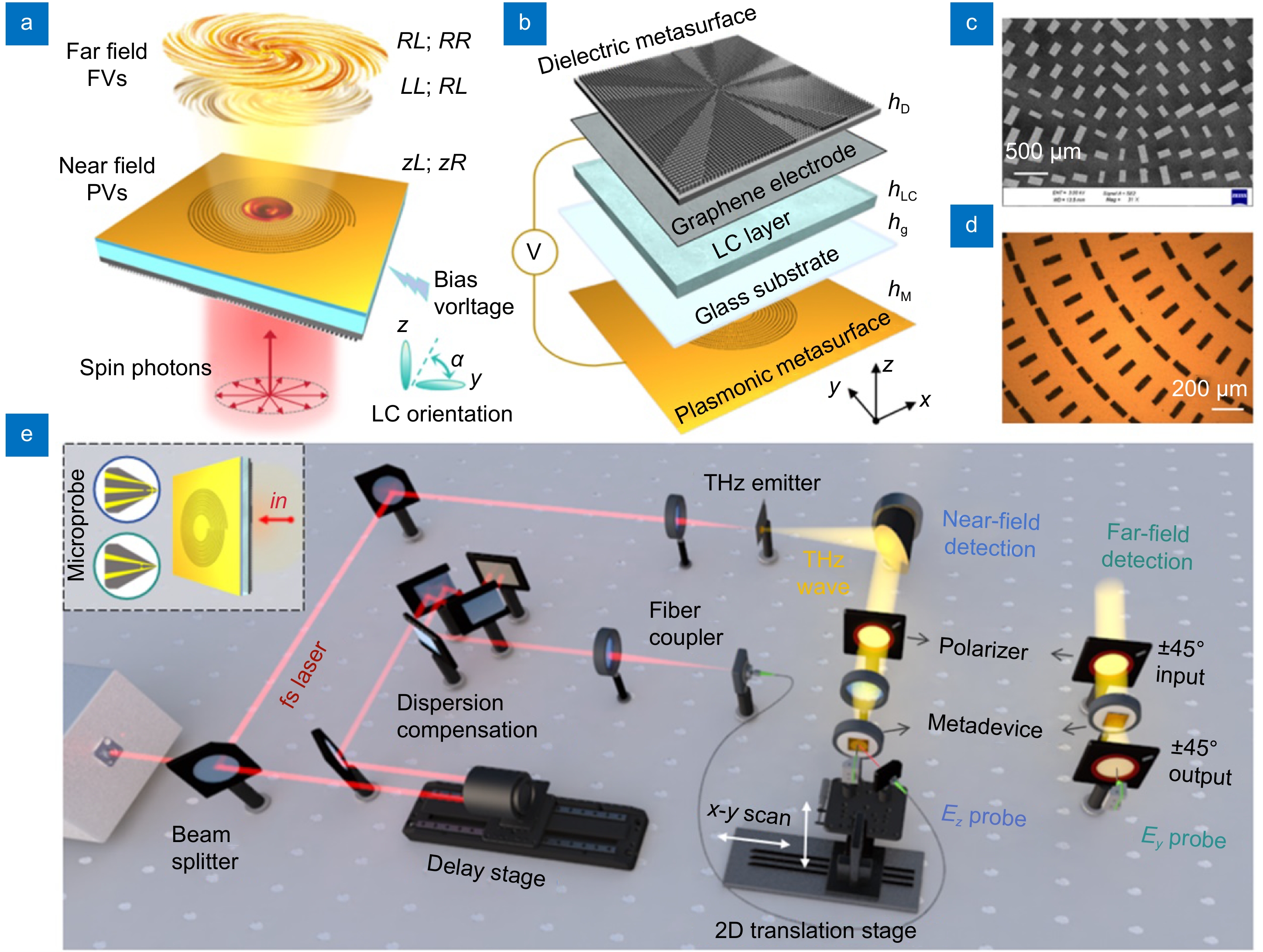
Vortex beams carrying orbital angular momentum (OAM) are of great significance for high-capacity communication and super-resolution imaging. However, there is a huge gap between the free-space vortices (FVs) and plasmonic vortices (PVs) on chips, and active manipulation as well as multiplexing in more channels have become a pressing demand.
In this work, we demonstrate a terahertz (THz) cascaded metadevice composed of a helical plasmonic metasurface, a liquid crystal (LC) layer, and a helical dielectric metasurface. By spin-orbital angular momentum coupling and photon state superposition, PVs and FVs are generated with mode purity of over 85% on average. Due to the inversion asymmetric design of the helical metasurfaces, the parity symmetry breaking of OAM is realized (the topological charge numbers no longer occur in positive and negative pairs, but all are positive), generating 6 independent channels associated with the decoupled spin states and the near-/far- field positions.
Moreover, by the LC integration, dynamic mode switching and energy distribution can be realized, finally obtaining up to 12 modes with a modulation ratio of above 70%. This active tuning and multi-channel multiplexing metadevice establishes a bridge connection between the PVs and FVs, exhibiting promising applications in THz communication, intelligent perception, and information processing.
Ultrafast all-optical modulation of wide-bandwidth pulses enabled by silicon-metasurfaces
Kaloyan Georgiev, Khosro Zangeneh Kamali, Anton A. Trifonov, Giulia Crotti, Lyuben Petrov, Stefan Georgiev, Hristo Iliev, Lei Xu, Unai Arregui Leon, Mohsen Rahmani, Giuseppe Della Valle, Ivan Buchvarov, Dragomir Neshev
Opto-Electronic Advances
2026-09-15
Physics-informed neural fields enable blind aberration correction for partially coherent quantitative phase imaging
Shun Zhou, Xingyu Huang, Linpeng Lu, Habib Ullah, Kaiyu Du, Maciej Trusiak, Malgorzata Kujawinska, Yuzhen Zhang, Yao Fan, Qian Chen, Qinrong Zhang, Chao Zuo
Opto-Electronic Science
2026-08-26
Heterogeneously integrated micro-ring with SnS₂ for dual-functional optical modulation and photodetection
Jinyi Du, Lidan Lu, Xu Zhang, Bofei Zhu, Wenbo Bo, Yingjie Xu, Guang Chen, Yanlin He, Guanghui Ren, Xiaoping Lou, Zheng You, Lianqing Zhu
Opto-Electronic Advances
2026-08-25
Hardware-aware lightweight photonic spiking neural network for pattern classification
Shuiying Xiang, Yahui Zhang, Shangxuan Shi, Haowen Zhao, Dianzhuang Zheng, Xingxing Guo, Yanan Han, Ye Tian, Liyue Zhang, Yuechun Shi, Yue Hao
Opto-Electronic Advances
2026-08-25
PhyspeNet: An empirical physics-aware network for adaptive speckle reconstructive spectrometry
Junrui Liang, Min Jiang, Jun Li, Zhongming Huang, Junhong He, Yanting Guo, Yanzhao Ke, Jun Ye, Jiangming Xu, Jinyong Leng, Pu Zhou
Opto-Electronic Advances
2026-08-25
A 36 × 240 Gbps hybrid mode/wavelength division multiplexing transmitter using lithium niobate on insulator
Mingyu Zhu, Weihan Wang, Ruitao Ma, Aoyun Gao, Chun Gao, Zexu Wang, Fei Huang, Zhenyuan Bao, Dajian Liu, Jiaxuan Gan, Zejie Yu, Huan Li, Weike Zhao, Daoxin Dai
Opto-Electronic Advances
2026-08-25