(Peer-Reviewed) Harmonic heterostructured pure Ti fabricated by laser powder bed fusion for excellent wear resistance via strength-plasticity synergy
Desheng Li 李德胜 ¹, Huanrong Xie ², Chengde Gao 高成德 ¹, Huan Jiang ¹, Liyuan Wang ¹, Cijun Shuai 帅词俊 ¹ ³
¹ State Key Laboratory of Precision Manufacturing for Extreme Service Performance, College of Mechanical and Electrical Engineering, Central South University, Changsha 410083, China
中国 长沙 中南大学机电工程学院 极端服役性能精准制造全国重点实验室
² Dundee International Institute, Central South University, Changsha 410083, China
中国 长沙 中南大学邓迪国际学院
³ Jiangxi Province Key Laboratory of Additive Manufacturing of Implantable Medical Device, Jiangxi University of Science and Technology, Nanchang 330013, China
中国 南昌 江西理工大学植入医疗器械增材制造江西省重点实验室
Opto-Electronic Advances, 2025-09-25
Abstract
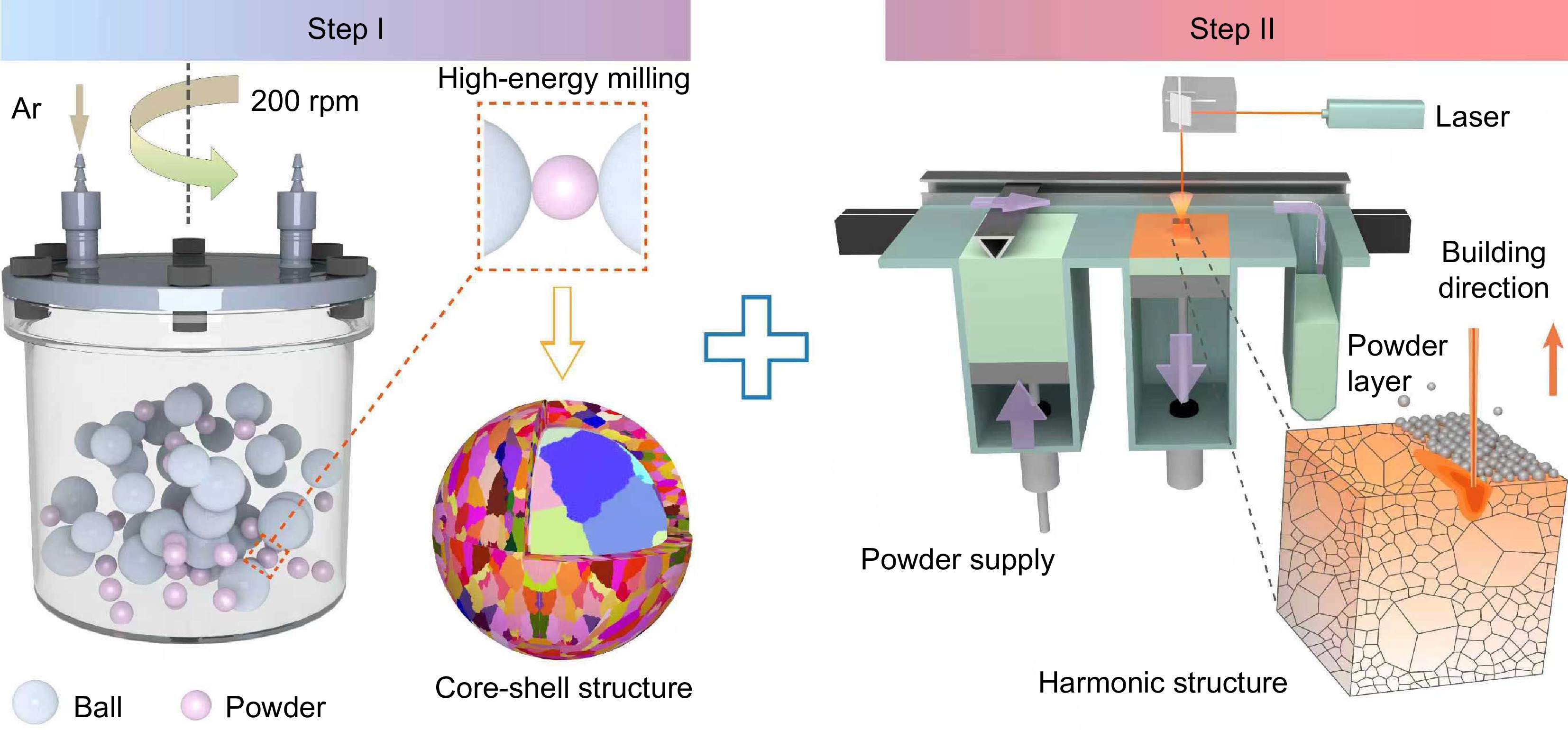
Titanium (Ti) is a promising candidate for biomedical implants due to lightweight, superior corrosion resistance and biocompatibility. Nevertheless, pure Ti is confronted with poor wear resistance which poses a profound bottleneck for orthopedic implant applications. In this work, a novel and feasible route of mechanical milling (MM) and laser powder bed fusion (LPBF) was first developed for architecting highly tunable heterostructure in pure Ti, aiming to overcome wear resistance dilemma.
During MM process, a spatial core-shell heterostructure within Ti particle was triggered by manipulating gradient and intense plastic deformation, accompanied with pre-existing dislocations. In subsequent LPBF process, the highly transient-melting kinetics and localized nature effectively perpetuated grain heterogeneity, hence creating a harmonic heterostructure within consolidated pure Ti. Consequently, the heterostructured Ti exhibited an excellent enhanced wear resistance (33.7%) compared to the homogeneous counterpart, which was attributed to a marvelous strength-plasticity synergy motivated by the hetero-deformation induced strengthening and strain-hardening.
Furthermore, back-stress caused by geometrical necessary dislocation pile-ups offset partial wear shear-stress, also contributing to wear resistance enhancement. This study not only provides a manoeuvrable and paradigm route to fabricate Ti with conspicuous strength-plasticity synergy and wear resistance, but also sheds light on developing and extending cutting-edge biomedical implant applications.
Heterogeneously integrated micro-ring with SnS₂ for dual-functional optical modulation and photodetection
Jinyi Du, Lidan Lu, Xu Zhang, Bofei Zhu, Wenbo Bo, Yingjie Xu, Guang Chen, Yanlin He, Guanghui Ren, Xiaoping Lou, Zheng You, Lianqing Zhu
Opto-Electronic Advances
2026-08-25
Hardware-aware lightweight photonic spiking neural network for pattern classification
Shuiying Xiang, Yahui Zhang, Shangxuan Shi, Haowen Zhao, Dianzhuang Zheng, Xingxing Guo, Yanan Han, Ye Tian, Liyue Zhang, Yuechun Shi, Yue Hao
Opto-Electronic Advances
2026-08-25
PhyspeNet: An empirical physics-aware network for adaptive speckle reconstructive spectrometry
Junrui Liang, Min Jiang, Jun Li, Zhongming Huang, Junhong He, Yanting Guo, Yanzhao Ke, Jun Ye, Jiangming Xu, Jinyong Leng, Pu Zhou
Opto-Electronic Advances
2026-08-25
A 36 × 240 Gbps hybrid mode/wavelength division multiplexing transmitter using lithium niobate on insulator
Mingyu Zhu, Weihan Wang, Ruitao Ma, Aoyun Gao, Chun Gao, Zexu Wang, Fei Huang, Zhenyuan Bao, Dajian Liu, Jiaxuan Gan, Zejie Yu, Huan Li, Weike Zhao, Daoxin Dai
Opto-Electronic Advances
2026-08-25
Light-perception-based interactive control of an underwater digital twin hand
Jinlong Lu, Chao Zhang, Hengchang Nong, Dongying Wang, Hongyu Zhou, Junjie Weng, Yuehua Deng, Yang Yu, Qiang Bian, Jianfa Zhang, Chaofan Zhang, Zhenrong Zhang, Junbo Yang
Opto-Electronic Advances
2026-07-10