(Peer-Reviewed) Digital twin optical computing system
Run Sun 孙润 ¹ ², Yuemin Li 李悦旻 ¹ ², Tingzhao Fu 符庭钊 ³, Wencan Liu 刘文灿 ¹ ², Sigang Yang 杨四刚 ¹ ², Hongwei Chen 陈宏伟 ¹ ²
¹ Department of Electronic Engineering, Tsinghua University, Beijing 100084, China
中国 北京 清华大学电子工程系
² Beijing National Research Center for Information Science and Technology, Beijing 100084, China
中国 北京 北京信息科学与技术国家研究中心
³ College of Advanced Interdisciplinary Studies & Hunan Provincial Key Laboratory of Novel Nano-Optoelectronic Information Materials and Devices, National University of Defense Technology, Changsha 410073, China
中国 长沙 国防科技大学前沿交叉学科学院 新型纳米光电信息材料与器件湖南省重点实验室
Opto-Electronic Advances, 2026-07-10
Abstract
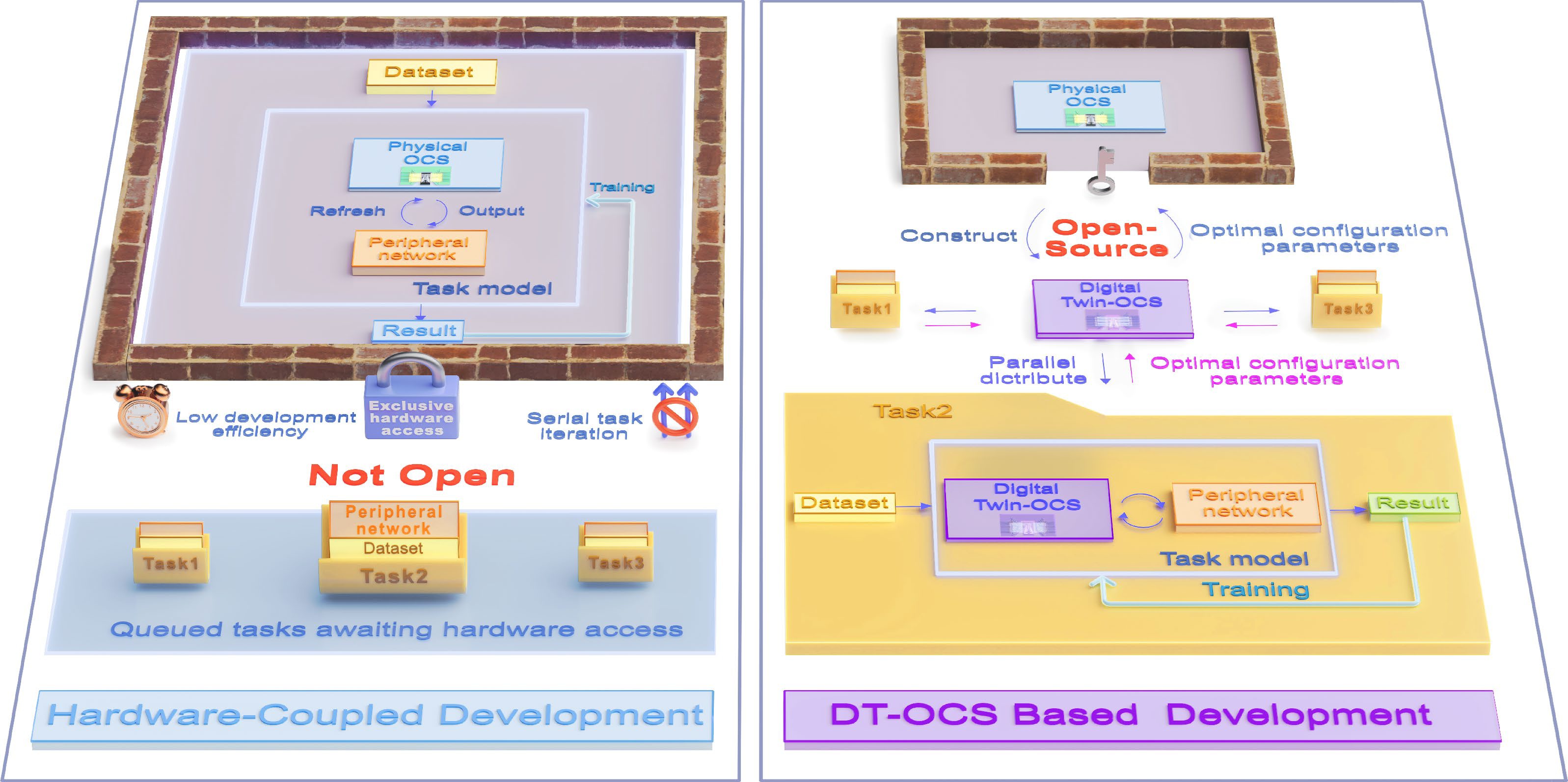
Optical computing systems (OCS) are promising accelerators for artificial intelligence due to their high bandwidth, low latency, and inherent parallelism. However, in existing OCS implementations, task development often requires direct participation of physical hardware during training and optimization, tightly coupling development workflows to device access and limiting offline design, reproducible benchmarking, and parallel exploration.
Here, we propose a Digital Twin Optical Computing System (DT-OCS), a system-level, measurement-driven digital surrogate that emulates the end-to-end input-output behavior of a specific physical OCS under different operating configurations. DT-OCS is implemented as a differentiable software module, enabling fully offline task training and configuration optimization. The optimized configuration parameters can be directly transferred to the physical OCS without hardware-in-the-loop retraining. We validate DT-OCS on a high-speed optical computing system operating at 10 GHz and equipped with a silicon-based integrated computing chip. Representative tasks, including image classification and temporal strategy generation, are evaluated.
Across all tasks, the transferred models closely match the performance of their digital-twin counterparts after direct parameter transfer. These results demonstrate that DT-OCS enables a hardware-decoupled and fully offline development paradigm for optical computing systems. The DT-OCS implementation is released as open-source code to facilitate reuse and further development.
A flexible wireless system for prospective photodynamic therapy applications
Rolan Mansour, Bhavani Yalagala, Vikas Vikas, Nikolas Bruce, Fawziye Tarhini, Georgios N. Arvanitakis, Mohammed Mughal, Jamie Blanche, Ahmad Taha, Jonathan Copper, Muhammad Imran, Karin Williams, Karin Oien, Mahmoud Wagih, Hadi Heidari, Robert Hadfield, David Flynn
Opto-Electronic Advances
2026-07-10
Parallel bright-field and multi-order edge imaging via wide field-of-view trichannel metalens
Xiaotong Li, Yeseul Kim, Youngsun Jeon, Junhwa Seong, Jaekyung Kim, Peng Tang, Shiqi Hu, Harit Keawmuang, Beomha Yang, Dongmin Jeon, Le Dai, Weiyan Li, Xiaodong Cai, Jinhui Shi, Yong-Sang Ryu, Trevon Badloe, Junsuk Rho
Opto-Electronic Advances
2026-07-10