(Peer-Reviewed) All-climate aqueous Na-ion batteries using “Water-in-Salt” electrolyte
Yu Zhang ¹, Jie Xua ¹, Zhi Li ¹, Yanrong Wang ¹, Sijia Wang ², Xiaoli Dong 董晓丽 ¹, Yonggang Wang 王永刚 ¹
¹ Department of Chemistry and Shanghai Key Laboratory of Molecular Catalysis and Innovative Materials, Institute of New Energy, iChEM (Collaborative Innovation Center of Chemistry for Energy Materials), Fudan University, Shanghai 200433, China
中国 上海复旦大学化学系、上海市分子催化和功能材料重点实验室、复旦大学新能源研究院、能源材料化学协同创新中心
² College of Pharmacy, Henan University of Chinese Medicine, Zhengzhou 450046, China
中国 郑州 河南中医药大学药学院
Science Bulletin, 2021-08-17
Abstract
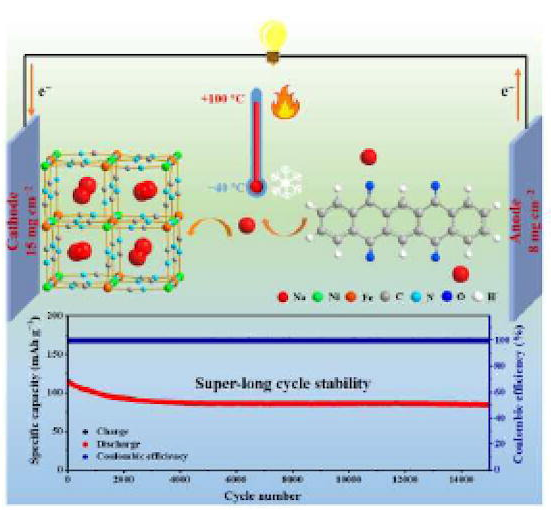
Aqueous Na-ion batteries have been extensively studied for large-scale energy storage systems. However, their wide application is still limited by their inferior cycle stability (< 3000 cycles) and poor temperature tolerance. Furthermore, many of the reported high rate behaviors are achieved at a low mass loading (<3 mg cm−2) of the electrodes. Herein, we propose an aqueous Na-ion battery which includes a Ni-based Prussian blue (NiHCF) cathode, a carbonyl-based organic compound, 5,7,12,14-pentacenetetrone (PT) anode and a “water-in-salt” electrolyte (17 mol kg−1 NaClO4 in water).
Its operation involves the reversible coordination reaction of the PT anode and the extraction/insertion of Na+ in the NiHCF cathode. It is demonstrated that the wide internal spaces of the PT anode and NiHCF cathode can not only buffer the volumetric change induced by Na+ storage, but also enable fast kinetics.
The full cell exhibits a supercapacitor-like rate performance of 50 A g−1 (corresponding to a discharge or charge within 6.3 s) and a super-long lifespan of 15,000 cycles. Moreover, the excellent rate performance can still be preserved even with a high mass loading of the electrodes (15 mgNiHCF cm−2 and 8 mgPT cm−2). Especially, the cell can work well in a wide temperature range, from −40 to 100 °C, showing a typical all-climate operation.
Light-perception-based interactive control of an underwater digital twin hand
Jinlong Lu, Chao Zhang, Hengchang Nong, Dongying Wang, Hongyu Zhou, Junjie Weng, Yuehua Deng, Yang Yu, Qiang Bian, Jianfa Zhang, Chaofan Zhang, Zhenrong Zhang, Junbo Yang
Opto-Electronic Advances
2026-07-10
Unlocking home-based nocturnal health management: A fiber-optic approach for early detection of cardiorespiratory rhythm disorders
Hanyu Jin, Hao Li, Zhuolin Chen, Liangye Li, Zurui Wang, Kai Zhou, Weijian Hang, Zhipeng Chen, Junfeng Chen, Kai Shen, Jianfeng Wen, Chen Chen, Cunzheng Fan, Zhijun Yan, Feng Wang, Qizhen Sun
Opto-Electronic Advances
2026-07-10
A flexible wireless system for prospective photodynamic therapy applications
Rolan Mansour, Bhavani Yalagala, Vikas Vikas, Nikolas Bruce, Fawziye Tarhini, Georgios N. Arvanitakis, Mohammed Mughal, Jamie Blanche, Ahmad Taha, Jonathan Copper, Muhammad Imran, Karin Williams, Karin Oien, Mahmoud Wagih, Hadi Heidari, Robert Hadfield, David Flynn
Opto-Electronic Advances
2026-07-10
Parallel bright-field and multi-order edge imaging via wide field-of-view trichannel metalens
Xiaotong Li, Yeseul Kim, Youngsun Jeon, Junhwa Seong, Jaekyung Kim, Peng Tang, Shiqi Hu, Harit Keawmuang, Beomha Yang, Dongmin Jeon, Le Dai, Weiyan Li, Xiaodong Cai, Jinhui Shi, Yong-Sang Ryu, Trevon Badloe, Junsuk Rho
Opto-Electronic Advances
2026-07-10