(Peer-Reviewed) Stretchable and self-healable hydrogel artificial skin
Bin Xue 薛斌 ¹, Hui Sheng 盛卉 ¹, Yongqiang Li ¹, Lan Li ², Weishuai Di 邸维帅 ¹, Zhengyu Xu 徐铮宇 ¹, Linjie Ma 马林杰 ¹, Xin Wang 王鑫 ¹, Haoting Jiang 姜鹤亭 ¹, Meng Qin 秦猛 ¹, Zhibo Yan ¹, Qing Jiang 蒋青 ², Jun-Ming Liu ¹, Wei Wang 王炜 ¹ ³, Yi Cao 曹毅 ¹ ³ ⁴
¹ National Laboratory of Solid State Microstructures, Department of Physics, Nanjing University, Nanjing 210093, China; 南京大学 物理学院 固体微结构物理国家重点实验室
² State Key Laboratory of Pharmaceutical Biotechnology, Department of Sports Medicine and Adult Reconstructive Surgery, Drum Tower Hospital affiliated to Medical School of Nanjing University, Nanjing 210008, China; 南京大学医学院附属鼓楼医院 运动医学与成人重建外科 医药生物技术国家重点实验室
³ Institute for Brain Sciences, Nanjing University, Nanjing 210093, China; 南京大学 脑科学研究院
⁴ Chemistry and Biomedicine Innovation Center, Nanjing University, Nanjing 210093, China 南京大学 化学和生物医药创新研究院
National Science Review, 2021-08-14
Abstract
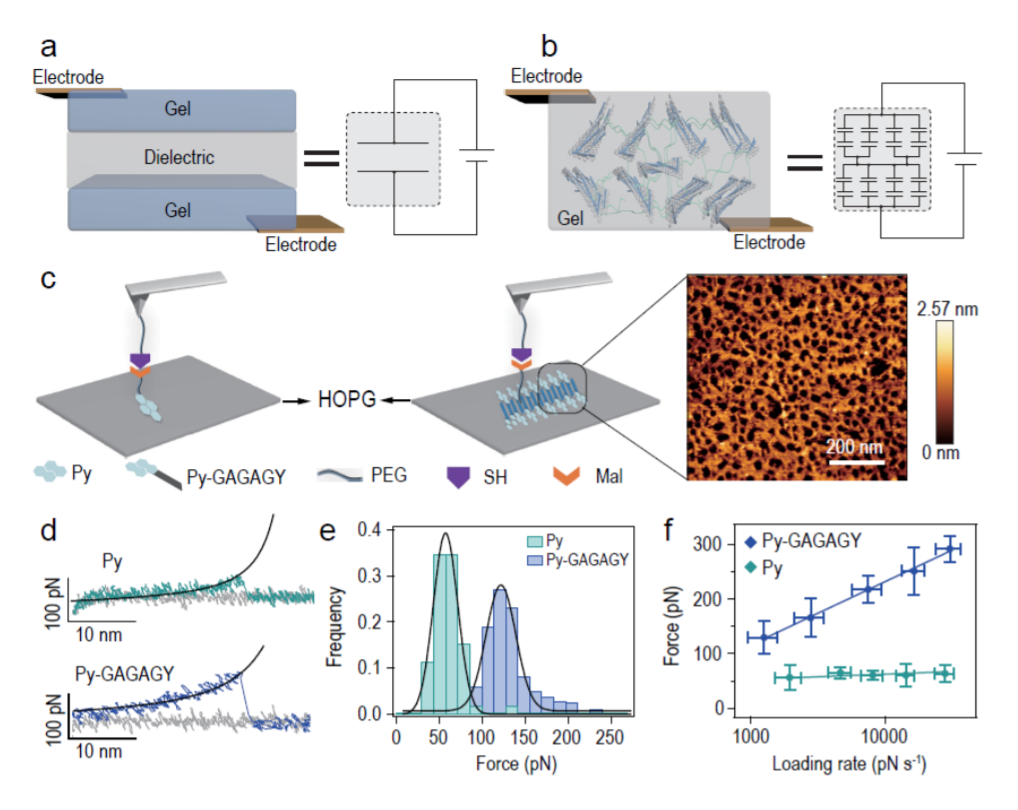
Hydrogels have emerged as promising materials for the construction of skin-like mechanical sensors. The common design of hydrogel-based artificial skin requires a dielectric sandwiched between two hydrogel layers for capacitive sensing. However, such a planar configuration limits the sensitivity, stretchability and self-healing properties.
Here, we report the design of single-layer composite hydrogels with bulk capacitive junctions as mechanical sensors. We engineer dielectric peptide-coated graphene (PCG) to serve as homogenously dispersed electric double layers in hydrogels. Any mechanical motions that alter the microscopic distributions of PCG in the hydrogels can significantly change the overall capacitance. We use peptide self-assembly to render strong yet dynamic interfacial interactions between the hydrogel network and graphene. The resulting hydrogels can be stretched up to 77 times their original length and self-heal in a few minutes. The devices can effectively sense strain and pressure in both air and aqueous environments, providing tremendous opportunities for next-generation iontronics.
Heterogeneously integrated micro-ring with SnS₂ for dual-functional optical modulation and photodetection
Jinyi Du, Lidan Lu, Xu Zhang, Bofei Zhu, Wenbo Bo, Yingjie Xu, Guang Chen, Yanlin He, Guanghui Ren, Xiaoping Lou, Zheng You, Lianqing Zhu
Opto-Electronic Advances
2026-08-25
Hardware-aware lightweight photonic spiking neural network for pattern classification
Shuiying Xiang, Yahui Zhang, Shangxuan Shi, Haowen Zhao, Dianzhuang Zheng, Xingxing Guo, Yanan Han, Ye Tian, Liyue Zhang, Yuechun Shi, Yue Hao
Opto-Electronic Advances
2026-08-25
PhyspeNet: An empirical physics-aware network for adaptive speckle reconstructive spectrometry
Junrui Liang, Min Jiang, Jun Li, Zhongming Huang, Junhong He, Yanting Guo, Yanzhao Ke, Jun Ye, Jiangming Xu, Jinyong Leng, Pu Zhou
Opto-Electronic Advances
2026-08-25
A 36 × 240 Gbps hybrid mode/wavelength division multiplexing transmitter using lithium niobate on insulator
Mingyu Zhu, Weihan Wang, Ruitao Ma, Aoyun Gao, Chun Gao, Zexu Wang, Fei Huang, Zhenyuan Bao, Dajian Liu, Jiaxuan Gan, Zejie Yu, Huan Li, Weike Zhao, Daoxin Dai
Opto-Electronic Advances
2026-08-25
Light-perception-based interactive control of an underwater digital twin hand
Jinlong Lu, Chao Zhang, Hengchang Nong, Dongying Wang, Hongyu Zhou, Junjie Weng, Yuehua Deng, Yang Yu, Qiang Bian, Jianfa Zhang, Chaofan Zhang, Zhenrong Zhang, Junbo Yang
Opto-Electronic Advances
2026-07-10