(Peer-Reviewed) Multiple-quantum-well-induced unipolar carrier transport multiplication in AlGaN solar-blind ultraviolet photodiode
Long Guo 郭龙 ¹ ², Ke Jiang 蒋科 ¹ ², Xiaojuan Sun 孙晓娟 ¹ ², Zihui Zhang ¹ ³, Jianwei Ben 贲建伟 ¹ ², Yuping Jia 贾玉萍 ¹ ², Yong Wang 王永 ¹ ², Dabing Li 黎大兵 ¹ ²
¹ State Key Laboratory of Luminescence and Applications, Changchun Institute of Optics, Fine Mechanics and Physics, Chinese Academy of Sciences, Changchun 130033, China
中国 长春 中国科学院长春光学精密机械与物理研究所 发光学及应用国家重点实验室
² Center of Materials Science and Optoelectronics Engineering, University of Chinese Academy of Sciences, Beijing 100049, China
中国 北京 中国科学院大学 材料科学与光电子工程中心
³ Key Laboratory of Electronic Materials and Devices of Tianjin, School of Electronics and Information Engineering, Hebei University of Technology, Tianjin 300401, China
中国 天津 河北工业大学电子与信息工程学院 天津市电子材料与器件重点实验室
Photonics Research, 2021-09-08
Abstract
AlGaN solar-blind ultraviolet (SBUV) detectors have potential application in fire monitoring, corona discharge monitoring, or biological imaging. With the promotion of application requirements, there is an urgent demand for developing a high-performance vertical detector that can work at low bias or even zero bias.
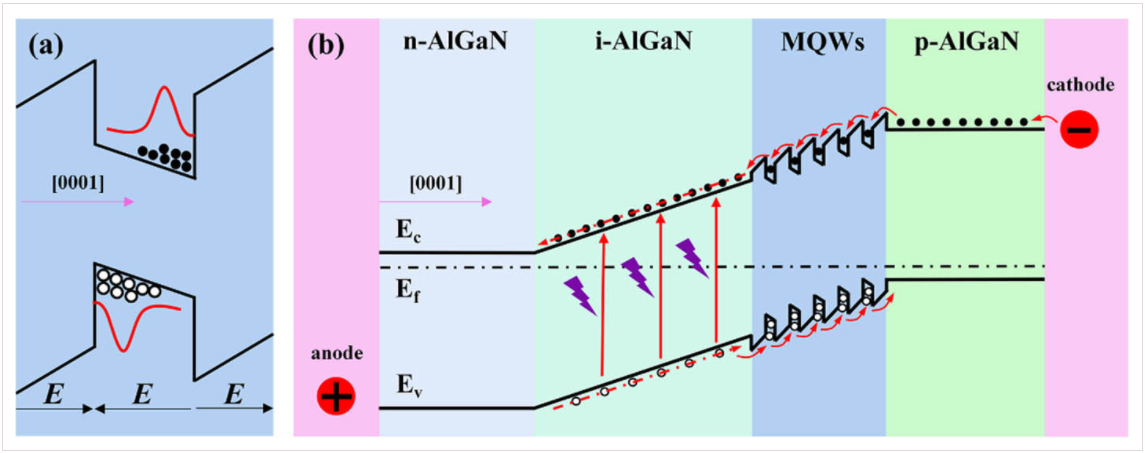
In this work, we have introduced a photoconductive gain mechanism into a vertical AlGaN SBUV detector and successfully realized it in a p-i-n photodiode via inserting a multiple-quantum-well (MQW) into the depletion region. The MQW plays the role of trapping holes and increasing carrier lifetime due to its strong hole confinement effect and quantum confinement Stark effect. Hence, the electrons can go through the detector multiple times, inducing unipolar carrier transport multiplication.
Experimentally, an AlGaN SBUV detector with a zero-bias peak responsivity of about 0.425 A/W at 233 nm is achieved, corresponding to an external quantum efficiency of 226%, indicating the existence of internal current gain. When compared with the device without MQW structure, the gain is estimated to be about 10³ in magnitude. The investigation provides an alternative and effective approach to obtain high current gain in vertical AlGaN SBUV detectors at zero bias.
Electrically switchable bright-field and interference-synthesized edge-enhanced imaging with a polarization-multiplexed metalens
Xiaotong Li, Junhwa Seong, Yeseul Kim, Kwang-Suk Oh, Shiqi Hu, Le Dai, Harit Keawmuang, Beomha Yang, Minseok Choi, Youngsun Jeon, Cherry Park, Weiyan Li, Tianxu Jia, Han Zhu, Xiaodong Cai, Qi Zheng, Jinhui Shi, Young-Ki Kim, Yuchuan Shao, Trevon Badloe, Junsuk Rho
Opto-Electronic Science
2026-09-20
3D-printed copper water cooling system assisted fabrication of 10.6-μm high-power CO₂ laser resistance reflectors
Hongfei Jiao, Binbin Jiang, Xinshang Niu, Yifan Wang, Dongdong Li, Jun Yu, Xiaochuan Ji, Jingjing Xia, Jinlong Zhang, Xinbin Cheng, Zhanshan Wang
Opto-Electronic Advances
2026-09-15
Ultrafast all-optical modulation of wide-bandwidth pulses enabled by silicon-metasurfaces
Kaloyan Georgiev, Khosro Zangeneh Kamali, Anton A. Trifonov, Giulia Crotti, Lyuben Petrov, Stefan Georgiev, Hristo Iliev, Lei Xu, Unai Arregui Leon, Mohsen Rahmani, Giuseppe Della Valle, Ivan Buchvarov, Dragomir Neshev
Opto-Electronic Advances
2026-09-15
Physics-informed neural fields enable blind aberration correction for partially coherent quantitative phase imaging
Shun Zhou, Xingyu Huang, Linpeng Lu, Habib Ullah, Kaiyu Du, Maciej Trusiak, Malgorzata Kujawinska, Yuzhen Zhang, Yao Fan, Qian Chen, Qinrong Zhang, Chao Zuo
Opto-Electronic Science
2026-08-26