(Peer-Reviewed) Seeing at a distance with multicore fibers
Haogong Feng 冯浩宫 ¹, Xi Chen 陈曦 ¹, Runze Zhu 朱润泽 ¹, Yifeng Xiong 熊毅丰 ¹, Ye Chen 陈烨 ², Yanqing Lu 陆延青 ¹, Fei Xu 徐飞 ¹
¹ National Laboratory of Solid State Microstructures, College of Engineering and Applied Sciences, and Collaborative Innovation Center of Advanced Microstructures, Nanjing University, Nanjing 210093, China
中国 南京 南京大学现代工程与应用科学学院 固体微结构物理国家重点实验室 人工微结构科学与技术协同创新中心
² College of Physics, MIIT Key Laboratory of Aerospace Information Materials and Physics, State Key Laboratory of Mechanics and Control for Aerospace Structures, Nanjing University of Aeronautics and Astronautics, Nanjing 211106, China
中国 南京 南京航空航天大学物理学院 空天信息材料与物理工信部重点实验室 航空航天结构力学及控制全国重点实验室
Opto-Electronic Advances, 2024-06-05
Abstract
Images and videos provide a wealth of information for people in production and life. Although most digital information is transmitted via optical fiber, the image acquisition and transmission processes still rely heavily on electronic circuits. The development of all-optical transmission networks and optical computing frameworks has pointed to the direction for the next generation of data transmission and information processing.
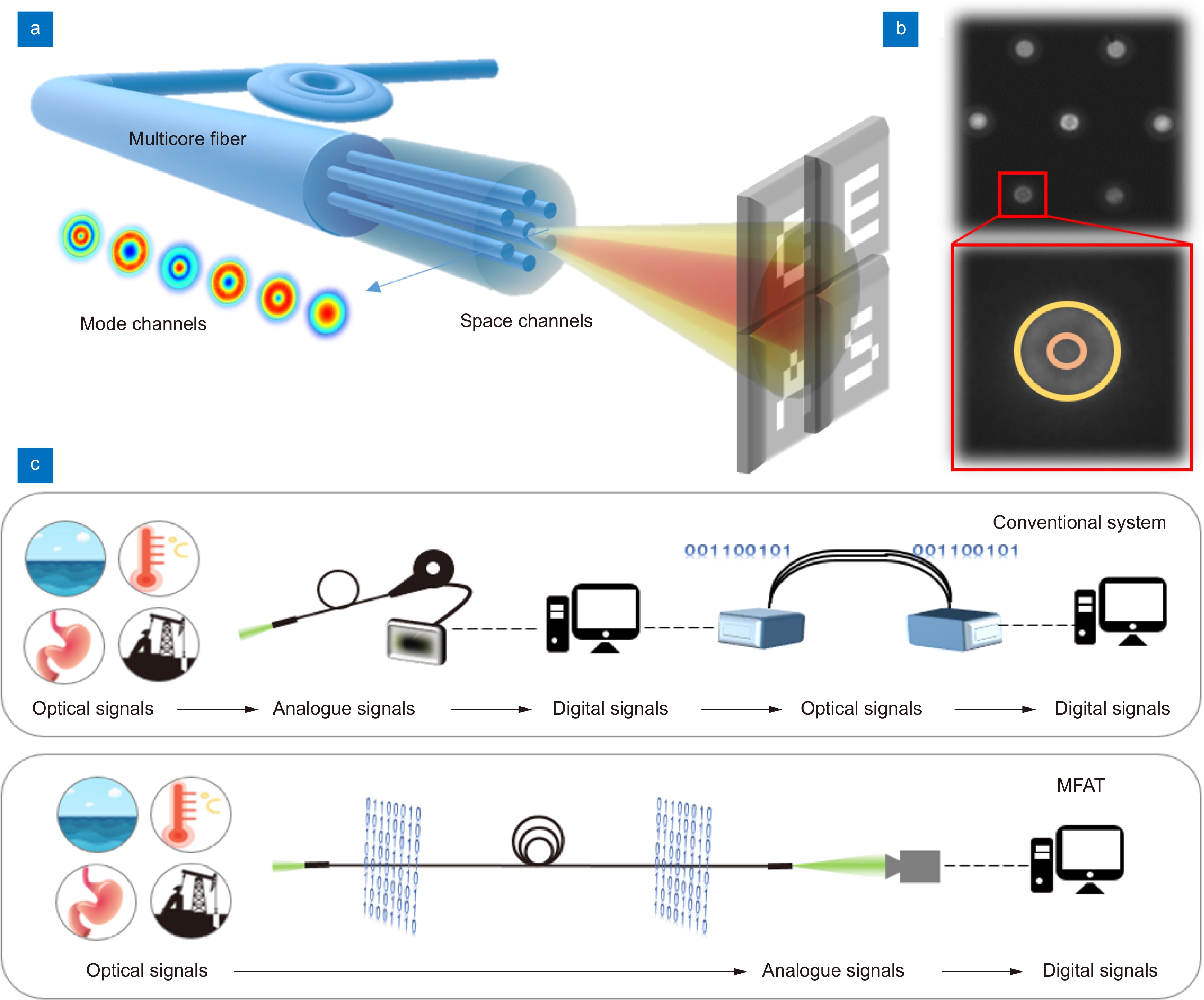
Here, we propose a high-speed, low-cost, multiplexed parallel and one-piece all-fiber architecture for image acquisition, encoding, and transmission, called the Multicore Fiber Acquisition and Transmission Image System (MFAT). Based on different spatial and modal channels of the multicore fiber, fiber-coupled self-encoding, and digital aperture decoding technology, scenes can be observed directly from up to 1 km away. The expansion of capacity provides the possibility of parallel coded transmission of multimodal high-quality data.
MFAT requires no additional signal transmitting and receiving equipment. The all-fiber processing saves the time traditionally spent on signal conversion and image pre-processing (compression, encoding, and modulation). Additionally, it provides an effective solution for 2D information acquisition and transmission tasks in extreme environments such as high temperatures and electromagnetic interference.
Ultrafast all-optical modulation of wide-bandwidth pulses enabled by silicon-metasurfaces
Kaloyan Georgiev, Khosro Zangeneh Kamali, Anton A. Trifonov, Giulia Crotti, Lyuben Petrov, Stefan Georgiev, Hristo Iliev, Lei Xu, Unai Arregui Leon, Mohsen Rahmani, Giuseppe Della Valle, Ivan Buchvarov, Dragomir Neshev
Opto-Electronic Advances
2026-09-15
Physics-informed neural fields enable blind aberration correction for partially coherent quantitative phase imaging
Shun Zhou, Xingyu Huang, Linpeng Lu, Habib Ullah, Kaiyu Du, Maciej Trusiak, Malgorzata Kujawinska, Yuzhen Zhang, Yao Fan, Qian Chen, Qinrong Zhang, Chao Zuo
Opto-Electronic Science
2026-08-26
Heterogeneously integrated micro-ring with SnS₂ for dual-functional optical modulation and photodetection
Jinyi Du, Lidan Lu, Xu Zhang, Bofei Zhu, Wenbo Bo, Yingjie Xu, Guang Chen, Yanlin He, Guanghui Ren, Xiaoping Lou, Zheng You, Lianqing Zhu
Opto-Electronic Advances
2026-08-25
Hardware-aware lightweight photonic spiking neural network for pattern classification
Shuiying Xiang, Yahui Zhang, Shangxuan Shi, Haowen Zhao, Dianzhuang Zheng, Xingxing Guo, Yanan Han, Ye Tian, Liyue Zhang, Yuechun Shi, Yue Hao
Opto-Electronic Advances
2026-08-25
PhyspeNet: An empirical physics-aware network for adaptive speckle reconstructive spectrometry
Junrui Liang, Min Jiang, Jun Li, Zhongming Huang, Junhong He, Yanting Guo, Yanzhao Ke, Jun Ye, Jiangming Xu, Jinyong Leng, Pu Zhou
Opto-Electronic Advances
2026-08-25
A 36 × 240 Gbps hybrid mode/wavelength division multiplexing transmitter using lithium niobate on insulator
Mingyu Zhu, Weihan Wang, Ruitao Ma, Aoyun Gao, Chun Gao, Zexu Wang, Fei Huang, Zhenyuan Bao, Dajian Liu, Jiaxuan Gan, Zejie Yu, Huan Li, Weike Zhao, Daoxin Dai
Opto-Electronic Advances
2026-08-25