(Preprint) CLSEBERT: Contrastive Learning for Syntax Enhanced Code Pre-Trained Model
Xin Wang ¹, Yasheng Wang ², Pingyi Zhou ², Meng Xiao ², Yadao Wang ², Li Li ³, Xiao Liu ⁴, Hao Wu 武浩 ⁵, Jin Liu 刘进 ¹, Xin Jiang ²
¹ School of Computer Science, Wuhan University 武汉大学 计算机学院
² Noah's Ark Lab, Huawei 华为 诺亚方舟实验室
³ Faculty of Information Technology, Monash University
⁴ School of Information Technology, Deakin University
⁵ School of Information Science and Engineering, Yunnan University 云南大学 信息学院
arXiv, 2021-08-10
Abstract
Pre-trained models for programming languages have proven their significant values in various code-related tasks, such as code search, code clone detection, and code translation. Currently, most pre-trained models treat a code snippet as a sequence of tokens or only focus on the data flow between code identifiers.
However, rich code syntax and hierarchy are ignored which can provide important structure information and semantic rules of codes to help enhance code representations. In addition, although the BERT-based code pre-trained models achieve high performance on many downstream tasks, the native derived sequence representations of BERT are proven to be of low-quality, it performs poorly on code matching and similarity tasks.
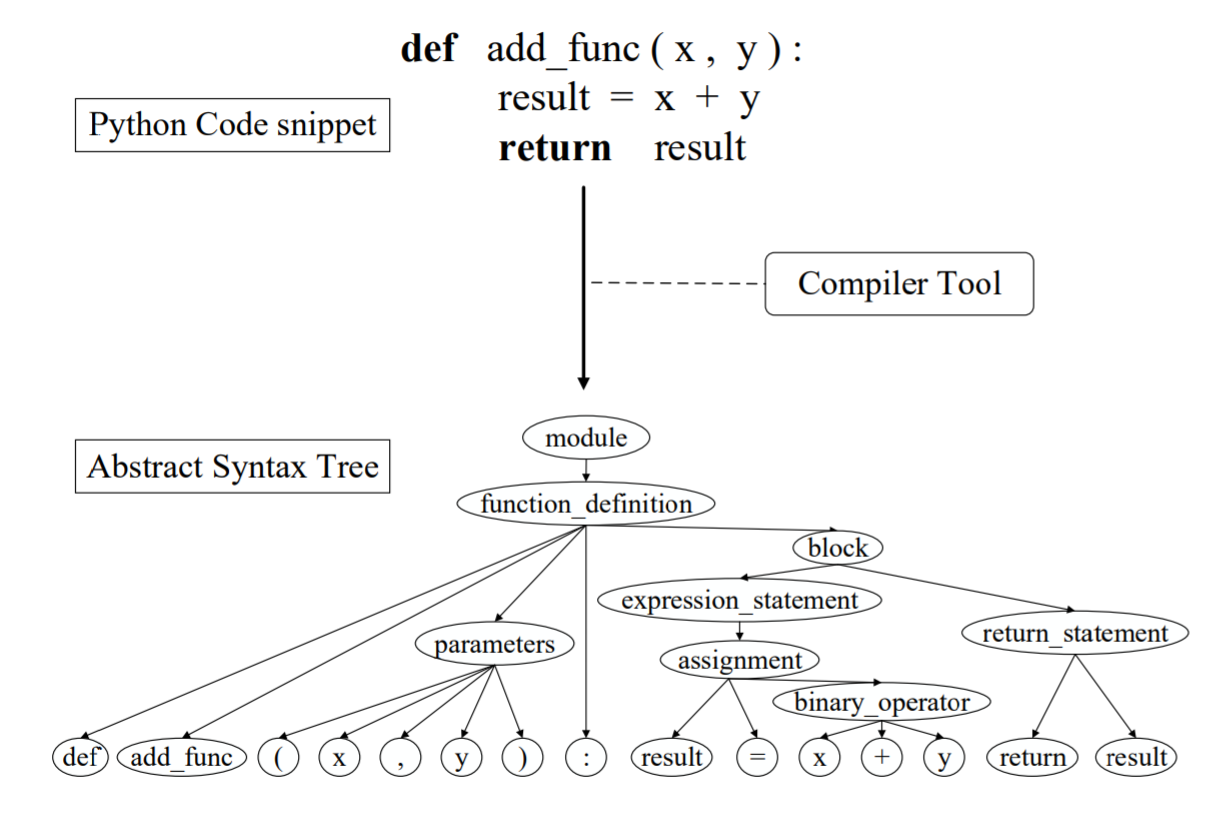
To address these problems, we propose CLSEBERT, a Constrastive Learning Framework for Syntax Enhanced Code Pre-Trained Model, to deal with various code intelligence tasks. In the pre-training stage, we consider the code syntax and hierarchy contained in the Abstract Syntax Tree (AST) and leverage the constrastive learning to learn noise-invariant code representations. Besides the masked language modeling (MLM), we also introduce two novel pre-training objectives. One is to predict the edges between nodes in the abstract syntax tree, and the other is to predict the types of code tokens. Through extensive experiments on four code intelligence tasks, we successfully show the effectiveness of our proposed model.
Ultrafast all-optical modulation of wide-bandwidth pulses enabled by silicon-metasurfaces
Kaloyan Georgiev, Khosro Zangeneh Kamali, Anton A. Trifonov, Giulia Crotti, Lyuben Petrov, Stefan Georgiev, Hristo Iliev, Lei Xu, Unai Arregui Leon, Mohsen Rahmani, Giuseppe Della Valle, Ivan Buchvarov, Dragomir Neshev
Opto-Electronic Advances
2026-09-15
Physics-informed neural fields enable blind aberration correction for partially coherent quantitative phase imaging
Shun Zhou, Xingyu Huang, Linpeng Lu, Habib Ullah, Kaiyu Du, Maciej Trusiak, Malgorzata Kujawinska, Yuzhen Zhang, Yao Fan, Qian Chen, Qinrong Zhang, Chao Zuo
Opto-Electronic Science
2026-08-26
Heterogeneously integrated micro-ring with SnS₂ for dual-functional optical modulation and photodetection
Jinyi Du, Lidan Lu, Xu Zhang, Bofei Zhu, Wenbo Bo, Yingjie Xu, Guang Chen, Yanlin He, Guanghui Ren, Xiaoping Lou, Zheng You, Lianqing Zhu
Opto-Electronic Advances
2026-08-25
Hardware-aware lightweight photonic spiking neural network for pattern classification
Shuiying Xiang, Yahui Zhang, Shangxuan Shi, Haowen Zhao, Dianzhuang Zheng, Xingxing Guo, Yanan Han, Ye Tian, Liyue Zhang, Yuechun Shi, Yue Hao
Opto-Electronic Advances
2026-08-25
PhyspeNet: An empirical physics-aware network for adaptive speckle reconstructive spectrometry
Junrui Liang, Min Jiang, Jun Li, Zhongming Huang, Junhong He, Yanting Guo, Yanzhao Ke, Jun Ye, Jiangming Xu, Jinyong Leng, Pu Zhou
Opto-Electronic Advances
2026-08-25
A 36 × 240 Gbps hybrid mode/wavelength division multiplexing transmitter using lithium niobate on insulator
Mingyu Zhu, Weihan Wang, Ruitao Ma, Aoyun Gao, Chun Gao, Zexu Wang, Fei Huang, Zhenyuan Bao, Dajian Liu, Jiaxuan Gan, Zejie Yu, Huan Li, Weike Zhao, Daoxin Dai
Opto-Electronic Advances
2026-08-25