(Peer-Reviewed) Topology transfer from vortex electrons to structured radiation via guided Cherenkov emission: orbital angular momentum and polarization skyrmions
Sun-Hong Min ¹ ² ³, Matlabjon Sattorov ¹ ² ⁴, Dongpyo Hong ³, Jin Pyung Kim ³, Ohjoon Kwon ⁵, Ilsung Cho ⁶, Seonmyeong Kim ⁷, Inkeun Baek ⁷, Seunghyuk Park ⁸, Young Joon Yoo ¹, Sang Yoon Park ³
¹ Center for Applied Electromagnetic Research, Advanced Institutes of Convergence Technology, Suwon-si, Gyeonggi-do 16229, Republic of Korea
² Center for THz-Driven Biomedical Systems, Department of Physics and Astronomy, College of Natural Sciences, Seoul National University, Seoul 08826, Republic of Korea
³ School of Electronic Engineering, Kyonggi University, Suwon-si, Gyeonggi-do 16227, Republic of Korea
⁴ Engineering Physics Institute, Samarkand State University, University Boulevard 15, 140104, Samarkand, Uzbekistan
⁵ Dark Matter Axion Group, Institute for Basic Science, Daejeon 34126, Republic of Korea
⁶ Korea Institute of Radiological and Medical Sciences (KIRAMS), Seoul 01812, Republic of Korea
⁷ Semiconductor R&D Center, Samsung Electronics Co., Ltd., Hwasung 18448, Republic of Korea
⁸ Hanwha Aerospace Corporation, 13488, Seongnam-si, Gyeonggi-do, Republic of Korea
Opto-Electronic Advances, 2026-11-05
Abstract
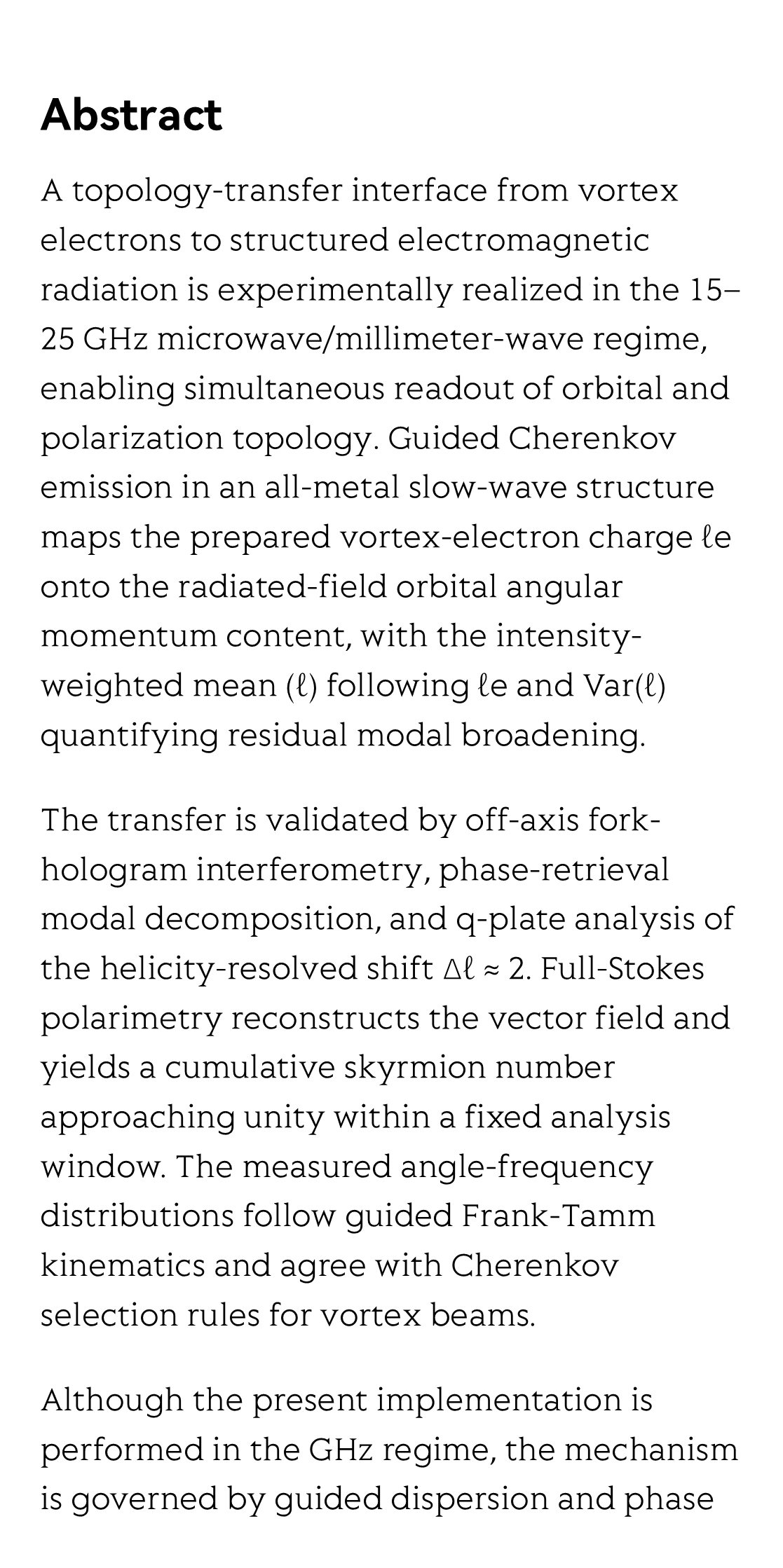
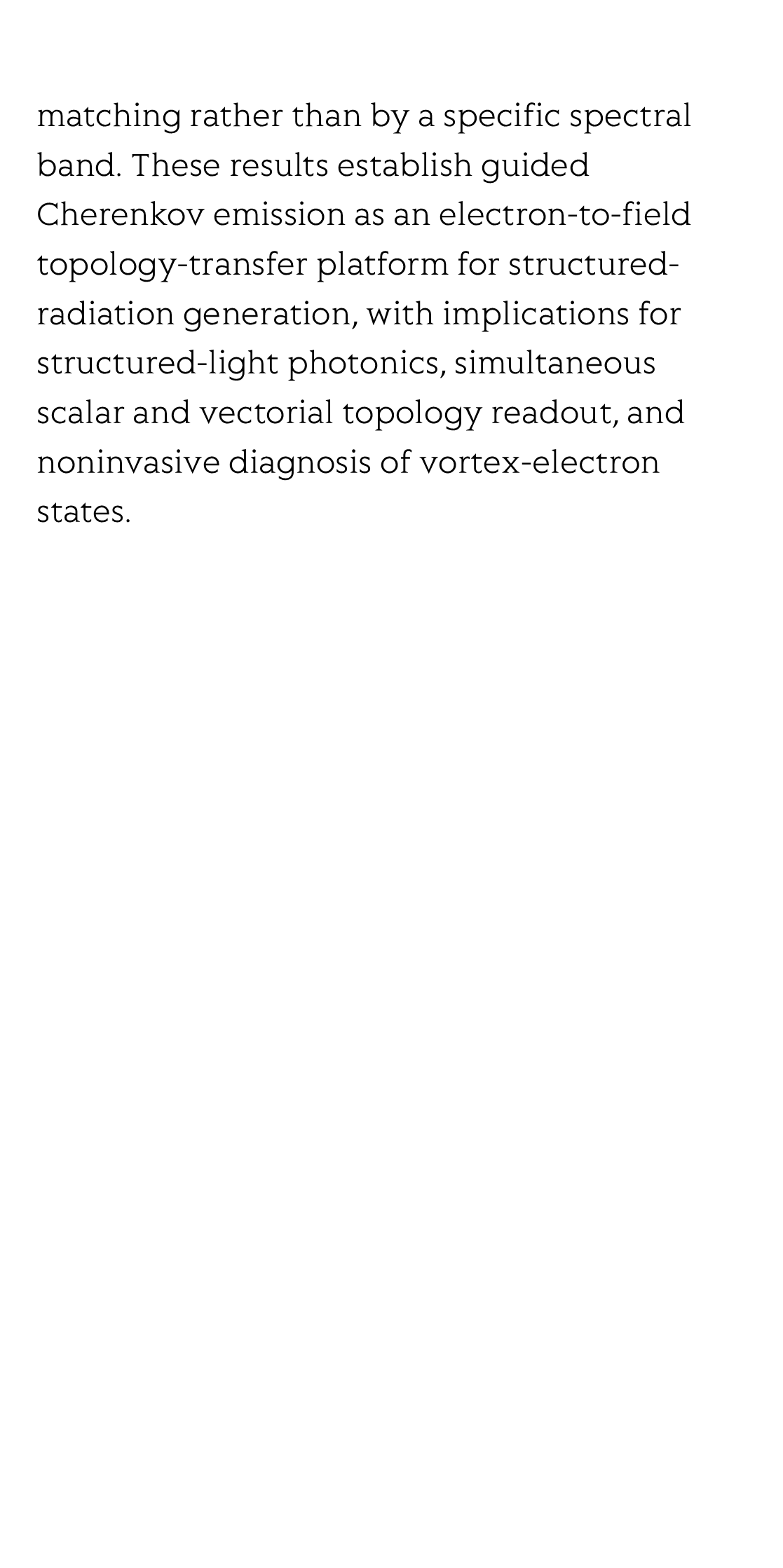
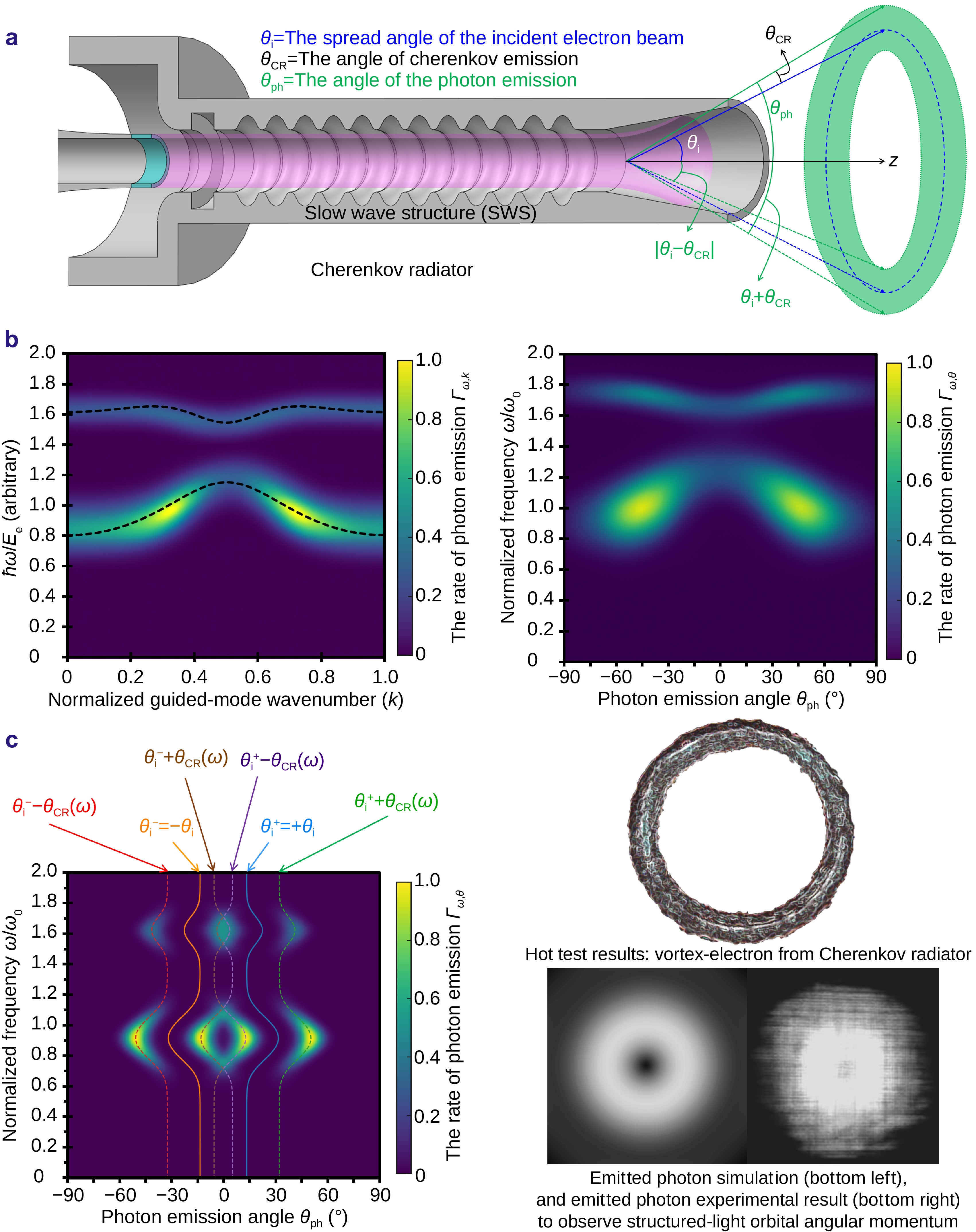
A topology-transfer interface from vortex electrons to structured electromagnetic radiation is experimentally realized in the 15–25 GHz microwave/millimeter-wave regime, enabling simultaneous readout of orbital and polarization topology. Guided Cherenkov emission in an all-metal slow-wave structure maps the prepared vortex-electron charge ℓe onto the radiated-field orbital angular momentum content, with the intensity-weighted mean (ℓ) following ℓe and Var(ℓ) quantifying residual modal broadening.
The transfer is validated by off-axis fork-hologram interferometry, phase-retrieval modal decomposition, and q-plate analysis of the helicity-resolved shift Δℓ ≈ 2. Full-Stokes polarimetry reconstructs the vector field and yields a cumulative skyrmion number approaching unity within a fixed analysis window. The measured angle-frequency distributions follow guided Frank-Tamm kinematics and agree with Cherenkov selection rules for vortex beams.
Although the present implementation is performed in the GHz regime, the mechanism is governed by guided dispersion and phase matching rather than by a specific spectral band. These results establish guided Cherenkov emission as an electron-to-field topology-transfer platform for structured-radiation generation, with implications for structured-light photonics, simultaneous scalar and vectorial topology readout, and noninvasive diagnosis of vortex-electron states.
Ultrafast all-optical biomimetic encoder for spiking neural networks
Qijun Bian, Fangchen Hu, Junlian Jia, Aolong Sun, Sizhe Xing, Boyu Dong, An Yan, Ziwei Li, Jianyang Shi, Nan Chi, Junwen Zhang
Opto-Electronic Science
2026-10-20
Neural holography enabled multi-beam steering for multi-task classifier
Lin Wu, Mian Wu, Zhen Li, Ying Qiu, Zichen Liu, Yongquan Zeng, Guozhen Liang, Hanbing Li, Guoxing Zheng, Zhixue He, Xi Xiao, Qi Jie Wang, Jin Tao, Shaohua Yu
Opto-Electronic Technology
2026-09-30
Recent progress on mid-infrared and terahertz dual-comb spectroscopy
Zhuoren Wan, Min Li, Binbin Liu, Yu Xia, Yuan Chen, Xiuxiu Zhang, Dongxu Zhu, Yan Dai, Sinan Tao, Hua Li, Ming Yan, Heping Zeng
Opto-Electronic Technology
2026-09-30