(Peer-Reviewed) Deep-learning-assisted label-free single-cell identification and sorting using femtosecond laser fabricated microfluidic surface-enhanced Raman scattering (SERS) chips with plasmonic ring-shaped nanostructure arrays
Shi Bai ¹, Kun Fang ¹, Jingtian Hu ², Ying Ma ², Kazunari Ozasa ¹, Shota Kawabata ¹ ³, Yoshihiro Ito ¹, Anming Hu ⁴, Koji Sugioka ¹
¹ Advanced Laser Processing Research Team, RIKEN Center for Advanced Photonics, 2-1 Hirosawa, Wako, Saitama 351-0198, Japan
² Academy of Artificial Intelligence, Beijing Institute of Petrochemical Technology, No. 19 North Qingyuan Road, Daxing District, Beijing 102617, China
中国 北京 北京石油化工学院人工智能研究院
³ Graduate School of Engineering, Tokyo University of Agriculture and Technology, 2-24-16 Nakacho, Koganei, Tokyo 184-8588, Japan
⁴ Department of Mechanical, Aerospace, Biomedical Engineering, University of Tennessee Knoxville, 1512 Middle Drive, Knoxville TN 37996, USA
Opto-Electronic Advances, 2026-11-05
Abstract
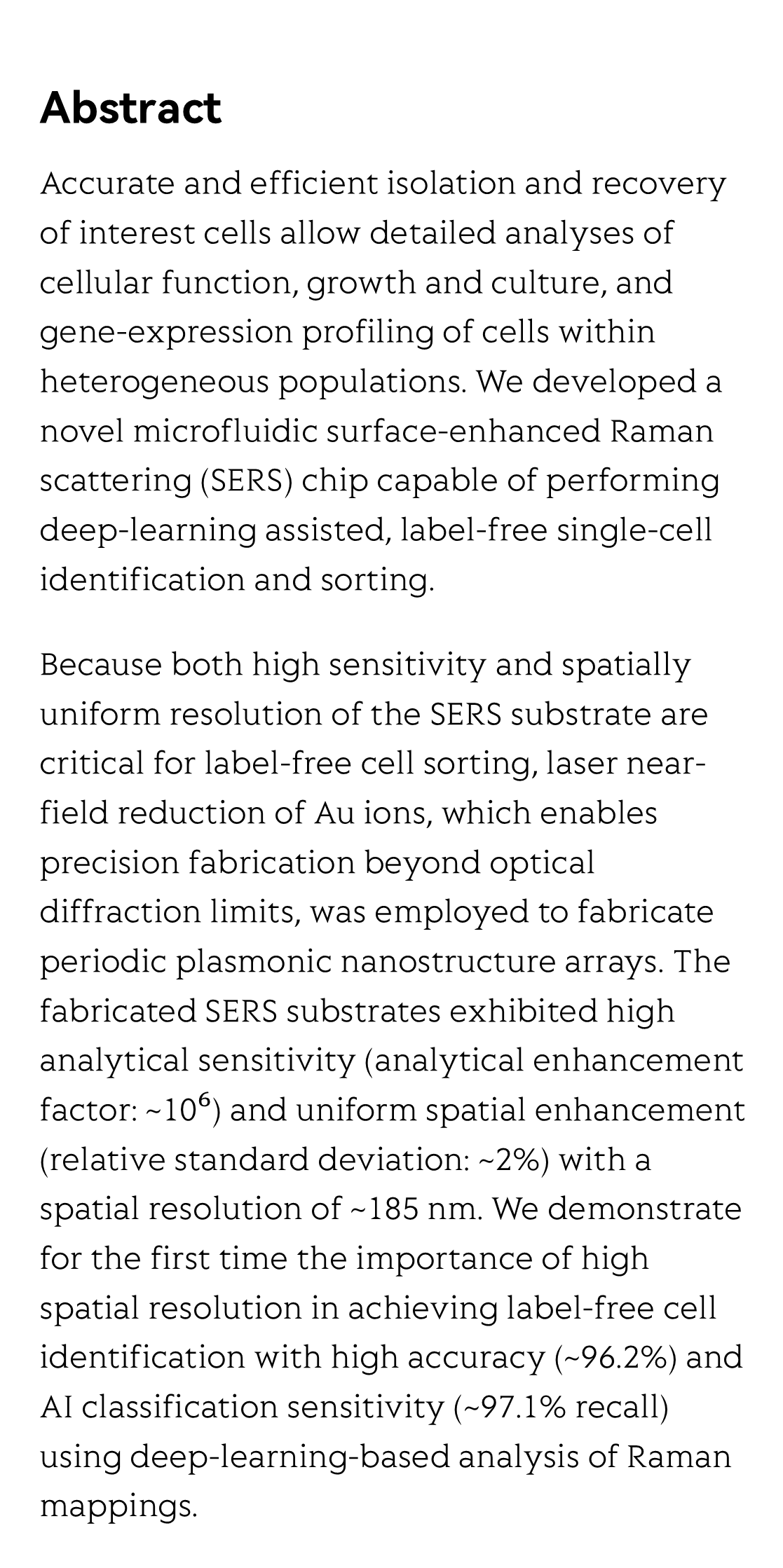
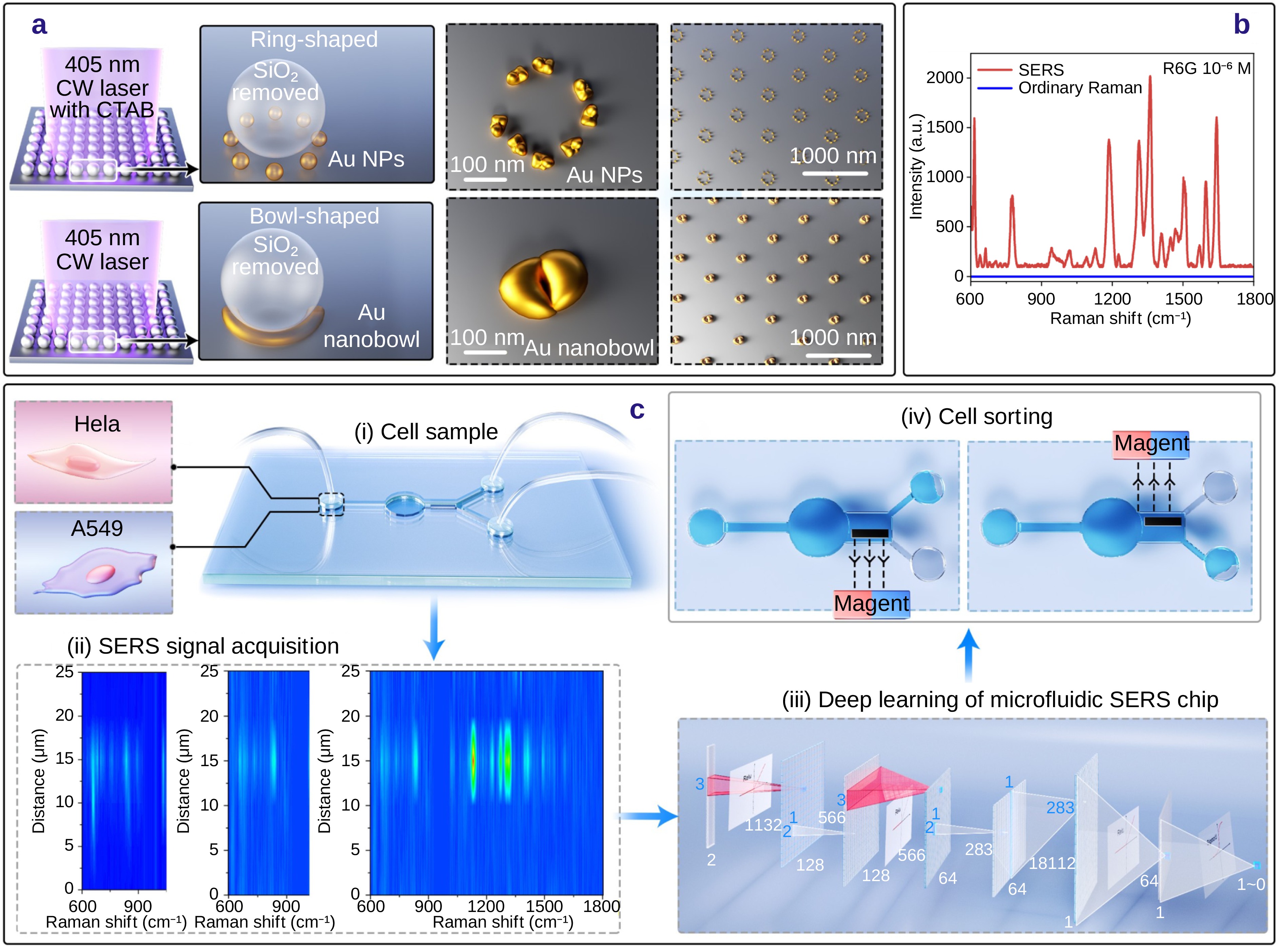
Accurate and efficient isolation and recovery of interest cells allow detailed analyses of cellular function, growth and culture, and gene-expression profiling of cells within heterogeneous populations. We developed a novel microfluidic surface-enhanced Raman scattering (SERS) chip capable of performing deep-learning assisted, label-free single-cell identification and sorting.
Because both high sensitivity and spatially uniform resolution of the SERS substrate are critical for label-free cell sorting, laser near-field reduction of Au ions, which enables precision fabrication beyond optical diffraction limits, was employed to fabricate periodic plasmonic nanostructure arrays. The fabricated SERS substrates exhibited high analytical sensitivity (analytical enhancement factor: ~10⁶) and uniform spatial enhancement (relative standard deviation: ~2%) with a spatial resolution of ~185 nm. We demonstrate for the first time the importance of high spatial resolution in achieving label-free cell identification with high accuracy (~96.2%) and AI classification sensitivity (~97.1% recall) using deep-learning-based analysis of Raman mappings.
The utility of the fabricated system in cell sorting was confirmed by integrating it into a functionalized microfluidic device for cancer-cell sorting. The results could be used to guide future research on the design and development of non-invasive, efficient cell-sorting techniques with potential applications in clinical diagnostics and precision medicine.
Recent progress on mid-infrared and terahertz dual-comb spectroscopy
Zhuoren Wan, Min Li, Binbin Liu, Yu Xia, Yuan Chen, Xiuxiu Zhang, Dongxu Zhu, Yan Dai, Sinan Tao, Hua Li, Ming Yan, Heping Zeng
Opto-Electronic Technology
2026-09-30
Electrically switchable bright-field and interference-synthesized edge-enhanced imaging with a polarization-multiplexed metalens
Xiaotong Li, Junhwa Seong, Yeseul Kim, Kwang-Suk Oh, Shiqi Hu, Le Dai, Harit Keawmuang, Beomha Yang, Minseok Choi, Youngsun Jeon, Cherry Park, Weiyan Li, Tianxu Jia, Han Zhu, Xiaodong Cai, Qi Zheng, Jinhui Shi, Young-Ki Kim, Yuchuan Shao, Trevon Badloe, Junsuk Rho
Opto-Electronic Science
2026-09-20
3D-printed copper water cooling system assisted fabrication of 10.6-μm high-power CO₂ laser resistance reflectors
Hongfei Jiao, Binbin Jiang, Xinshang Niu, Yifan Wang, Dongdong Li, Jun Yu, Xiaochuan Ji, Jingjing Xia, Jinlong Zhang, Xinbin Cheng, Zhanshan Wang
Opto-Electronic Advances
2026-09-15