(Peer-Reviewed) Exceptional-point-enhanced sensing in an all-fiber bending sensor
Zheng Li 李铮 ¹, Jingxu Chen 陈敬旭 ¹, Lingzhi Li 李凌志 ¹, Jiejun Zhang 张杰君 ¹, Jianping Yao 姚建平 ¹ ²
¹ Guangdong Provincial Key Laboratory of Optical Fiber Sensing and Communications, Institute of Photonics Technology, Jinan University, Guangzhou 510632, China
中国 广州 暨南大学光子技术研究院 广东省光纤传感与通信技术重点实验室
² Microwave Photonics Research Laboratory, School of Electrical Engineering and Computer Science, University of Ottawa, Ottawa, ON K1N 6N5, Canada
Opto-Electronic Advances, 2023-12-12
Abstract
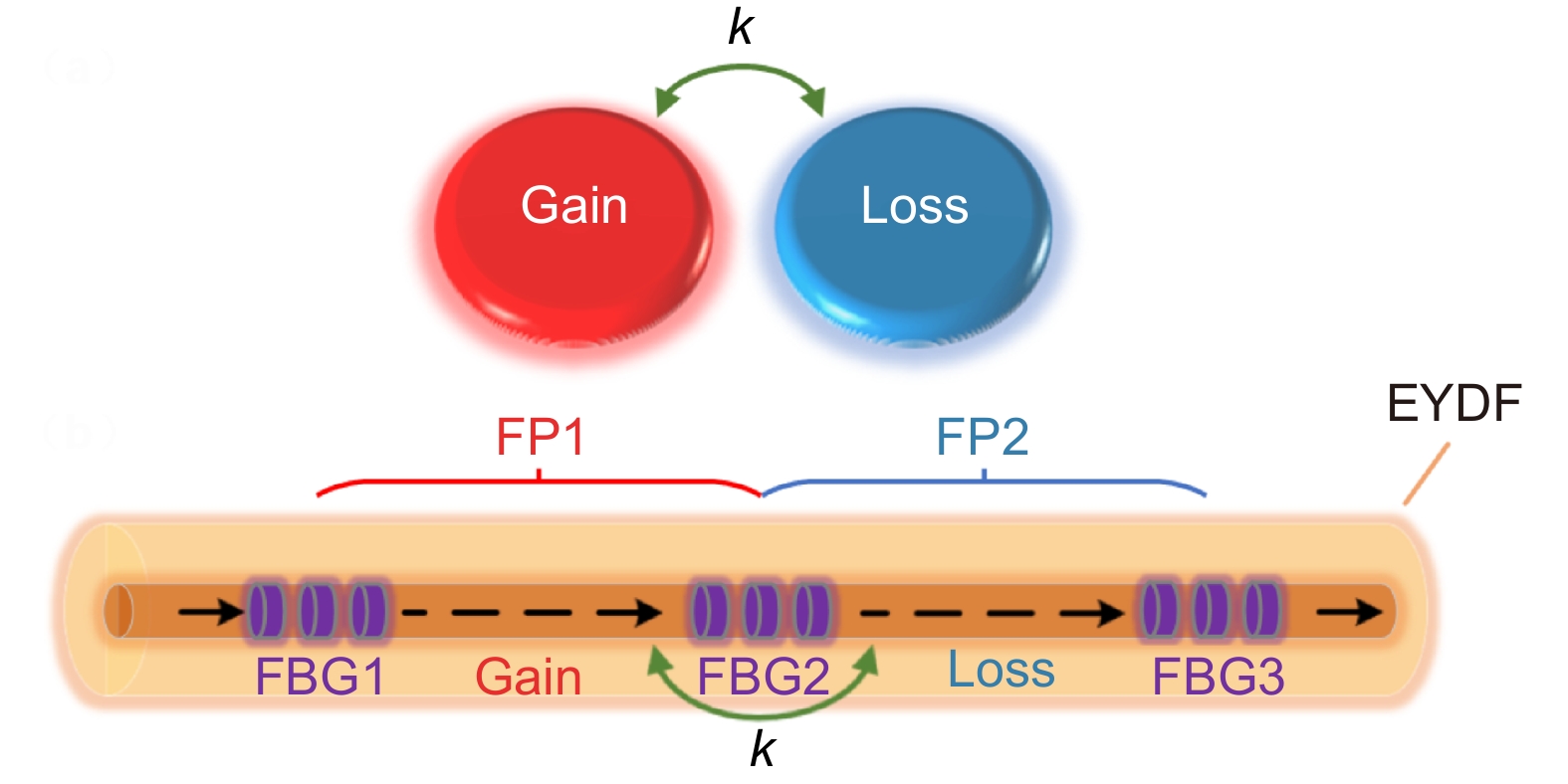
An exceptional-point (EP) enhanced fiber-optic bending sensor is reported. The sensor is implemented based on parity-time (PT)-symmetry using two coupled Fabry-Perot (FP) resonators consisting of three cascaded fiber Bragg gratings (FBGs) inscribed in an erbium-ytterbium co-doped fiber (EYDF). The EP is achieved by controlling the pumping power to manipulate the gain and loss of the gain and loss FP resonators.
Once a bending force is applied to the gain FP resonator to make the operation of the system away from its EP, frequency splitting occurs, and the frequency spacing is a nonlinear function of the bending curvature, with an increased slope near the EP. Thus, by measuring the frequency spacing, the bending information is measured with increased sensitivity.
To achieve high-speed and high-resolution interrogation, the optical spectral response of the sensor is converted to the microwave domain by implementing a dual-passband microwave-photonic filter (MPF), with the spacing between the two passbands equal to that of the frequency splitting.
The proposed sensor is evaluated experimentally. A curvature sensing range from 0.28 to 2.74 m⁻¹ is achieved with an accuracy of 7.56×10⁻⁴ m⁻¹ and a sensitivity of 1.32 GHz/m⁻¹, which is more than 4 times higher than those reported previously.
Ultrafast all-optical modulation of wide-bandwidth pulses enabled by silicon-metasurfaces
Kaloyan Georgiev, Khosro Zangeneh Kamali, Anton A. Trifonov, Giulia Crotti, Lyuben Petrov, Stefan Georgiev, Hristo Iliev, Lei Xu, Unai Arregui Leon, Mohsen Rahmani, Giuseppe Della Valle, Ivan Buchvarov, Dragomir Neshev
Opto-Electronic Advances
2026-09-15
Physics-informed neural fields enable blind aberration correction for partially coherent quantitative phase imaging
Shun Zhou, Xingyu Huang, Linpeng Lu, Habib Ullah, Kaiyu Du, Maciej Trusiak, Malgorzata Kujawinska, Yuzhen Zhang, Yao Fan, Qian Chen, Qinrong Zhang, Chao Zuo
Opto-Electronic Science
2026-08-26
Heterogeneously integrated micro-ring with SnS₂ for dual-functional optical modulation and photodetection
Jinyi Du, Lidan Lu, Xu Zhang, Bofei Zhu, Wenbo Bo, Yingjie Xu, Guang Chen, Yanlin He, Guanghui Ren, Xiaoping Lou, Zheng You, Lianqing Zhu
Opto-Electronic Advances
2026-08-25
Hardware-aware lightweight photonic spiking neural network for pattern classification
Shuiying Xiang, Yahui Zhang, Shangxuan Shi, Haowen Zhao, Dianzhuang Zheng, Xingxing Guo, Yanan Han, Ye Tian, Liyue Zhang, Yuechun Shi, Yue Hao
Opto-Electronic Advances
2026-08-25
PhyspeNet: An empirical physics-aware network for adaptive speckle reconstructive spectrometry
Junrui Liang, Min Jiang, Jun Li, Zhongming Huang, Junhong He, Yanting Guo, Yanzhao Ke, Jun Ye, Jiangming Xu, Jinyong Leng, Pu Zhou
Opto-Electronic Advances
2026-08-25
A 36 × 240 Gbps hybrid mode/wavelength division multiplexing transmitter using lithium niobate on insulator
Mingyu Zhu, Weihan Wang, Ruitao Ma, Aoyun Gao, Chun Gao, Zexu Wang, Fei Huang, Zhenyuan Bao, Dajian Liu, Jiaxuan Gan, Zejie Yu, Huan Li, Weike Zhao, Daoxin Dai
Opto-Electronic Advances
2026-08-25