(Peer-Reviewed) China's energy transition pathway in a carbon neutral vision
Shu Zhang 张枢, Wenying Chen 陈文颖
Institute of Energy, Environment, and Economy, Tsinghua University, Beijing 100084, China
中国 北京 清华大学能源环境经济研究所
Abstract
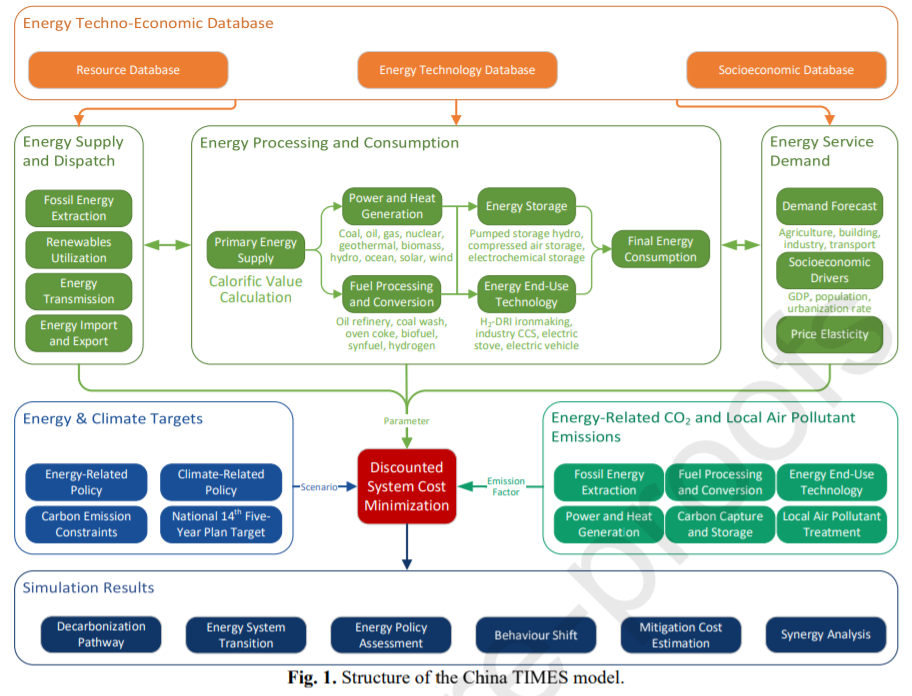
China’s energy system requires a thorough transformation to achieve carbon neutrality. Here, leveraging the highly acclaimed The Integrated MARKAL-EFOM System model of China (China TIMES) that takes energy, the environment, and the economy into consideration, four carbon-neutral scenarios are proposed and compared for different emission peak times and carbon emissions in 2050.
The results show that China’s carbon emissions will peak at 10.3–10.4 Gt between 2025 and 2030. In 2050, renewables will account for 60% of total energy consumption (calorific value calculation) and 90% of total electricity generation, and the electrification rate will be close to 60%. The energy transition will bring sustained air quality improvement, with an 85% reduction in local air pollutants in 2050 compared with 2020 levels, and an early emission peak will yield more near-term benefits.
Early peak attainment requires the extensive deployment of renewables over the next decade and an accelerated phasing out of coal after 2025. However, it will bring benefits such as obtaining better air quality sooner, reducing cumulative CO2 emissions, and buying more time for other sectors to transition. The pressure for more ambitious emission reductions in 2050 can be transmitted to the near future, affecting renewable energy development, energy service demand, and welfare losses.
Ultrafast all-optical modulation of wide-bandwidth pulses enabled by silicon-metasurfaces
Kaloyan Georgiev, Khosro Zangeneh Kamali, Anton A. Trifonov, Giulia Crotti, Lyuben Petrov, Stefan Georgiev, Hristo Iliev, Lei Xu, Unai Arregui Leon, Mohsen Rahmani, Giuseppe Della Valle, Ivan Buchvarov, Dragomir Neshev
Opto-Electronic Advances
2026-09-15
Physics-informed neural fields enable blind aberration correction for partially coherent quantitative phase imaging
Shun Zhou, Xingyu Huang, Linpeng Lu, Habib Ullah, Kaiyu Du, Maciej Trusiak, Malgorzata Kujawinska, Yuzhen Zhang, Yao Fan, Qian Chen, Qinrong Zhang, Chao Zuo
Opto-Electronic Science
2026-08-26
Heterogeneously integrated micro-ring with SnS₂ for dual-functional optical modulation and photodetection
Jinyi Du, Lidan Lu, Xu Zhang, Bofei Zhu, Wenbo Bo, Yingjie Xu, Guang Chen, Yanlin He, Guanghui Ren, Xiaoping Lou, Zheng You, Lianqing Zhu
Opto-Electronic Advances
2026-08-25
Hardware-aware lightweight photonic spiking neural network for pattern classification
Shuiying Xiang, Yahui Zhang, Shangxuan Shi, Haowen Zhao, Dianzhuang Zheng, Xingxing Guo, Yanan Han, Ye Tian, Liyue Zhang, Yuechun Shi, Yue Hao
Opto-Electronic Advances
2026-08-25
PhyspeNet: An empirical physics-aware network for adaptive speckle reconstructive spectrometry
Junrui Liang, Min Jiang, Jun Li, Zhongming Huang, Junhong He, Yanting Guo, Yanzhao Ke, Jun Ye, Jiangming Xu, Jinyong Leng, Pu Zhou
Opto-Electronic Advances
2026-08-25
A 36 × 240 Gbps hybrid mode/wavelength division multiplexing transmitter using lithium niobate on insulator
Mingyu Zhu, Weihan Wang, Ruitao Ma, Aoyun Gao, Chun Gao, Zexu Wang, Fei Huang, Zhenyuan Bao, Dajian Liu, Jiaxuan Gan, Zejie Yu, Huan Li, Weike Zhao, Daoxin Dai
Opto-Electronic Advances
2026-08-25