(Peer-Reviewed) Multiplexed stimulated emission depletion nanoscopy (mSTED) for 5-color live-cell long-term imaging of organelle interactome
Yuran Huang 黄宇然 ¹, Zhimin Zhang 张智敏 ¹ ², Wenli Tao 陶汶理 ¹, Yunfei Wei 魏云飞 ³, Liang Xu 徐良 ¹, Wenwen Gong 宫文文 ¹, Jiaqiang Zhou 周嘉强 ⁴, Liangcai Cao 曹良才 ⁵, Yong Liu 刘勇 ⁶, Yubing Han 韩于冰 ¹ ³, Cuifang Kuang 匡翠方 ¹ ² ⁷, Xu Liu 刘旭 ¹ ²
¹ State Key Laboratory of Extreme Photonics and Instrumentation, College of Optical Science and Engineering, Zhejiang University, Hangzhou 310027, China
中国 杭州 浙江大学光电科学与工程学院 极端光学技术与仪器全国重点实验室
² Research Center for Intelligent Chips and Devices, Zhejiang Lab, Hangzhou 311121, China
中国 杭州 之江实验室 智能芯片与器件研究中心
³ Wuhan National Laboratory for Optoelectronics, Huazhong University of Science and Technology, Wuhan 430074, China
中国 武汉 华中科技大学武汉光电国家研究中心
⁴ Department of Endocrinology and Metabolism, Sir Run Run Shaw Hospital, Zhejiang University School of Medicine, Hangzhou 310016, China
中国 杭州 浙江大学医学院附属邵逸夫医院 内分泌代谢科
⁵ Department of Precision Instruments, Tsinghua University, Beijing 100084, China
中国 北京 清华大学精密仪器系
⁶ College of electronics and information engineering, Shanghai University of Electrical Power, Shanghai 200090, China
中国 上海 上海电力大学 电子与信息工程学院
⁷ ZJU-Hangzhou Global Scientific and Technological Innovation Center, Hangzhou 311200, China
中国 杭州 浙江大学杭州国际科创中心
Opto-Electronic Advances, 2024-07-05
Abstract
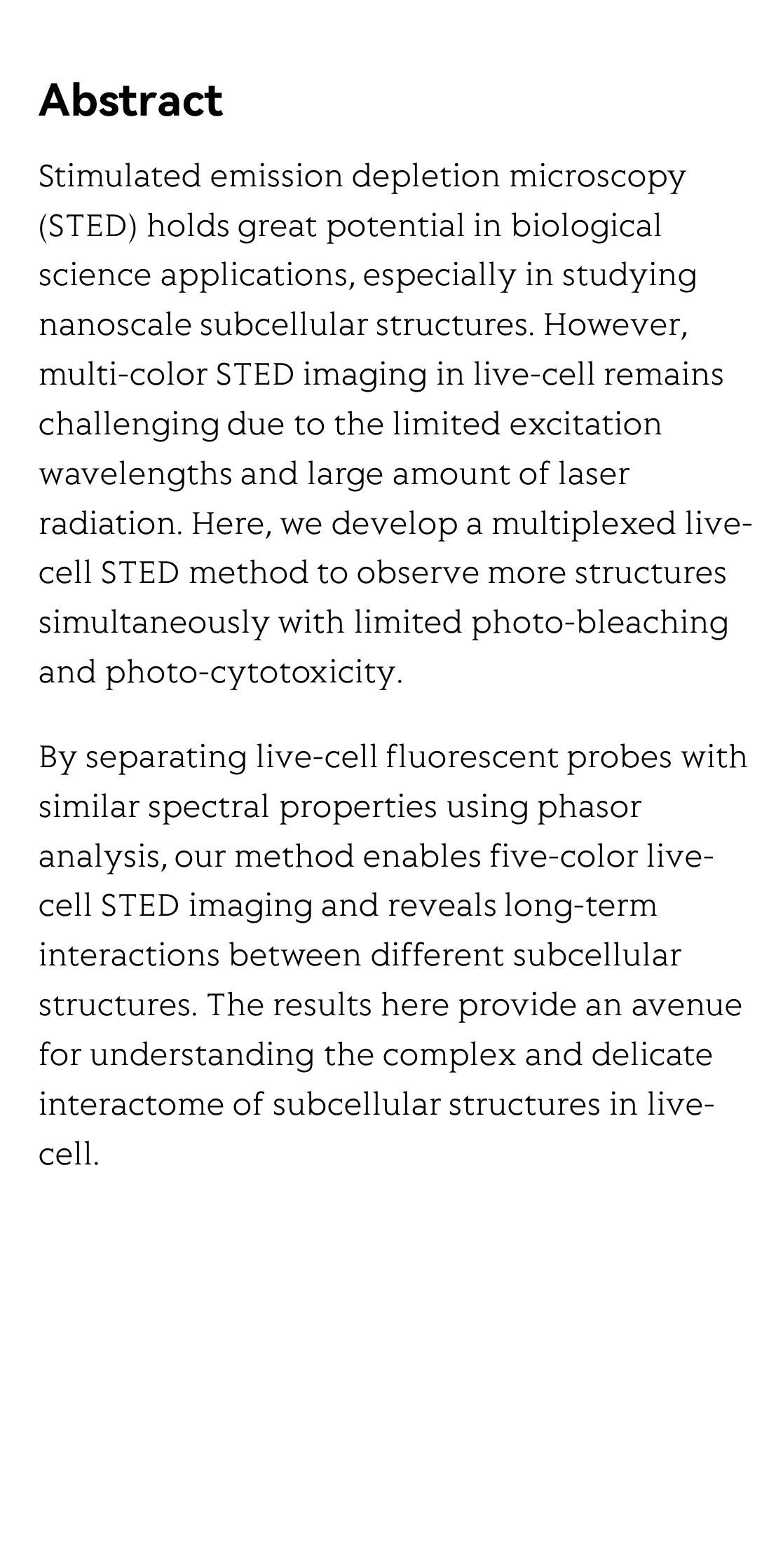
Stimulated emission depletion microscopy (STED) holds great potential in biological science applications, especially in studying nanoscale subcellular structures. However, multi-color STED imaging in live-cell remains challenging due to the limited excitation wavelengths and large amount of laser radiation. Here, we develop a multiplexed live-cell STED method to observe more structures simultaneously with limited photo-bleaching and photo-cytotoxicity.
By separating live-cell fluorescent probes with similar spectral properties using phasor analysis, our method enables five-color live-cell STED imaging and reveals long-term interactions between different subcellular structures. The results here provide an avenue for understanding the complex and delicate interactome of subcellular structures in live-cell.
Ultrafast all-optical modulation of wide-bandwidth pulses enabled by silicon-metasurfaces
Kaloyan Georgiev, Khosro Zangeneh Kamali, Anton A. Trifonov, Giulia Crotti, Lyuben Petrov, Stefan Georgiev, Hristo Iliev, Lei Xu, Unai Arregui Leon, Mohsen Rahmani, Giuseppe Della Valle, Ivan Buchvarov, Dragomir Neshev
Opto-Electronic Advances
2026-09-15
Physics-informed neural fields enable blind aberration correction for partially coherent quantitative phase imaging
Shun Zhou, Xingyu Huang, Linpeng Lu, Habib Ullah, Kaiyu Du, Maciej Trusiak, Malgorzata Kujawinska, Yuzhen Zhang, Yao Fan, Qian Chen, Qinrong Zhang, Chao Zuo
Opto-Electronic Science
2026-08-26
Heterogeneously integrated micro-ring with SnS₂ for dual-functional optical modulation and photodetection
Jinyi Du, Lidan Lu, Xu Zhang, Bofei Zhu, Wenbo Bo, Yingjie Xu, Guang Chen, Yanlin He, Guanghui Ren, Xiaoping Lou, Zheng You, Lianqing Zhu
Opto-Electronic Advances
2026-08-25
Hardware-aware lightweight photonic spiking neural network for pattern classification
Shuiying Xiang, Yahui Zhang, Shangxuan Shi, Haowen Zhao, Dianzhuang Zheng, Xingxing Guo, Yanan Han, Ye Tian, Liyue Zhang, Yuechun Shi, Yue Hao
Opto-Electronic Advances
2026-08-25
PhyspeNet: An empirical physics-aware network for adaptive speckle reconstructive spectrometry
Junrui Liang, Min Jiang, Jun Li, Zhongming Huang, Junhong He, Yanting Guo, Yanzhao Ke, Jun Ye, Jiangming Xu, Jinyong Leng, Pu Zhou
Opto-Electronic Advances
2026-08-25
A 36 × 240 Gbps hybrid mode/wavelength division multiplexing transmitter using lithium niobate on insulator
Mingyu Zhu, Weihan Wang, Ruitao Ma, Aoyun Gao, Chun Gao, Zexu Wang, Fei Huang, Zhenyuan Bao, Dajian Liu, Jiaxuan Gan, Zejie Yu, Huan Li, Weike Zhao, Daoxin Dai
Opto-Electronic Advances
2026-08-25