(Peer-Reviewed) Laser direct writing and characterizations of flexible piezoresistive sensors with microstructures
Chenying Zhang 张陈应 ¹, Wei Zhou 周伟 ¹, Da Geng 耿达 ¹, Cheng Bai 白成 ¹, Weida Li ¹ ², Songyue Chen 陈松月 ¹, Tao Luo 罗涛 ¹, Lifeng Qin 秦利锋 ¹, Yu Xie 谢瑜 ¹
¹ Department of Mechanical & Electrical Engineering, Xiamen University, Xiamen 361101, China
中国 厦门 厦门大学机电工程系
² College of Information Science and Engineering, Northeastern University, Shenyang 110004, China
中国 沈阳 东北大学信息科学与工程学院
Opto-Electronic Advances
, 2021-04-06
Abstract
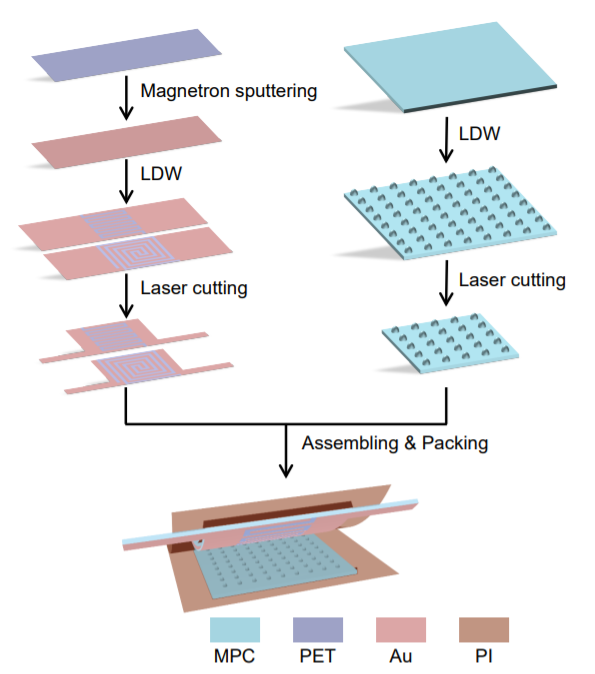
Functional materials with high viscosity and solid materials have received more and more attentions in flexible pressure sensors, which are inadequate in the most used molding method. Herein, laser direct writing (LDW) method is proposed to fabricate flexible piezoresistive sensors with microstructures on PDMS/ MWCNTs composites with an 8% MWCNTs mass fraction.
By controlling laser energy, microstructures with different geometries can be obtained, which significantly impacts the performances of the sensors. Subsequently, curved microcones with excellent performance are fabricated under parameters of f = 40 kHz and v = 150 mm·s-1.
The sensor exhibits continuous multi-linear sensitivity, ultrahigh original sensitivity of 21.80 % kPa-1, wide detection range of over 20 kPa, response/recovery time of ~100 ms and good cycle stability for more than 1000 times. Besides, obvious resistance variation can be observed when tiny pressure (a peanut of 30 Pa) is applied. Finally, the flexible piezoresistive sensor can be applied for LED brightness controlling, pulse detection and voice recognition.
Ultrafast all-optical modulation of wide-bandwidth pulses enabled by silicon-metasurfaces
Kaloyan Georgiev, Khosro Zangeneh Kamali, Anton A. Trifonov, Giulia Crotti, Lyuben Petrov, Stefan Georgiev, Hristo Iliev, Lei Xu, Unai Arregui Leon, Mohsen Rahmani, Giuseppe Della Valle, Ivan Buchvarov, Dragomir Neshev
Opto-Electronic Advances
2026-09-15
Physics-informed neural fields enable blind aberration correction for partially coherent quantitative phase imaging
Shun Zhou, Xingyu Huang, Linpeng Lu, Habib Ullah, Kaiyu Du, Maciej Trusiak, Malgorzata Kujawinska, Yuzhen Zhang, Yao Fan, Qian Chen, Qinrong Zhang, Chao Zuo
Opto-Electronic Science
2026-08-26
Heterogeneously integrated micro-ring with SnS₂ for dual-functional optical modulation and photodetection
Jinyi Du, Lidan Lu, Xu Zhang, Bofei Zhu, Wenbo Bo, Yingjie Xu, Guang Chen, Yanlin He, Guanghui Ren, Xiaoping Lou, Zheng You, Lianqing Zhu
Opto-Electronic Advances
2026-08-25
Hardware-aware lightweight photonic spiking neural network for pattern classification
Shuiying Xiang, Yahui Zhang, Shangxuan Shi, Haowen Zhao, Dianzhuang Zheng, Xingxing Guo, Yanan Han, Ye Tian, Liyue Zhang, Yuechun Shi, Yue Hao
Opto-Electronic Advances
2026-08-25
PhyspeNet: An empirical physics-aware network for adaptive speckle reconstructive spectrometry
Junrui Liang, Min Jiang, Jun Li, Zhongming Huang, Junhong He, Yanting Guo, Yanzhao Ke, Jun Ye, Jiangming Xu, Jinyong Leng, Pu Zhou
Opto-Electronic Advances
2026-08-25
A 36 × 240 Gbps hybrid mode/wavelength division multiplexing transmitter using lithium niobate on insulator
Mingyu Zhu, Weihan Wang, Ruitao Ma, Aoyun Gao, Chun Gao, Zexu Wang, Fei Huang, Zhenyuan Bao, Dajian Liu, Jiaxuan Gan, Zejie Yu, Huan Li, Weike Zhao, Daoxin Dai
Opto-Electronic Advances
2026-08-25