(Peer-Reviewed) Meta-analysis on the effect of combining Lianhua Qingwen with Western medicine to treat coronavirus disease 2019
Deng-chao Wang 王邓超 ¹, Miao Yu 余淼 ², Wen-xian Xie 谢文贤 ², Li-yan Huang ³, Jian Wei 魏健 ¹, Yue-hua Lei 雷跃华 ¹
¹ Department of General Surgery, Zigong Fourth People’s Hospital, Zigong 643000, Sichuan Province, China
中国 四川 自贡 自贡市第四人民医院普外科
² Department of Basic Medicine, Sichuan Vocational College of Health and Rehabilitation, Zigong 643000, Sichuan Province, China
中国 四川 自贡 四川卫生康复职业学院基础医学部
³ Department of Pathology, West China Second Hospital of Sichuan University, Chengdu 610000, Sichuan Province, China
中国 四川 成都 四川大学华西第二医院病理科
Background
Coronavirus disease 2019 (COVID-19) has become a worldwide life-threatening pandemic. Lianhua Qingwen is believed to possess the ability to treat or significantly improve the symptoms of COVID-19. These claims make it important to systematically evaluate the effects of using Lianhua Qingwen with Western medicine to treat COVID-19.
Objective
To evaluate the safety and efficacy of combination therapy, employing Lianhua Qingwen with Western medicine, to treat COVID-19, using a meta-analysis approach.
Search strategy
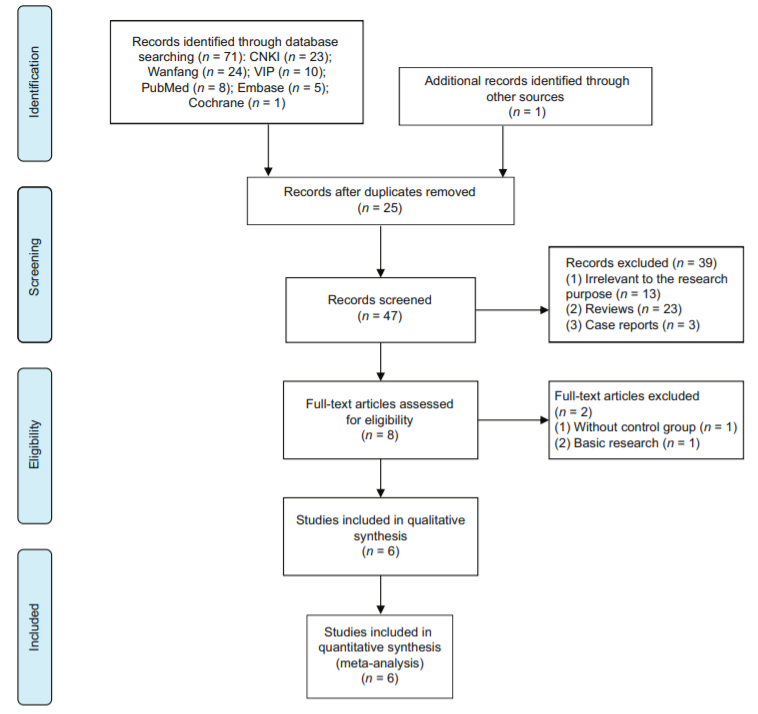
China National Knowledge Infrastructure, Wanfang Database, VIP Database, PubMed, Embase, and Cochrane Library databases were searched for studies evaluating the effect of Lianhua Qingwen-Western medicine combination therapy in the treatment of COVID-19.
Inclusion criteria
(1) Research object: hospitalized patients meeting the diagnostic criteria of COVID-19 were included. (2) Intervention measures: patients in the treatment group received Lianhua Qingwen treatment combined with Western medicine, while the control group received either Western medicine or Chinese medicine treatment. (3) Research type: randomized controlled trials and retrospective study were included.
Data extraction and analysis
Two researchers extracted the first author, the proportion of males and females, age, body temperature, course of treatment, rate of disappearance of main symptoms, duration of fever, adverse reactions, and total effectiveness from the literature. Odds ratio (OR) and 95% confidence interval (CI) were used as the effect value for count data, and mean difference (MD) and 95% CI were used as the effect value for measurement data.
Results
Six articles met the inclusion criteria, including a total of 856 COVID-19 patients. The meta-analysis showed that Lianhua Qingwen combination therapy achieved higher rates of fever reduction (OR = 3.43, 95% CI [1.78, 6.59], P = 0.0002), cough reduction (OR = 3.39, 95% CI [1.85, 6.23], P < 0.0001), recovery from shortness of breath (OR = 10.62, 95% CI [3.71, 30.40], P < 0.0001) and recovery from fatigue (OR = 2.82, 95% CI [1.44, 5.53], P = 0.003), higher total effectiveness rate (OR = 2.51, 95% CI [1.73, 3.64], P < 0.00001), and shorter time to recovery from fever (MD = −1.00, 95% CI [−1.04, 0.96], P < 0.00001), and did not increase the adverse reaction rate (OR = 0.65, 95% CI [0.42, 1.01], P = 0.06), compared to the single medication control.
Conclusion
The Lianhua Qingwen and Western medicine combination therapy is highly effective for COVID-19 patients and has good clinical safety. As only a small number of studies and patients were included in this review, more high-quality, multicenter, large-sample-size, randomized, double-blind, controlled trials are still needed for verification.
Ultrafast all-optical modulation of wide-bandwidth pulses enabled by silicon-metasurfaces
Kaloyan Georgiev, Khosro Zangeneh Kamali, Anton A. Trifonov, Giulia Crotti, Lyuben Petrov, Stefan Georgiev, Hristo Iliev, Lei Xu, Unai Arregui Leon, Mohsen Rahmani, Giuseppe Della Valle, Ivan Buchvarov, Dragomir Neshev
Opto-Electronic Advances
2026-09-15
Physics-informed neural fields enable blind aberration correction for partially coherent quantitative phase imaging
Shun Zhou, Xingyu Huang, Linpeng Lu, Habib Ullah, Kaiyu Du, Maciej Trusiak, Malgorzata Kujawinska, Yuzhen Zhang, Yao Fan, Qian Chen, Qinrong Zhang, Chao Zuo
Opto-Electronic Science
2026-08-26
Heterogeneously integrated micro-ring with SnS₂ for dual-functional optical modulation and photodetection
Jinyi Du, Lidan Lu, Xu Zhang, Bofei Zhu, Wenbo Bo, Yingjie Xu, Guang Chen, Yanlin He, Guanghui Ren, Xiaoping Lou, Zheng You, Lianqing Zhu
Opto-Electronic Advances
2026-08-25
Hardware-aware lightweight photonic spiking neural network for pattern classification
Shuiying Xiang, Yahui Zhang, Shangxuan Shi, Haowen Zhao, Dianzhuang Zheng, Xingxing Guo, Yanan Han, Ye Tian, Liyue Zhang, Yuechun Shi, Yue Hao
Opto-Electronic Advances
2026-08-25
PhyspeNet: An empirical physics-aware network for adaptive speckle reconstructive spectrometry
Junrui Liang, Min Jiang, Jun Li, Zhongming Huang, Junhong He, Yanting Guo, Yanzhao Ke, Jun Ye, Jiangming Xu, Jinyong Leng, Pu Zhou
Opto-Electronic Advances
2026-08-25
A 36 × 240 Gbps hybrid mode/wavelength division multiplexing transmitter using lithium niobate on insulator
Mingyu Zhu, Weihan Wang, Ruitao Ma, Aoyun Gao, Chun Gao, Zexu Wang, Fei Huang, Zhenyuan Bao, Dajian Liu, Jiaxuan Gan, Zejie Yu, Huan Li, Weike Zhao, Daoxin Dai
Opto-Electronic Advances
2026-08-25